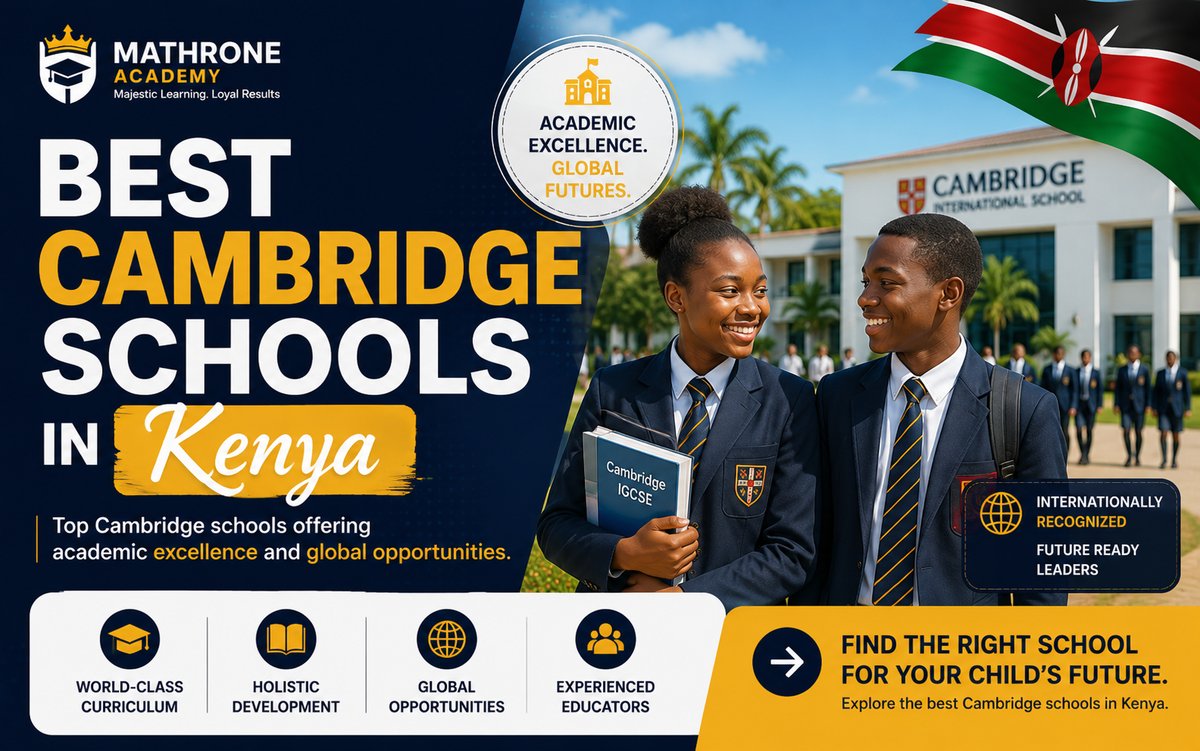
Kenya has one of the largest and most competitive international school markets in East Africa, with close to 50 international schools concentrated in Nairobi alone. Not all of them run the Cambridge curriculum, though. Some follow American, IB-only, French, or German national systems instead, and it's genuinely easy for a parent to assume "international school" automatically means "Cambridge school" when it often doesn't.
This guide focuses specifically on schools confirmed to teach Cambridge IGCSE and Cambridge A-Levels, organized loosely by fee tier so you can filter by what's realistic for your family before diving into the finer details of campus, boarding, and academic track record.
Understanding Kenya's Cambridge School Tiers
Before comparing individual schools, it helps to understand the three rough tiers Kenyan Cambridge education actually falls into, since the difference between them isn't really about exam quality, it's about facilities, class size, and the overall school experience.
Premium tier schools, generally running KES 3 million to 6.8 million per year for senior boarding students, include Brookhouse and Peponi. These schools compete on campus quality, pastoral care, boarding culture, and often decades of established results.
Mid tier schools, generally KES 1.5 million to 2.4 million per year, is where the bulk of Kenyan Cambridge families actually sit. This includes Braeburn's various campuses, Hillcrest, and several others: strong academic teaching and reasonably resourced campuses without the resort-grade facilities of the premium tier.
Value tier schools, often Kenyan-owned institutions running genuine Cambridge IGCSE alongside or instead of KCSE or CBC, can cost as little as KES 240,000 to 540,000 per year all-in, with term fees as low as KES 80,000 in some Mombasa, Nakuru, Eldoret, and outer-Nairobi schools. The syllabus and the final exam are the same Cambridge syllabus and exam sat anywhere in the world; what differs is campus facilities, sports breadth, and class size. For families who care primarily about the qualification itself rather than the boarding-school experience, this tier is often the best value in Kenya.
On top of any school's tuition, every Cambridge IGCSE student pays a separate Cambridge International exam-entry fee per subject in their final year, typically adding another KES 150,000 to 250,000 across 8 to 10 subjects, regardless of which school they attend.
1. Brookhouse School
Founded by the Mehta family in 1981, Brookhouse is widely regarded as Kenya's leading British Curriculum school and has held that reputation for over four decades. It operates two Nairobi campuses: Karen, the original site off Magadi Road offering both day and boarding places, and Runda, a day-only campus that opened in 2018 off Kiambu Road. The school is fully accredited to deliver Cambridge International, Edexcel, and AQA examinations, and students take IGCSE at 16 and A-Levels at 18, with a BTEC vocational pathway also available at Sixth Form.
Brookhouse educates around 1,150 students from more than 50 nationalities, with a notably small typical class size of 16. Facilities span a 15-acre Karen campus with an indoor sports centre, swimming pool, a purpose-built performance theatre, dedicated STEM laboratories, and VR-integrated classrooms. The school reported its best IGCSE and A-Level results in 40 years in 2020, and it remains a Round Square member and part of the UK-based Inspired Education Group since 2015. Day fees for 2025-2026 run from roughly KES 145,000 per term in early years up to KES 940,000 per term for Years 7-10, rising further for Year 11 and Year 13, with senior boarding at the Karen campus reaching approximately KES 6.8 million for a full year.
2. Peponi School
Peponi School was established in 1985 (with its earlier feeder institution, Peponi House, founded in 1979), and it sits on a 50-acre campus at Northlands, Ruiru, just north of Nairobi. It is often named in the same breath as Brookhouse, ISK, and Hillcrest as one of Kenya's genuinely top-tier schools, though it's known specifically for its boarding culture: full and weekly boarding have been core to the school's identity for nearly three decades, split across four houses of roughly 65 to 70 students each.
Peponi follows the British National Curriculum through to Cambridge IGCSE, AS-Levels, and A-Levels, with Pearson Edexcel IGCSE also offered as an option, and it takes around 400 pupils aged 13 to 18. Weekly boarding is popular among Nairobi-based families who want the boarding experience without full separation, while full boarding is often used by diplomatic and corporate families needing posting flexibility. Fees are among the highest in Kenya: day fees run from roughly KES 685,000 to over KES 824,000 per term depending on year group, while full boarding for Years 9-13 runs to approximately KES 1.29 million per term, or roughly KES 3.3 to 3.65 million annually including one-time entry charges. Academic results are described by independent reviewers as solid rather than spectacular, with the school's core appeal centred on its campus, pastoral setup, and boarding-led community rather than headline exam rankings alone.
3. Hillcrest International School
Hillcrest has one of the more genuinely historic Cambridge credentials on this list. Its Secondary School was founded in 1965 with just 54 students and three classrooms, and it was one of the first schools in Kenya to offer Cambridge Overseas O-Level and A-Level examinations, well before "international school" became a crowded category in Nairobi. In 2020, Hillcrest absorbed the former GEMS Cambridge Education Karen campus when it closed, further consolidating its Cambridge identity. The school's motto, Semper Prospice ("Always Look Forward"), reflects that long institutional history.
Sitting on Hillcrest Road in Karen, the school follows the British National Curriculum with Cambridge IGCSE in Years 9-11 and Cambridge A-Levels or BTEC Level 3 in Years 12-13, and it represents around 40 nationalities. Facilities include five science laboratories, two libraries, multiple IT suites, a design technology suite, a drama studio, and an indoor pool. Hillcrest offers boarding for Years 7-13, both full and weekly. Annual tuition for 2026-2027 ranges from roughly KES 384,000 for playgroup up to KES 3.08 million for Years 12-13, placing it firmly in the premium tier despite its more understated public profile compared to Brookhouse or Peponi.
4. Braeburn Garden Estate School
Braeburn is Kenya's largest single school group, with the Braeburn Group operating 19 schools across 11 campuses in Kenya and Tanzania, teaching over 5,000 pupils under the British National Curriculum, IGCSE, and GCE A-Levels. Founded in 1968, Braeburn's flagship Garden Estate campus sits on 32 acres eight kilometres northeast of central Nairobi, offering the British Curriculum through to Cambridge IGCSE plus IB Diploma, IB Career-related, and BTEC Level 3 options in the senior years. Boarding is available from Year 7.
The Garden Estate campus is CIS accredited and an IB World School, with large playing fields, two swimming pools, a sports hall, dance studio, gym, squash courts, and a strong music and drama programme. Beyond the flagship campus, Braeburn also runs Braeburn Imani in Thika, plus campuses in Mombasa, Nanyuki, Kisumu, and Eldoret, making it the most geographically distributed Cambridge option in the country for families outside central Nairobi. Fees vary significantly by campus and year group, generally ranging from around KES 987,900 at kindergarten level up to KES 2.4 million annually for Grade 12 at the flagship campus, with entry requiring a completed set of IGCSE grades (five subjects minimum) for progression into the IB or A-Level pathway.
5. St. Andrew's School, Turi
St. Andrew's, Turi is a well-established boarding school in the Rift Valley, outside Nairobi, and is regularly named alongside ISK, Brookhouse, Hillcrest, and Peponi in discussions of Kenya's genuinely top-tier schools. It offers a Cambridge IGCSE and A-Level pathway within a full boarding environment at altitude, distinct from the day-and-boarding hybrid model most Nairobi-based schools run. It's a strong option specifically for families who want a dedicated boarding culture away from Nairobi traffic and are comfortable with the additional travel logistics involved in reaching the school.
6. Nairobi Academy
Nairobi Academy is a private, co-educational day and boarding school in Karen serving students aged 2 to 19, combining the British Curriculum with Cambridge Secondary, Cambridge IGCSE, Cambridge A-Levels, BTEC qualifications, and the IB Diploma Programme. Secondary admissions begin from Year 8 (age 11+). What makes Nairobi Academy distinct is its explicit pathway for KCSE students to transition into GCE A-Levels, BTEC, or IBDP, making it a particularly useful option for Kenyan families who start in the national system and want to move into Cambridge partway through secondary school rather than committing from day one.
Facilities include modern classrooms with projectors, dedicated science laboratories per subject, two ICT rooms, a well-equipped library, and a 25-metre swimming pool, supporting sports including cricket, hockey, and rugby. Annual fees for Year 11 run around KES 1.16 million, rising to roughly KES 1.22 million for Years 12-13, with the IB Diploma pathway priced separately at approximately KES 1.25 million annually and BTEC at around KES 1 million, placing Nairobi Academy solidly in the mid tier.
7. Brookhurst International School
Brookhurst runs a full Cambridge pathway, IGCSE through AS and A-Levels, alongside IB Diploma and BTEC qualifications, across two campuses: Kiserian in Kajiado County and Lavington in Nairobi. Core subjects include English, Kiswahili, and Mathematics, with a foreign language (French, German, or Mandarin) also compulsory. Facilities include 31 classrooms, ICT centres with interactive boards and VR headsets, and four libraries, split between Wangari Maathai House (girls' boarding) and Heroes Tower (boys' boarding). Brookhurst distinguishes itself through its Aviation Program, including Private Pilot License training, alongside Model United Nations, Debate Team, and a broad performing arts offering.
8. Durham International School Kenya
Durham International School Kenya is the Nairobi branch of Durham UK, operating two campuses, Thigiri (near Karura Forest) and Rosslyn, and welcoming students from age 1 through 18. It runs the British Curriculum through Cambridge IGCSE and Cambridge A-Levels, with continuous assessment from Year 1 and online parent journals for tracking progress. As a newer entrant to Nairobi's Cambridge market, Durham differentiates on its Grow with Durham continuity model linking Key Stage 3 through Sixth Form, with an expanded IB or A-Level offering and dedicated university guidance planned to launch as the school's cohort matures. Families evaluating Durham specifically for its long-term Sixth Form provision should confirm current status directly with the school, since some elements of that offering were still being phased in as of this writing.
9. Light International School
Light International School operates across Nairobi, Mombasa, and Malindi, following the Cambridge International Curriculum from Early Years through A-Levels, including Cambridge Primary, Lower Secondary, and Upper Secondary stages, AS-Level, and the AICE Diploma option. It also supports Pearson Edexcel pathways alongside its core Cambridge Pathway planning. Its multi-city footprint makes it one of the more geographically accessible genuine Cambridge options for families outside Nairobi specifically, particularly along the coast in Mombasa.
10. Braeburn Imani International School
Braeburn Imani, located in Thika just outside Nairobi, is part of the wider Braeburn Group and offers the same British Curriculum leading to Cambridge IGCSE and A-Levels as the flagship Garden Estate campus, at a generally more accessible fee point. For families based in Thika or the outer Nairobi metro area who want a genuine Cambridge pathway without the daily commute into central Nairobi, Imani represents a practical mid-tier alternative within the same trusted school group.
A Note on Schools That Look Cambridge But Aren't
One school that frequently appears on general "best international schools in Kenya" lists, but is deliberately excluded here, is the International School of Kenya (ISK). Founded in 1976 under a joint partnership between the U.S. Embassy and Canadian High Commission, ISK follows an American curriculum built on Common Core standards, leading to a North American high school diploma, with roughly two-thirds of students also completing the IB Diploma. It does not offer Cambridge IGCSE or A-Levels at all. If a parent's specific goal is a Cambridge pathway, ISK, despite its strong reputation, prestige, and position as one of Kenya's most expensive schools, would not deliver that outcome. This is exactly the kind of mismatch worth double-checking before enrollment, since "international" and "Cambridge" are used almost interchangeably in casual conversation but mean genuinely different things on paper, and on results day.
Cambridge vs. KCSE: The Real Trade-off for Kenyan Families
Neither system is objectively superior; they serve different goals. KCSE, Kenya's national secondary examination, is directly aligned with the country's university placement system (KUCCPS) and is generally the far more affordable route for families planning to remain within Kenya's own higher education and job market long-term. Cambridge IGCSE and A-Levels suit families expecting to study abroad, relocate internationally, or who want a qualification recognized directly by universities across the UK, US, Canada, Australia, and the Middle East without additional conversion or recognition steps.
It's also worth noting that several schools on this list, particularly Nairobi Academy, offer an explicit bridge between the two systems, letting KCSE students move into Cambridge A-Levels or BTEC at the senior level. This kind of hybrid pathway is worth asking about directly if your family isn't fully committed to one system from the very start of secondary school.
If you're comparing Cambridge options across East Africa more broadly, our guide on Cambridge Primary schools in Rwanda covers the equivalent landscape in Kigali, and our explainer on what Cambridge IGCSE actually is is worth reading first if you're still new to how the qualification works before comparing individual schools.
Questions to Ask Before Choosing a School
Fee structures and exact subject offerings shift from year to year, and headline fee figures published online are frequently out of date within months, so confirm the following directly with each school's admissions office rather than relying solely on marketing pages:
- Does the school run Cambridge IGCSE and A-Levels specifically, or only IB and/or American pathways under a general "international" label?
- What is the complete current fee schedule, including registration, capital or development levy, transport, lunch, and boarding if applicable, since these are frequently billed separately from base tuition and can add 15-25% to the headline figure?
- What subject combinations and options blocks are actually available at A-Level, since smaller campuses may offer a narrower range than larger, more established ones?
- What exam results data can the school share, including actual entry numbers per subject, not just headline pass rates?
- Is there a clear pathway back into KCSE or CBC, in case the family's circumstances or plans change?
- What is the typical class size at the year level your child would be entering, since this varies enormously even within the same fee tier?
Supporting Cambridge Students Beyond the Classroom
Choosing the right school is only the first step. Once your child is inside a Cambridge programme, whether in Nairobi, Kigali, or anywhere else, consistent, subject-specific support through IGCSE and A-Level makes the biggest difference to final results, particularly in Mathematics and the Sciences, where content builds directly year over year and small gaps compound quickly. If you're trying to work out whether your child needs that kind of extra support right now, our article on signs your child needs a private tutor is a useful starting point before you commit to anything.
Mathrone Academy provides one-on-one Cambridge IGCSE and A-Level tutoring for students anywhere in the world, matched to your child's specific subjects and tier, whether Core or Extended. For Rwanda-based families, our tutors also support the REB national curriculum alongside Cambridge, so you can get guidance on both systems from a single team rather than juggling separate providers.
Get matched with a tutor:
WhatsApp: +250 786 684 285
Email: [email protected]