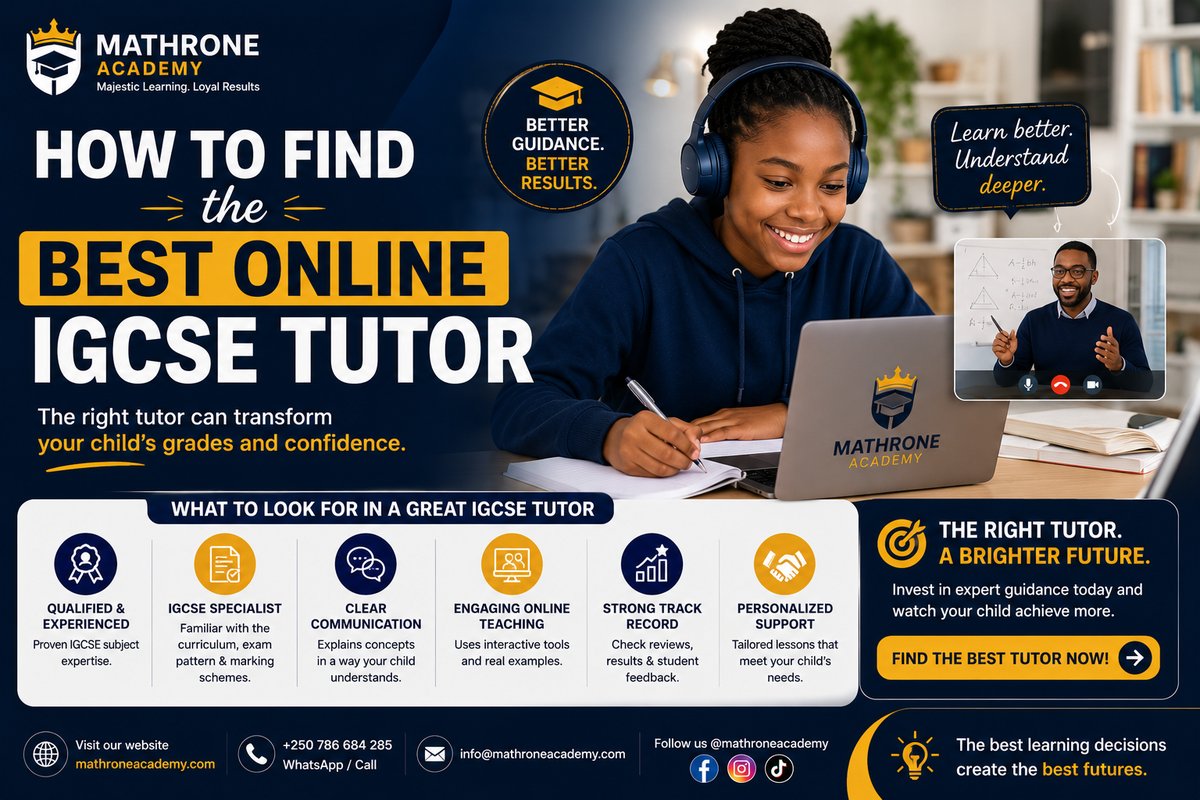
Search "best online IGCSE tutors" and you'll mostly find lists written by tutoring companies ranking themselves first. That's not particularly useful if you're an actual parent trying to make a real decision. This guide skips the rankings and focuses on something more useful: exactly what separates a genuinely effective IGCSE tutor from one who simply advertises well, what fair pricing actually looks like, and the specific questions worth asking before you commit to anyone.
Why "I Teach IGCSE" Isn't Enough
IGCSE isn't a general school-leaving qualification; it's an internationally benchmarked programme with its own specific syllabus codes, exam board differences, and marking conventions. A tutor who's excellent at teaching a national curriculum equivalent, GCSE Mathematics in the UK, for example, doesn't automatically understand the nuances of Cambridge IGCSE Mathematics (0580) versus Edexcel International GCSE Mathematics, which differ in paper structure, content emphasis, and assessment style. Before booking anyone, it's worth confirming they know your child's specific exam board and subject code, not just the subject in general terms.
What Actually Makes an IGCSE Tutor Effective
A handful of specific things separate tutors who genuinely move the needle on IGCSE results from those who simply go through the textbook with a student. It's worth checking for these directly rather than assuming any tutor with subject knowledge will deliver the same outcome.
Syllabus-specific knowledge. IGCSE exams test very specific syllabus points, and a good tutor knows precisely what's examinable and what isn't, so time in sessions isn't spent on content that will never appear on the paper.
Command word precision. IGCSE mark schemes reward specific responses to command words like "describe," "explain," "evaluate," and "compare," each requiring a genuinely different style of answer. Generic subject teaching frequently misses this distinction entirely, and it's one of the most common reasons capable students lose marks despite understanding the content.
Core versus Extended tier awareness. Many IGCSE subjects, particularly Mathematics and the Sciences, offer both Core and Extended tiers. A strong tutor adjusts their teaching to the tier a student is actually sitting rather than teaching generically, and can help a family make an informed decision about which tier suits their child in the first place, a choice we cover in more depth in our guide on what Cambridge IGCSE actually is.
Exam board fluency. Cambridge and Edexcel IGCSEs, while broadly comparable in difficulty, have different paper structures and content emphasis. A tutor confident in one board isn't automatically equally strong in the other, so this is worth confirming directly rather than assumed.
A structured plan, not just reactive help. Effective tutoring follows a plan that covers the full syllabus, actively identifies knowledge gaps, and builds exam technique progressively over the weeks and months leading up to the exam, rather than simply answering whatever homework question comes up that week.
What Online IGCSE Tutoring Actually Costs
Pricing varies enormously depending on the type of platform and tutor experience, and it's worth understanding the real range before comparing options, since headline "starting from" prices can be misleading.
Open marketplaces (where anyone can list themselves as a tutor with minimal vetting) tend to start as low as 3 to 15 USD per hour, but quality varies enormously since verification is often limited to self-reported experience and student reviews rather than genuine subject or exam-board screening.
Specialist IGCSE tutoring services, with tutors specifically vetted for IGCSE experience, generally run 25 to 50 USD per hour, reflecting the more curated and syllabus-specific matching involved.
Premium platforms, often built around tutors from top universities or with extensive specific track records, can charge 49 to 80 USD or more per hour.
The honest guidance worth repeating here: the cheapest option is rarely the best value, but the most expensive isn't automatically the most effective either. A tutor with no specific IGCSE experience charging around 15 USD an hour can genuinely waste more of a family's money over a term than a specialist charging closer to 40 USD an hour who closes the same knowledge gap in half the sessions, simply because their time isn't spent re-teaching things a syllabus-aware tutor would never need to cover.
Red Flags Worth Watching For
A few warning signs are worth taking seriously before committing to any tutor or platform, online or otherwise.
- No trial lesson available. A tutor or platform unwilling to offer any form of trial or introductory session before a longer commitment is worth being cautious about, since rapport between tutor and student matters as much as qualifications.
- No flexibility to switch tutors. Even well-matched tutors don't always suit every student. A platform or arrangement with no reasonable way to change tutors if the fit isn't right limits your options if things aren't working.
- Pressure to commit to large upfront packages before a single session has taken place, without any way to assess quality first.
Questions Worth Asking Before You Commit
- Which exam board and subject code have you specifically taught before, Cambridge or Edexcel, and which specific IGCSE subjects?
- How do you approach past papers and command word technique in your sessions?
- Is my child sitting Core or Extended tier, and how would that change your teaching approach?
- Can we do a trial lesson before committing to ongoing sessions?
- What does a typical study plan look like leading up to the exam, not just week to week?
Timing: Don't Wait Until Exam Season
The single most common mistake families make is starting tutoring only once exam season has already begun. By that point, knowledge gaps have usually compounded across multiple topics, and there's limited time left to close them properly. Starting 6 to 12 months before the exam gives enough runway to identify gaps gradually, build genuine exam technique, and work consistently through past papers, widely regarded as the single most effective IGCSE revision tool, under timed conditions, well before the pressure of exam season sets in.
Tutoring Alone Isn't a Complete Solution
Even the best tutor works best as a structured supplement to consistent independent study, not a replacement for it. For most students, one to two hours per subject per week is a reasonable baseline, increasing to two to three hours during the final two to three months before exams. Between sessions, pairing tutoring with free, syllabus-aligned self-study resources can meaningfully reinforce what's covered live. If you're building a broader self-study routine around live tutoring, our guide on free AI tools for learning English is a useful starting point specifically for English-language support alongside subject tutoring, and our worked past paper solutions give students real practice material to work through independently between sessions.
Choosing Between Online and In-Person Tutoring
Online tutoring has moved well past being a pandemic-era substitute; for many families it's now the preferred option, largely because interactive whiteboards, screen sharing, and digital past papers make remote sessions genuinely effective, not just convenient. It also removes travel time and lets a student learn from a comfortable, familiar environment, while giving families access to specialist tutors regardless of physical location, which matters enormously for a globally distributed qualification like IGCSE where a genuinely subject- and board-specific tutor might not be based anywhere near you.
Getting Support That's Actually Built Around Your Child's Syllabus
If you've worked through this guide and you're ready to actually find a tutor rather than keep comparing platforms, the most reliable next step is a conversation, not another ranked list. Mathrone Academy provides one-on-one online IGCSE tutoring across Mathematics, the Sciences, and other core subjects, matched specifically to your child's exam board (Cambridge or Edexcel) and tier (Core or Extended), for students anywhere in the world. For Rwanda-based families, our tutors also support the REB national curriculum alongside Cambridge, so you can get guidance across both systems from a single team. If you're still weighing whether tutoring is even the right next step for your child, our article on signs your child needs a private tutor is a useful place to start.
Get matched with a tutor:
WhatsApp: +250 786 684 285
Email: [email protected]