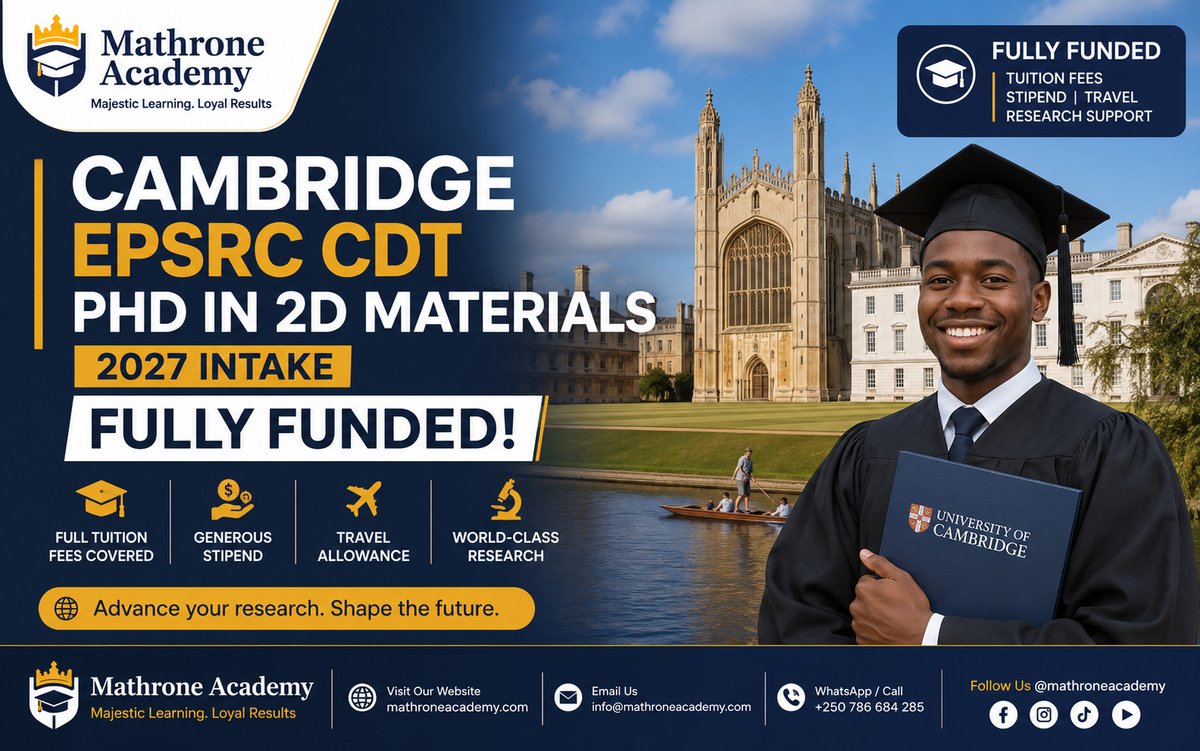
The EPSRC Centre for Doctoral Training in 2D Materials of Tomorrow (2DMoT) is a fully funded, four-year PhD programme jointly run by the University of Manchester and the University of Cambridge, covering tuition fees and a UKRI-rate stipend for every student it accepts. Built around graphene and the wider family of two-dimensional materials, a field the UK has led globally since graphene's discovery at Manchester, the programme funds a minimum of 8 places at Manchester and 2 at Cambridge every single year. This guide covers the real eligibility requirements, funding structure, application process, and the actual 2027 entry deadlines, verified directly against the CDT's official pages.
Programme Summary
| Host Institutions | University of Manchester (lead) and University of Cambridge |
| Funded By | EPSRC (UK Research and Innovation) |
| Degree Level | PhD (Centre for Doctoral Training) |
| Duration | 4 years, full-time |
| Places Available Annually | Minimum 8 at Manchester, minimum 2 at Cambridge |
| Funding Type | Fully funded (fees + stipend) |
| Stipend | UKRI minimum rate, approx. £21,000/year (+£10,000/year TechExpert top-up for home-fee-status students in the Sept 2026 cohort) |
| International Applications for 2027 Entry | Open October 2026 |
About the Programme
2D materials, ultra-thin, atom-scale materials with properties unlike anything in their bulk form, are considered one of the most promising frontiers in advanced materials science, with applications spanning quantum electronics, clean energy, sensors, and next-generation computing. The 2DMoT CDT organizes its research into seven interdisciplinary research missions, covering areas including materials discovery for quantum electronics, novel heterostructures, twistronics, and 2D magnets and superconductors, giving students genuine choice within a coherent, cross-institutional research programme rather than a single fixed project track.
Programme Structure
All students, regardless of which institution they'll eventually be based at, begin with 6 months of intensive taught training at the University of Manchester, covering the fundamentals of 2D materials physics and chemistry alongside hands-on experimental and computational skills training in small groups. Around the fourth month, students begin exploring PhD project options through open days and meetings with research mission coordinators, before finalizing their specific project with a supervisor.
By the end of year 1 (the CDT's 5th term), students must produce a written report on their initial research and pass an oral examination, a probationary exercise that determines whether they're formally registered for the PhD. Years 2 through 4 are dedicated to the research project itself, with a requirement to spend at least two months working at an industrial partner site during year 3, alongside training in AI ethics, innovation and entrepreneurship, and environmental sustainability throughout the programme.
Where you'll be based: home/UK students are initially registered at Manchester and only transfer their registration to Cambridge if allocated a Cambridge-based PhD project. International students are registered at Cambridge from the very start of the programme, but still live and complete the initial training phase in Manchester alongside the rest of the cohort.
Eligibility Criteria
- A First or high 2:1 UK undergraduate degree (or recognized international equivalent) comprising at least 4 years of training in a relevant subject
- Suitable degree backgrounds include a 4-year integrated Master's (e.g., MPhys, MChem, MEng) or a BSc followed by an MSc, in Physics, Chemistry, Materials Science, or Engineering
- Evidence of research experience is highly desirable, including extended undergraduate research projects
- A genuine interest in interdisciplinary, cross-institutional research training
Funding and Benefits
- Full tuition fees covered for the entire 4-year programme
- A UKRI-rate stipend, currently around £21,000 per year
- An additional £10,000/year top-up for home-fee-status students in the September 2026 cohort specifically, through the UK's TechExpert pilot programme (in exchange for up to 10 days/year of outreach and industry engagement activities); whether this continues for the 2027 cohort has not yet been confirmed and should be checked directly with the CDT
- A minimum 2-month funded placement at an industrial partner site during year 3
- Transferable skills training in AI ethics, innovation, entrepreneurship, and sustainability throughout the programme
For context on the scale of the underlying cost this funding covers: Manchester's published 2026-entry PhD fee bands range from roughly £5,200 to £36,100 per year for home students and £29,900 to £60,800 per year for international students, depending on the specific research area's cost banding. Students on this CDT do not pay these fees themselves; they're covered in full by the studentship.
How to Apply
- Decide whether you're applying as a UK/home or international student, since the two routes follow different timelines.
- Review the CDT's research missions and identify which project areas interest you, in priority order.
- Prepare a personal/supporting statement indicating your preferred host university (Manchester or Cambridge) and your research mission priorities, or the title of a specific advertised project.
- Submit your application through the University of Manchester's application portal (all applicants apply via Manchester initially, regardless of eventual host institution), selecting "No" for Identified Supervisor and, for UK applicants, "No" for independent funding sources, since the CDT provides full funding directly.
- Upload the required supporting documents as listed on the CDT's official application page.
- Email the CDT's admissions team once your application is submitted.
Application Deadlines for September 2027 Entry
- International applicants: The 2026 international recruitment cycle has already closed. Applications for September 2027 entry open in October 2026.
- UK/home applicants: Applications are accepted on a rolling basis with no formal deadline, but places are typically filled by spring of the entry year, so applying early is strongly recommended rather than waiting until close to that window.
If you're weighing this against other fully funded UK PhD routes, our guide to Warwick Doctoral Scholarships 2027 covers a broader, subject-general funding competition worth comparing.
Frequently Asked Questions
Is the 2D Materials of Tomorrow CDT fully funded?
Yes. Every place on the programme, a minimum of 8 at Manchester and 2 at Cambridge each year, is fully funded, covering tuition fees and a UKRI-rate stipend of approximately £21,000 per year.
What degree do I need to apply?
A First or high 2:1 UK undergraduate degree (or international equivalent) comprising at least 4 years of training in Physics, Chemistry, Materials Science or Engineering, such as a 4-year integrated Master's or a BSc followed by an MSc.
When is the application deadline for 2027 entry?
International applications for September 2027 entry open in October 2026 (the 2026 international cycle has already closed). UK/home applicants apply on a rolling basis, with places typically filled by spring of the entry year.
Will I study at Cambridge or Manchester?
All students begin with 6 months of shared taught training at Manchester. International students are registered at Cambridge from the start; UK/home students are initially registered at Manchester and transfer to Cambridge only if allocated a Cambridge-based PhD project.
Official Resources
Full application guidance and the current list of research missions and advertised projects are available on the official 2D Materials of Tomorrow CDT website, with the Cambridge-specific course page on the Cavendish Laboratory site. For direct questions, contact the CDT admissions team at [email protected].
Get Help With Your Application
A CDT application like this one rewards a genuinely well-matched personal statement and research proposal over a generic one, since you're expected to name specific research missions or projects you're targeting. If you'd like a second opinion on your application strategy, explore other verified opportunities in our scholarship section or reach out directly.
Get matched with a tutor or application advisor:
WhatsApp: +250 786 684 285
Email: [email protected]