If you are a graduate student considering a PhD anywhere in the world, Germany deserves serious attention in 2027 but tuition costs continue rising across the United States, United Kingdom, Canada, and Australia, Germany's public universities charge no tuition fees for doctoral studies, add allso generous monthly stipends, world-class research infrastructure, and a post-study work permit valid for 18 months and Germany is offering one of the most compelling packages for international PhD researchers anywhere on the planet.
This guide covers every major funding pathway for a fully funded PhD in Germany in 2027 from the flagship DAAD scholarship to the Alexander von Humboldt Foundation, the Max Planck Society, the German Research Foundation (DFG), and Germany's prestigious political foundations. For each, you will find verified stipend amounts, eligibility requirements, deadlines, and application steps.
Why Germany for a PhD in 2027?
Before choosing a country for doctoral study, the practical advantages matter:
1. No tuition fees at public universities. Germany's public universities generally do not charge traditional tuition for PhD studies and most doctoral researchers receive monthly stipends or salaried research contracts that allow full focus on research without accumulating educational debt.
2. Strong research ecosystem. Germany operates one of the strongest research ecosystems in Europe combining universities, government-funded research institutes (Max Planck, Fraunhofer, Helmholtz, Leibniz), and strong industry-academia partnerships and also esearch in artificial intelligence, engineering, renewable energy, robotics, medicine, biotechnology, climate science, and data technology is particularly advanced.
3. Post-study work opportunities. After completing a PhD, international graduates in Germany can apply for an 18-month residence permit to search for employment related to their field of study giving ample time to transition into Germany's strong labour market.
4. English-taught programmes expanding. While German is the primary language of daily life, a growing number of doctoral programmes are conducted in English particularly in sciences, engineering, and international research institutes.
5. Open to developing country researchers. Unlike some European scholarships that restrict eligibility to specific countries, Germany's major funding bodies explicitly prioritise researchers from developing and emerging
Pathway 1: DAAD Research Grants Doctoral Programmes in Germany
The flagship fully funded PhD scholarship from the German Academic Exchange Service (DAAD) Germany's primary international academic funding organisation, founded in 1925 and supported by the German Federal Foreign Office, Federal Ministry of Education, and the European Union. DAAD awards more than 100,000 scholarships annually and since its founding, around 3 million scholars have benefited from its funding.
What it covers:
- Monthly stipend of €1,300 for doctoral candidates (recent sources indicate this may be updated to €1,350–€1,500 for those with professional experience — verify the current rate on the official DAAD portal at time of application)
- Flat-rate travel allowance to and from Germany
- Health, accident, and personal liability insurance contributions
- Annual research allowance of €460
- Under certain conditions: monthly rent subsidy, family allowance for accompanying family members
- Funding for research phases outside Germany (up to one quarter of total funding period) if critical to doctoral completion
Duration: Initially up to 3 years as cademic achievements are assessed annually and a 4th year extension can be applied for if the doctorate is on track for timely completion.
Eligibility:
- Above-average academic qualifications
- Completed Master's degree or Diploma and must be completed before the funding period begins
- Must have completed your Master's degree within the last 6 years
- Must not have been in Germany for more than 15 months at the time of application
- Students from EU countries, USA, Canada, Australia, New Zealand, and Japan are generally not eligible for the developing country-focused doctoral programme these regions have separate DAAD programmes
- African applicants are explicitly eligible and encouraged
What you can do: Either an individual supervised doctoral project at a German university under a specific professor, or participation in a structured doctoral study programme.
Deadline for 2027 start: Applications open in May and close on 15th October 2026 for scholarships beginning in October 2027 and you have to submit at least two weeks before the deadline DAAD's portal experiences heavy traffic in the final days.
How to apply:
1. Register at portal.daad.de , do this at least 4-6 weeks before your deadline as email verification can take 24–48 hours during peak periods
2. Find a suitable supervisor at a German university and obtain a preliminary agreement to supervise your research
3. Complete the online application form covering academic background, research proposal, and funding history
4. Upload all required documents
5. Submit before 15th October 2026
Official DAAD scholarship database: daad.de/stipdb-redirect
Pathway 2: DAAD EPOS
The Development-Related Postgraduate Courses (EPOS) programme targets graduates from developing countries who want to pursue a Master's or in exceptional cases a PhD at a German university, with a clear focus on development-related fields.
It covers;
- Monthly stipend of €992 for graduates / €1,300 for doctoral candidates
- Travel allowance, health insurance
- Study allowance and additional benefits depending on circumstances
Key difference from the main DAAD doctoral programme: EPOS applications work differently you apply directly to participating German universities, not to DAAD centrally also each university sets its own deadline, typically between July and December. Key participating institutions include TU Munich, University of Dresden, and Cologne University of Applied Sciences.
Who it is for: Graduates from developing countries in fields related to development, sustainability, agriculture, public health, governance, economics, and related areas.
Check the DAAD database for the complete list of 2027 programmes at daad.de/stipdb-redirect and filter by "EPOS."
Pathway 3: Alexander von Humboldt Foundation Research Fellowships
The Alexander von Humboldt Foundation is one of Germany's most prestigious research funding organisations, awarding fellowships to outstanding researchers at all career stages from postdoctoral fellows to senior scientists.
The Foundation aims to promote international cultural dialogue and academic exchange between Germany and countries abroad and its alumni network the Humboldt Network includes over 29,000 Humboldtians across more than 140 countries, including 55 Nobel Prize winners. Alumni are granted ongoing sponsorship opportunities to maintain academic and cultural exchange long after their original stay.
Relevant programmes for PhD-level and early career researchers:
Humboldt Research Fellowship for Postdoctoral Researchers:
- For researchers who completed their PhD within the last 4 years
- Duration: 6 to 24 months in Germany
- Monthly stipend: approximately €2,670 (postdoctoral level)
- Open to researchers of all nationalities except German
- Must be nominated or apply independently at humboldt-foundation.de
- No fixed application deadline applications accepted year-round
Georg Forster Research Fellowship (for developing country researchers):
- Specifically for researchers from developing and transition countries (including Rwanda)
- Postdoctoral and experienced researcher levels
- Covers research stays in Germany with full stipend and benefits
- Named after the German naturalist who accompanied James Cook reflects the Foundation's commitment to global scientific exchange
How to apply: Applications are submitted online at humboldt-foundation.de/apply
Pathway 4: Max Planck Society
The Max Planck Society operates 86 research institutes across Germany in natural sciences, life sciences, humanities, and social sciences and these institutes regularly offer fully funded doctoral and postdoctoral positions not scholarships in the traditional sense, but salaried research contracts. Max Planck doctoral positions are among the most competitive and well-resourced in the world as doctoral researchers typically receive:
- A salary or stipend of approximately €1,500-€2,000/month depending on the institute and funding source
- Access to world-class laboratory facilities and equipment
- Supervision from leading researchers in their field
- Full integration into an internationally diverse research team
The Max Planck Society does not have a centralised application for all positions as each institute advertises independently.
Notable Max Planck programmes include the International Max Planck Research Schools (IMPRS), structured PhD programmes offered jointly by Max Planck institutes and German universities in fields including biology, chemistry, physics, neuroscience, computer science, economics, and more.
Pathway 5: German Research Foundation (DFG), Research Project Positions
The Deutsche Forschungsgemeinschaft (DFG), the German Research Foundation is Germany's largest independent research funding organization and it supports thousands of doctoral researchers through funded research projects across universities and institute and more importantly, DFG positions are not applied for directly by PhD students. Instead, a professor at a German university receives DFG funding for a research project and then hires doctoral researchers to work on that project. These are employment contracts meaning doctoral researchers receive a salary rather than a scholarship stipend.
DFG-supported doctoral positions are especially common in:
- Natural sciences (physics, chemistry, biology, materials science)
- Engineering and technology
- Computer science and data science
- Environmental and climate sciences
- Life sciences and medicine
Contact professors at German universities directly in your field of interest and search for open positions through academics.com or individual university job portals. Many are also advertised on jobs.zeit.de.
Pathway 6: Germany's Political Foundations
Germany's major political party foundations each fund international PhD students independently of DAAD and these are among the most prestigious and least known funding sources available:
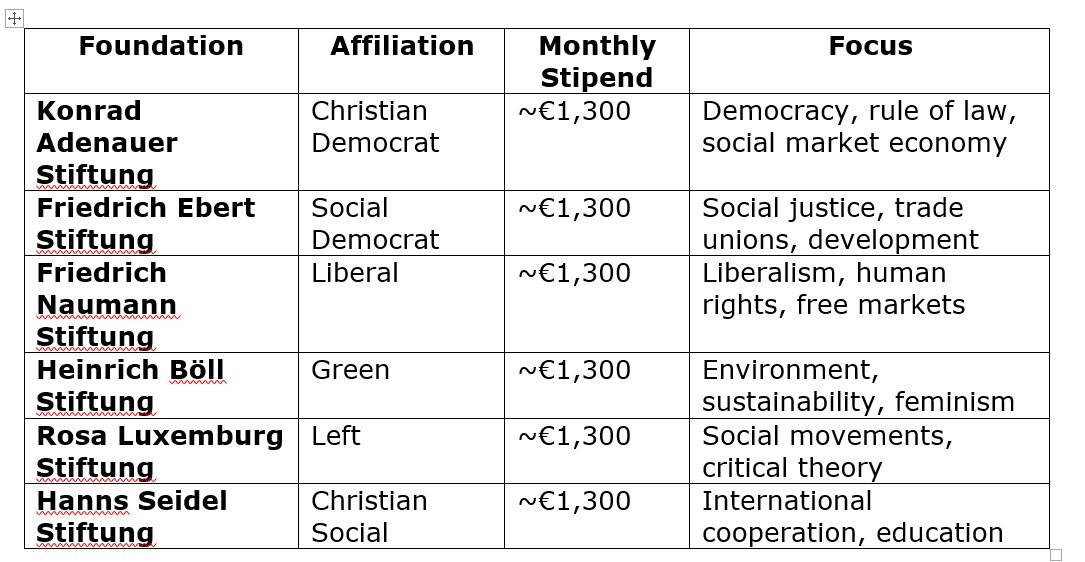
Each foundation funds international students and researchers at German universities whose work and values align broadly with the foundation's mission. Applications are competitive and require a demonstration of academic excellence plus social and political commitment.
Important: Each foundation has its own application process and deadline. Research which foundation aligns with your values and research focus and apply accordingly. Receiving funding from one foundation while being selected by another is not permitted.
Finding a Supervisor, The Most Important Step
For all pathway types that involve individual doctoral research (DAAD, Humboldt, DFG projects), you need to identify and establish contact with a potential supervisor at a German university before applying for funding and this is not optional as without a supervisor's agreement, most applications will not be accepted.
How to find a supervisor:
Step 1: Use Google Scholar, ResearchGate, or Academia.edu to find German professors publishing in your specific research area and read their recent papers.
Step 2: Go to the professor's university homepage and verify their research group is active and taking new PhD students.
Step 3: Write a concise, specific email no more than 300 words introducing yourself, your academic background, your specific research interest, and why their work is relevant to your goals. Attach your CV. Do not use generic templates.
Step 4: If accepted, request a formal letter of intent or supervision agreement. This document supports your scholarship application.
Starting this process 6–12 months before the application deadline is strongly recommended. Professors who are approached well in advance are far more likely to consider a student seriously than those who receive a request two weeks before a DAAD deadline.
What Makes a Competitive German PhD Application
Whether you are applying for DAAD, Humboldt, or a Max Planck position, the selection criteria are consistent:
1. Academic excellence, strong grades throughout your undergraduate and Master's studies. DAAD uses academic achievement as the primary screening criterion.
2. Research proposal quality , for scholarship-based applications, your research proposal is the centrepiece. It must identify a specific, original research question; demonstrate knowledge of the existing literature; explain your proposed methodology; and show why Germany and your specific host institution is the right environment for this research.
3. Supervisor relationship having an established, enthusiastic supervisor at a top German institution significantly strengthens any application.
4. Professional experience DAAD in particular values candidates who have demonstrated commitment to their field through professional work after their Master's degree.
5. Language skills English proficiency is required for English-taught programmes; German language skills (at least A2–B1 level) are valued for integration into German research culture, even if your programme is in English.
Key Deadlines
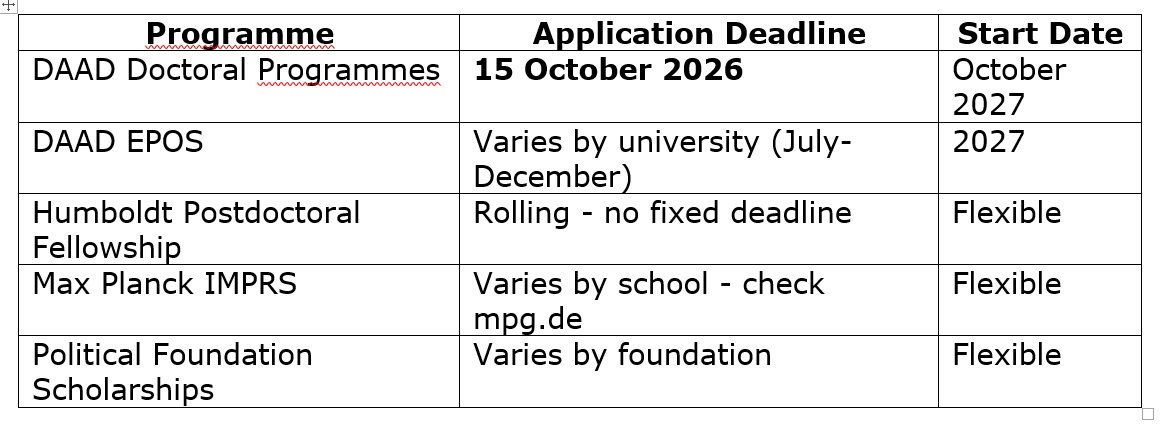
Official application portals:
- DAAD: portal.daad.de | Database: daad.de/stipdb-redirect
- Humboldt Foundation: humboldt-foundation.de
- Max Planck: mpg.de
Frequently Asked Questions
Q: Are Germany PhD scholarships open to students from Africa? Yes. DAAD doctoral scholarships are offered primarily to applicants from developing and emerging countries all African countries qualify. Germany's other major funding bodies including the Humboldt Foundation and political foundation scholarships are also open to non-German nationals from all countries.
Q: What is the monthly stipend for a DAAD PhD scholarship in 2027? The DAAD doctoral stipend is €1,300 per month for doctoral candidates, with some indicating €1,350-€1,500 for candidates with professional experience and the stipend is supplemented by a travel allowance, health insurance contributions, and an annual research allowance of €460. So, verify the current rate on the official DAAD portal at the time of your application as amounts are subject to periodic review.
Q: Do I need to speak German to do a PhD in Germany? Not necessarily. A growing number of doctoral programmes at German universities and Max Planck institutes are conducted in English. However, German language skills even at A2–B1 level are valued for daily life and integration. The DAAD may also fund preparatory German language courses before your programme begins.
Q: What is the DAAD PhD scholarship deadline for 2027? For scholarships beginning in October 2027, the DAAD Research Grants Doctoral Programmes application deadline is 15th October 2026 and applications open in May 2026. You have to Submit at least two weeks before the deadline as DAAD's portal experiences heavy traffic in the final days.
Q: Do I need a supervisor before applying for a DAAD PhD scholarship? Yes. For individual doctoral project applications, you need to have identified a professor at a German university who has agreed in principle to supervise your research and without a supervisor, your application will not be accepted. Begin the supervisor search process 6-12 months before the application deadline.
Q: How long does DAAD fund a PhD in Germany? DAAD doctoral scholarships are initially awarded for a maximum of 3 years and academic achievements are assessed annually. If you are on track to complete your doctorate within a reasonable period, the scholarship continues as planned. A 4th year extension can be applied for if needed.
Q: Can I work part-time while on a DAAD scholarship in Germany? This depends on your specific scholarship terms and generally, scholarship holders are expected to focus on their research full-time. Discuss any part-time work arrangements with your DAAD programme officer and supervisor before committing to additional employment.
Read: LASOMA Fully Funded Masters and PhD Scholarships for African Students →
Read: CICOPS Scholarship 2027 — Fully Funded Research at University of Pavia, Italy →
Read: HEC Government Study Loan — September 2026 Intake →
Browse all scholarships and opportunities →
Published by Mathrone Academy Rwanda's leading tutoring platform. We connect students across Rwanda with qualified, vetted tutors for personalised 1-on-1 learning, online or at home. Contact us: WhatsApp +250 786 684 285 | mathroneacademy.com