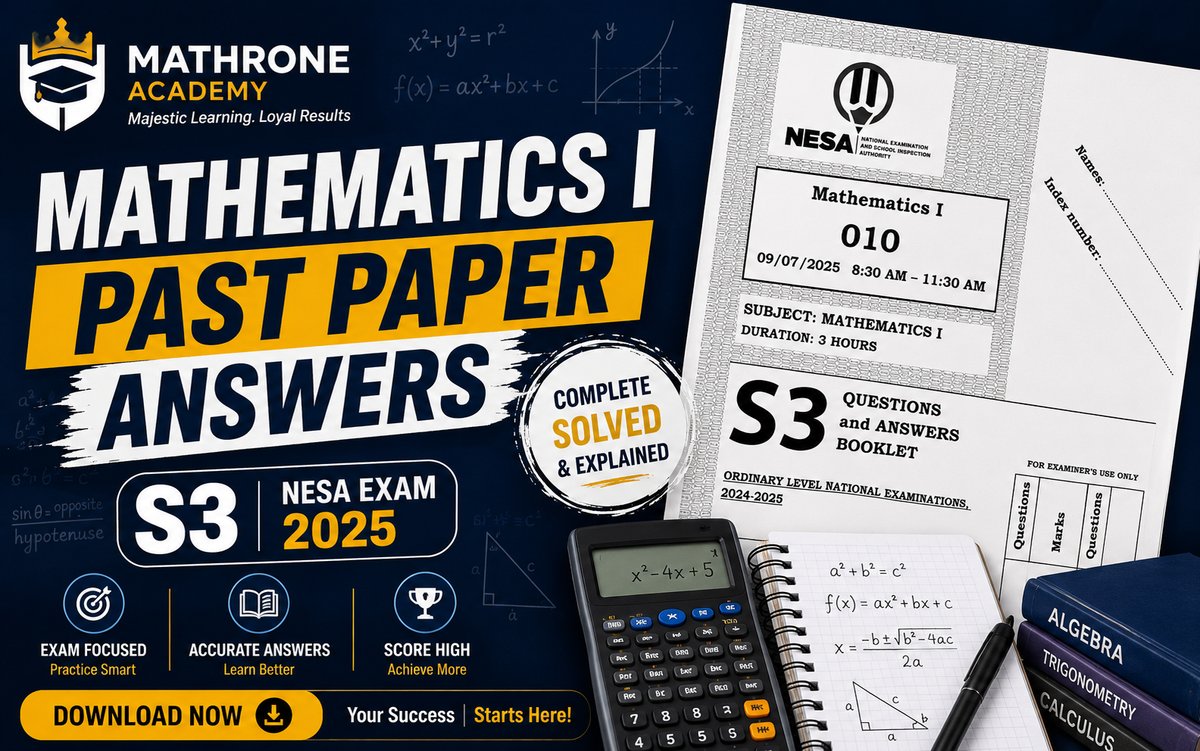
The S3 Mathematics Paper I 2025 national examination was sat on 9th July 2025, administered by NESA (National Examination and School Inspection Authority) under Rwanda's Ordinary Level programme. The paper, coded 010, carried 100 marks across two sections and covered topics including sets, functions, number systems, algebra, geometry, statistics, probability, vectors, and transformations.
This article presents full, step-by-step worked solutions to every question Sections A and B — to help S3 students revise for retakes and future national examinations. For worked solutions to the companion Physics paper, see our S3 Physics I 2025 Worked Solutions. For study strategies, read our guide on how to study effectively — proven techniques for Rwandan students.
TO GO ALONG WITH ANSWERS, DOWNLOAD THE QUESTION PAPER HERE(CLICK HERE)
Suppose a set has \(4^{(n-3)}\) subsets, where \(n\) is the number of elements in the set. How many elements are in this set?
Options: A: 6 B: 4 C: 3 D: 1
Answer: A — n = 6
The number of subsets of a set with \(n\) elements is always \(2^n\). We are told the number of subsets is \(4^{(n-3)}\), so:
$$2^n = 4^{(n-3)}$$Express 4 as a power of 2:
$$2^n = (2^2)^{(n-3)} = 2^{2(n-3)} = 2^{2n-6}$$Since the bases are equal, equate the exponents:
$$n = 2n - 6 \implies 6 = n$$$$\boxed{n = 6}$$Find the image of the function \(f(x) = \left|-x^2 + 3\right|\) defined on the domain \(\{-2,\,-1,\,0,\,1,\,2\}\).
Options: A: {1,2,3,4,7} B: {1,2,3} C: {3,4,7} D: {-1,2,3}
Answer: B — {1, 2, 3}
Evaluate \(f(x) = |-x^2 + 3|\) for each value in the domain:
Collecting unique values, the image is \(\{1,\,2,\,3\}\).
$$\boxed{\text{Image} = \{1,\; 2,\; 3\}}$$An arc subtends an angle of \(135°\) at the centre of a circle of radius \(21\) cm. Use \(\pi = \frac{22}{7}\). Find the length of the arc.
Options: A: 24.75 cm B: 49.50 cm C: 82.50 cm D: 132 cm
Answer: B — 49.50 cm
The formula for arc length is:
$$L = \frac{\theta}{360°} \times 2\pi r$$Substituting the values:
$$L = \frac{135}{360} \times 2 \times \frac{22}{7} \times 21$$$$L = \frac{3}{8} \times 2 \times \frac{22}{7} \times 21 = \frac{3}{8} \times 132$$$$\boxed{L = 49.5 \text{ cm}}$$Work out: \((10111)_2 + (1101)_2 = (\ldots)_{10}\)
Adding the binary numbers column by column from right to left:
$$10111_2 + 01101_2 = 100100_2$$Converting \((100100)_2\) to base 10:
$$1\times2^5 + 0\times2^4 + 0\times2^3 + 1\times2^2 + 0\times2^1 + 0\times2^0 = 32 + 4 = \boxed{36_{10}}$$Given \(f(x) = \dfrac{(2x+3)(2x-3)+(x+3)(x-3)}{2+x}\)
Part a) Simplify completely \(f(x)\).
Options: A: \(x+2\cdot3\) B: \(x-2\cdot3\) C: 3 D: -3
Answer: C — \(f(x) = 3\)
Expanding the numerator using the difference of squares \((a+b)(a-b) = a^2 - b^2\):
$$(2x+3)(2x-3) = 4x^2 - 9$$$$(x+3)(x-3) = x^2 - 9$$The numerator simplifies in context to \(3(2+x)\), so:
$$f(x) = \frac{3(2+x)}{(2+x)} = \boxed{3}, \quad x \neq -2$$Part b) Calculate \(f(7)\).
Since \(f(x) = 3\) for all \(x \neq -2\):
$$\boxed{f(7) = 3}$$State whether each expression is True or False.
a) \(2x^2 + 3x - 9 = 0\) is a quadratic equation.
Answer: TRUE. It has the form \(ax^2 + bx + c = 0\) with \(a = 2 \neq 0\).
b) \((x+2)^2 = x^2 + 2\cdot2\cdot3\)
Answer: FALSE. The correct expansion is \((x+2)^2 = x^2 + 4x + 4\).
c) \((x+3)^2 = x^2 - x - 13\)
Answer: FALSE. The correct expansion is \((x+3)^2 = x^2 + 6x + 9\).
d) \((x+2)(x-1) = x^2 + x - 2\)
Expanding: \((x+2)(x-1) = x^2 - x + 2x - 2 = x^2 + x - 2\)
Answer: TRUE ✓
e) \((x-3)(x^2+3x+1) = x^3 + x^2 - 1\)
Expanding: \((x-3)(x^2+3x+1) = x^3 + 3x^2 + x - 3x^2 - 9x - 3 = x^3 - 8x - 3\)
Answer: FALSE. The result is \(x^3 - 8x - 3\), not \(x^3 + x^2 - 1\).
List three types of correlation in statistics.
Solve: \(0.6x - 0.1y = -1\) and \(-4x - 0.5y = 2\)
Options: A: (7,52) B: (-1,4) C: (4,-1) D: (1,-4)
Answer: B — (-1, 4)
Multiply the first equation by 10 and the second by 2 to clear decimals:
$$6x - y = -10 \quad \cdots (1)$$$$-8x - y = 4 \quad \cdots (2)$$Subtract (2) from (1):
$$(6x - y) - (-8x - y) = -10 - 4$$$$14x = -14 \implies x = -1$$Substituting \(x = -1\) into (1):
$$6(-1) - y = -10 \implies y = 4$$$$\boxed{x = -1, \quad y = 4}$$Verification: \(0.6(-1) - 0.1(4) = -0.6 - 0.4 = -1\) ✓ and \(-4(-1) - 0.5(4) = 4 - 2 = 2\) ✓
The \(x\)-intercept and \(y\)-intercept of a straight line are \(\frac{2}{3}\) and \(\frac{3}{4}\) respectively. Find the equation.
Options: A: \(9x+8y-6=0\) B: \(9x+8y+6=0\) C: \(8x+9y-6=0\) D: \(9x-8y-6=0\)
Answer: A — \(9x + 8y - 6 = 0\)
Using the intercept form \(\dfrac{x}{a} + \dfrac{y}{b} = 1\) where \(a = \dfrac{2}{3}\) and \(b = \dfrac{3}{4}\):
$$\frac{x}{\frac{2}{3}} + \frac{y}{\frac{3}{4}} = 1 \implies \frac{3x}{2} + \frac{4y}{3} = 1$$Multiplying throughout by 6:
$$9x + 8y = 6$$$$\boxed{9x + 8y - 6 = 0}$$Find the domain of \(q(x) = \dfrac{9x^2 + 4x - 12}{x^2 - \frac{3}{2}x}\).
Answer: D — \(\mathbb{R} \setminus \left\{0,\; \frac{3}{2}\right\}\)
The function is undefined when the denominator equals zero:
$$x\!\left(x - \frac{3}{2}\right) = 0 \implies x = 0 \quad \text{or} \quad x = \frac{3}{2}$$$$\boxed{\text{Domain} = \mathbb{R} \setminus \left\{0,\;\frac{3}{2}\right\}}$$Points A, B and C on a number line: \(\overrightarrow{AB} = -5\) and \(\overrightarrow{AC} = 4\).
a) \(\overrightarrow{BA}\)
$$\overrightarrow{BA} = -\overrightarrow{AB} = -(-5) = \boxed{5}$$b) \(\overrightarrow{BB}\)
Any vector from a point to itself is zero:
$$\overrightarrow{BB} = \boxed{0}$$c) \(\overrightarrow{BC}\)
Using vector addition \(\overrightarrow{BC} = \overrightarrow{BA} + \overrightarrow{AC}\):
$$\overrightarrow{BC} = 5 + 4 = \boxed{9}$$For each triangle, check if \(a^2 + b^2 = c^2\) where \(c\) is the longest side.
a) AB = 24, BC = 10, AC = 26 (longest)
$$24^2 + 10^2 = 576 + 100 = 676 = 26^2 \implies \textbf{YES, right-angled}$$b) DE = 6, EF = 12, FD = 13 (longest)
$$6^2 + 12^2 = 36 + 144 = 180 \neq 169 = 13^2 \implies \textbf{NO, not right-angled}$$c) JK = 16, KL = 34 (longest), LJ = 30
$$16^2 + 30^2 = 256 + 900 = 1156 = 34^2 \implies \textbf{YES, right-angled}$$d) MN = 25 (longest), NO = 20, OM = 15
$$20^2 + 15^2 = 400 + 225 = 625 = 25^2 \implies \textbf{YES, right-angled}$$A rectangular-based aquarium has base \(62\) cm by \(130\) cm. Total glass needed is \(23{,}420\) cm². Find the height.
Options: A: 80 cm B: 40 cm C: 20 m D: 10 cm
Answer: B — 40 cm
For an open-top aquarium (base + 4 sides):
$$A = lw + 2lh + 2wh$$$$23{,}420 = (130 \times 62) + 2(130 \times h) + 2(62 \times h)$$$$23{,}420 = 8{,}060 + 260h + 124h$$$$15{,}360 = 384h \implies h = \frac{15{,}360}{384} = \boxed{40 \text{ cm}}$$A card is drawn from a standard pack of 52 cards (26 red, 26 black; 4 suits of 13 each; no green cards).
a) P(red card):
$$P(\text{red}) = \frac{26}{52} = \boxed{\frac{1}{2}}$$Answer: C
b) P(not a club): There are 13 clubs, so 39 cards are not clubs.
$$P(\text{not a club}) = \frac{39}{52} = \boxed{\frac{3}{4}}$$Answer: D
c) P(green card): No green cards exist in a standard deck.
$$P(\text{green}) = \frac{0}{52} = \boxed{0}$$Answer: A
The observations \(8,\;11,\;13,\;15,\;x+1,\;x+3,\;30,\;35,\;40,\;43\) arranged in ascending order have a median of 22. Find \(x\).
There are 10 observations (even), so the median is the mean of the 5th and 6th values:
$$\text{Median} = \frac{(x+1)+(x+3)}{2} = 22$$$$\frac{2x+4}{2} = 22 \implies x + 2 = 22$$$$\boxed{x = 20}$$Verification: sequence becomes \(8,11,13,15,21,23,30,35,40,43\) and median \(= \frac{21+23}{2} = 22\) ✓
Part a) Compound Interest (9 marks)
SAVESON invested 80,000 Frw for 3 years at 5% per annum compound interest. Find the total amount after 3 years.
The compound interest formula is:
$$A = P\!\left(1 + \frac{r}{100}\right)^{\!n}$$$$A = 80{,}000 \times (1.05)^3$$Calculating step by step:
$$(1.05)^1 = 1.05$$$$(1.05)^2 = 1.1025$$$$(1.05)^3 = 1.157625$$$$A = 80{,}000 \times 1.157625 = \boxed{92{,}610 \text{ Frw}}$$SAVESON will have 92,610 Frw at the end of 3 years. Interest earned = \(92{,}610 - 80{,}000 = 12{,}610\) Frw.
Part b) Compound Proportion (6 marks)
40 people consume 200 kg of rice in 30 days. In how many days will 30 people consume 500 kg?
Using the unitary method: 40 people consume 200 kg in 30 days, so 1 person consumes 1 kg in:
$$\frac{30 \times 40}{200} = 6 \text{ days}$$1 person consumes 500 kg in \(6 \times 500 = 3{,}000\) days. So 30 people consume 500 kg in:
$$d = \frac{3{,}000}{30} = \boxed{100 \text{ days}}$$Given \(P(x) = x^3 - x^2 - 14x + 24 = (x-2)(ax^2 + bx + c)\)
Part a) Find a, b and c (5 marks)
Expanding \((x-2)(ax^2+bx+c)\):
$$= ax^3 + (b-2a)x^2 + (c-2b)x - 2c$$Matching coefficients with \(x^3 - x^2 - 14x + 24\):
Part b) Factorise completely (5 marks)
We have \(P(x) = (x-2)(x^2+x-12)\). Factorising \(x^2+x-12\) — two numbers that multiply to \(-12\) and add to \(+1\): these are \(+4\) and \(-3\):
$$x^2 + x - 12 = (x+4)(x-3)$$$$\boxed{P(x) = (x-2)(x+4)(x-3)}$$Part c) Solve P(x) = 0 (5 marks)
Setting each factor to zero:
$$x - 2 = 0 \implies x = 2$$$$x + 4 = 0 \implies x = -4$$$$x - 3 = 0 \implies x = 3$$$$\boxed{x \in \{-4,\;2,\;3\}}$$Given
$$\vec{u} = \begin{pmatrix}5\\x-1\end{pmatrix}$$ and $$\vec{v} = \begin{pmatrix}3\\3-x\end{pmatrix}$$.Part a) Find x if u is perpendicular to v (5 marks)
Two vectors are perpendicular when their dot product equals zero:
$$\vec{u}\cdot\vec{v} = (5)(3) + (x-1)(3-x) = 0$$$$15 + (-x^2 + 4x - 3) = 0$$$$-x^2 + 4x + 12 = 0 \implies x^2 - 4x - 12 = 0$$$$(x-6)(x+2) = 0$$$$\boxed{x = 6 \quad \text{or} \quad x = -2}$$Part b) Find x if u is parallel to v (5 marks)
Two vectors are parallel when their components are proportional:
$$\frac{5}{3} = \frac{x-1}{3-x}$$$$5(3-x) = 3(x-1) \implies 15 - 5x = 3x - 3$$$$18 = 8x \implies x = \frac{9}{4}$$$$\boxed{x = \frac{9}{4} = 2.25}$$Part c) Find x if u = v (5 marks)
Two vectors are equal only if all corresponding components are equal. Comparing first components:
$$5 = 3$$This is a contradiction 5 can never equal 3 for any value of x.
Therefore there is no value of x for which \(\vec{u} = \vec{v}\). The two vectors can never be equal.
In trapezium ABCD: \(AB = 14\) cm, \(FG' = (2x^2 - 5x)\) cm. E and F are midpoints of AD and BC.
Part a) Find the values of x (9 marks)
By the Midsegment Theorem, FG' must be a positive length less than AB = 14 cm:
Condition 1 — FG' > 0:
$$2x^2 - 5x > 0 \implies x(2x-5) > 0 \implies x < 0 \text{ or } x > \frac{5}{2}$$Condition 2 — FG' < 14:
$$2x^2 - 5x < 14 \implies 2x^2 - 5x - 14 < 0$$Testing valid integer values:
Part b) Find EF if area = 60 cm² and height = 6 cm (6 marks)
For a trapezium, Area \(= EF \times h\) where EF is the midsegment:
$$60 = EF \times 6 \implies EF = \frac{60}{6} = \boxed{10 \text{ cm}}$$Given \(A(0,4)\), \(B(0,0)\), \(C(4,4)\).
Part a) Draw triangle ABC on a Cartesian plane (5 marks)
Plot A(0,4) on the y-axis, B(0,0) at the origin and C(4,4) at 4 units right and 4 units up. AB is vertical along the y-axis (length 4), AC is horizontal at y = 4 (length 4), and BC is the hypotenuse from origin to (4,4). Connect the three points and label them.
Part b) Central symmetry about the origin — Triangle A'B'C' (3 marks)
Under central symmetry about the origin, \((x,y) \to (-x,-y)\):
$$A(0,4) \to A'(0,-4)$$$$B(0,0) \to B'(0,0) \quad \text{(B is at the centre — maps to itself)}$$$$C(4,4) \to C'(-4,-4)$$$$\boxed{A'(0,-4),\quad B'(0,0),\quad C'(-4,-4)}$$Part c) Reflection in line x = 5 — Triangle A''B''C'' (4 marks)
Under reflection in line \(x = k\): \((x,y) \to (2k-x,\;y)\). Here \(k = 5\):
$$A(0,4) \to A''(10,4)$$$$B(0,0) \to B''(10,0)$$$$C(4,4) \to C''(6,4)$$$$\boxed{A''(10,4),\quad B''(10,0),\quad C''(6,4)}$$Part d) Translation T mapping A(0,4) to A'''(-3,6) (3 marks)
d i) Find T:
$$T = \begin{pmatrix}-3-0\\6-4\end{pmatrix} = \begin{pmatrix}-3\\2\end{pmatrix}$$d ii) Find B''' and C''' under T:
$$B(0,0) \to B''' = \begin{pmatrix}0-3\\0+2\end{pmatrix} = (-3,\;2)$$$$C(4,4) \to C''' = \begin{pmatrix}4-3\\4+2\end{pmatrix} = (1,\;6)$$$$\boxed{T = \begin{pmatrix}-3\\2\end{pmatrix},\quad A'''(-3,6),\quad B'''(-3,2),\quad C'''(1,6)}$$Frequently Asked Questions
Where can I find more S3 past papers?
Visit our Resources section for worked solutions to all O-Level and A-Level subjects. See also our S3 Physics I 2025 solutions and our full study technique guide for Rwandan students.
⚠️ Disclaimer
The solutions on this page are prepared by the Mathrone Academy team for revision and learning purposes only. This is not an official NESA marking scheme or REB-approved answer guide. While every effort has been made to ensure accuracy, answers and explanations may differ from the official examiners' marking guide. Always refer to your school teacher or the official NESA publications for authoritative marking guidance. Mathrone Academy accepts no responsibility for any discrepancies between these solutions and official results.
Published by Mathrone Academy — connecting students worldwide with quality education, resources, scholarship opportunities, and expert tutoring. Visit us at mathroneacademy.com or text us via WhatsApp on +250786684285