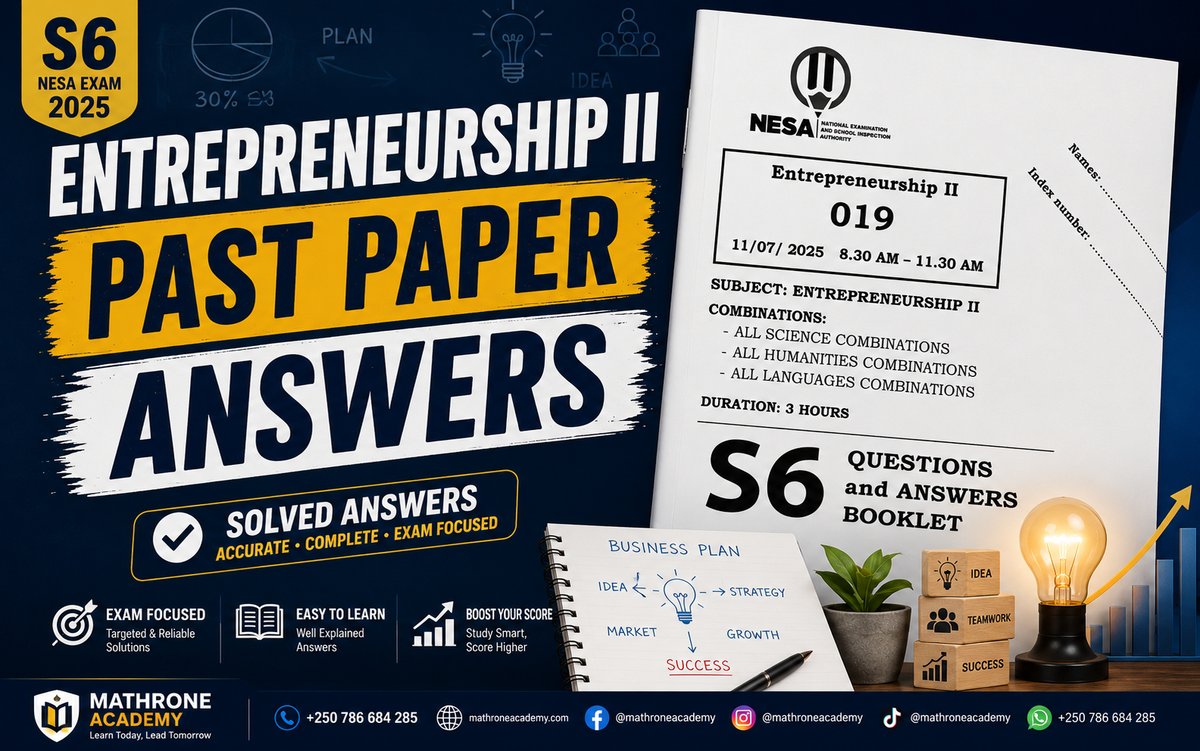
The 2025 NESA S6 Entrepreneurship II national exam tested students across all combinations Sciences, Humanities, and Languages — on everything from the entrepreneurial process to break-even analysis and full business plan writing. If you sat this paper on 11th July 2025, or you're an S5 student preparing for next year's exam, here are complete, step-by-step solutions to every question in Sections A, B, and C.
Entrepreneurship II is one of those subjects where marks are lost not from not knowing the content, but from missing the exact terminology examiners want, or from skipping working steps the marking scheme actually rewards. We've broken down each answer the way a marker would expect to see it.
TO GO ALONG WITH ANSWERS DOWNLOAD THE PASTPAPER HERE
This question tests the five stages of the innovation development lifecycle. Matching each description to the correct stage:
Tip: A common mistake is swapping Idea Generation and Concept Development. Remember: you generate an idea first, then you evaluate/develop the concept.
Answer: C) Products that customer like
Interviews, observation, and focused group discussions are all recognised environmental scanning tools used to gather market intelligence. "Products that customer like" is an outcome of research, not a scanning tool itself.
SMART goals must be Specific, Measurable, Achievable, Relevant, and Time-bound.
Answer: D) Communication Survey
Customer survey, product survey, and supplier survey are standard market research elements. "Communication survey" is not a recognised category of market research in the entrepreneurship syllabus.
Answer: B) Working place challenges
Availability of market, enough capital, and competent business management are all positive indicators that support business growth. Working place challenges represent a constraint, not a growth indicator.
✅ Advantage: Helps in cross-reference with other systems.
❌ Disadvantage: Filing and location of documents is not simple.
✅ Advantage: Useful if the dates are known.
❌ Disadvantage: Incoming letters might be mixed up with outgoing ones.
This is a calculation question, so we show full working as the marking scheme requires:
Accounting income = 960,000 Frw
Less: Other deductible expenses = 90,000 Frw
Fiscal (Taxable) Income = 960,000 − 90,000 = 870,000 Frw
Important note: The "30% of profit put in reserve" is a profit appropriation (a decision on what to do with after-tax profit), not a tax-deductible business expense. Only genuine deductible expenses reduce fiscal income — appropriations of profit do not. This is a common trap in this question type.
Answer: B) Job description
A job description is the written statement outlining the duties and responsibilities involved in performing a job, as distinct from a job offer, job advertising, or job analysis.
The standard emergency management cycle in order:
Five common ICT-related challenges faced by businesses in a typical Rwandan community context:
Nyirabisabo's Bags Shop: Statement of Owner's Equity for the Quarter Ended 16th July 2025
Working: 65,000,000 − 10,000,000 − 5,000,000 = 50,000,000 Frw
Selling price per unit = 750 Frw
Direct material = 200 Frw
Direct labour = 75 Frw
Variable overheads = 25 Frw
Fixed cost per period = 900,000 Frw
a) Variable cost per unit (2 marks)
Variable cost = 200 + 75 + 25 = 300 Frw per unit
b) Break-Even Point in quantity and value (6 marks)
First find contribution per unit:
Contribution per unit = Selling price − Variable cost = 750 − 300 = 450 Frw
BEP in quantity:
BEP (units) = Fixed Cost ÷ Contribution per unit = 900,000 ÷ 450 = 2,000 units
BEP in value:
BEP (value) = BEP units × Selling price = 2,000 × 750 = 1,500,000 Frw
c) Quantity to produce for a target profit of 450,000 Frw (4 marks)
Required units = (Fixed Cost + Target Profit) ÷ Contribution per unit = (900,000 + 450,000) ÷ 450 = 1,350,000 ÷ 450 = 3,000 units
d) Contribution per unit (3 marks)
Contribution per unit = 750 − 300 = 450 Frw
The question asks for any 5 key points of the Business Model Canvas, clearly explained, for Ineza Mary's small restaurant business in Kibeho Sector, Nyaruguru District.
(Other valid canvas elements a student could also choose: Key Activities — daily food preparation and customer service; Key Partners — local food and ingredient suppliers; Cost Structure — ingredients, rent, staff wages; Customer Relationships — friendly, personalised service that builds repeat customers.)
This question must be answered in the first person, as Ineza Mary, without including the candidate's own identifying details. A strong pitch covers: the problem/opportunity, the solution, the target market, why now, and the ask (funding need).
"Good morning. My name is Ineza Mary, and I am from Kibeho Sector in Nyaruguru District. I have identified an opportunity to open a small restaurant in my community, where residents, students, and travelers currently have limited access to quick, affordable, and quality food. My restaurant will serve tea, milk, water, doughnuts (amandazi), chapatti, and full meals such as rice, potatoes, beans, vegetables, and fruits, prepared fresh daily.
My target customers are local residents, students from nearby schools, and travelers passing through Kibeho who need convenient and reliable meal options. Umurenge SACCO has advised me that I need start-up capital to secure premises, purchase cooking equipment, and buy initial stock of ingredients.
I am requesting funding support to launch this restaurant, which I am confident will generate steady daily income, create local employment opportunities, and meet a real, unmet need in my community. For any inquiries, I can be reached at 0799999999."
What date was the S6 Entrepreneurship II 2025 national exam?
The exam was sat on 11th July 2025, from 8:30 AM to 11:30 AM, lasting 3 hours, under code 019.
Which combinations sit Entrepreneurship II?
Entrepreneurship II is sat by all Science combinations, all Humanities combinations, and all Languages combinations at S6 level under the REB curriculum.
How is the BEP (Break-Even Point) calculated?
BEP in units = Fixed Costs ÷ Contribution per unit, where Contribution per unit = Selling Price − Variable Cost per unit. BEP in value = BEP units × Selling price.
Is the profit appropriated to reserve included when calculating fiscal income?
No. Profit appropriated to reserve is a decision on how after-tax profit is used, not a deductible business expense, so it does not reduce taxable (fiscal) income.
Where can I get more help with Entrepreneurship II topics like business plans and financial statements?
Mathrone Academy connects S6 students with qualified private tutors across Rwanda for one-on-one or group support in Entrepreneurship, Accounting, and all REB subjects — both online and at-home.
Whether it's break-even analysis, financial statements, or writing a business plan pitch that actually scores full marks, a private tutor can walk you through past papers like this one question by question. Find a verified Entrepreneurship tutor on Mathrone Academy for personalised, exam-focused support, or explore our structured Entrepreneurship courses to build mastery from the ground up.
Need a calculator or stationery for revision? Check out our Mathrone Academy shop for scientific calculators and exam essentials.
Looking for more past paper solutions? Browse our growing library of S6 Mathematics II solutions, S6 Physics solutions, and more in our News & Resources hub.
⚠️Important Disclaimer
The solutions on this page are prepared by the Mathrone Academy team for revision and learning purposes only. This is not an official NESA marking scheme or REB-approved answer guide. While every effort has been made to ensure accuracy, answers and explanations may differ from the official examiners' marking guide. Always refer to your school teacher or the official NESA publications for authoritative marking guidance. Mathrone Academy accepts no responsibility for any discrepancies between these solutions and official results