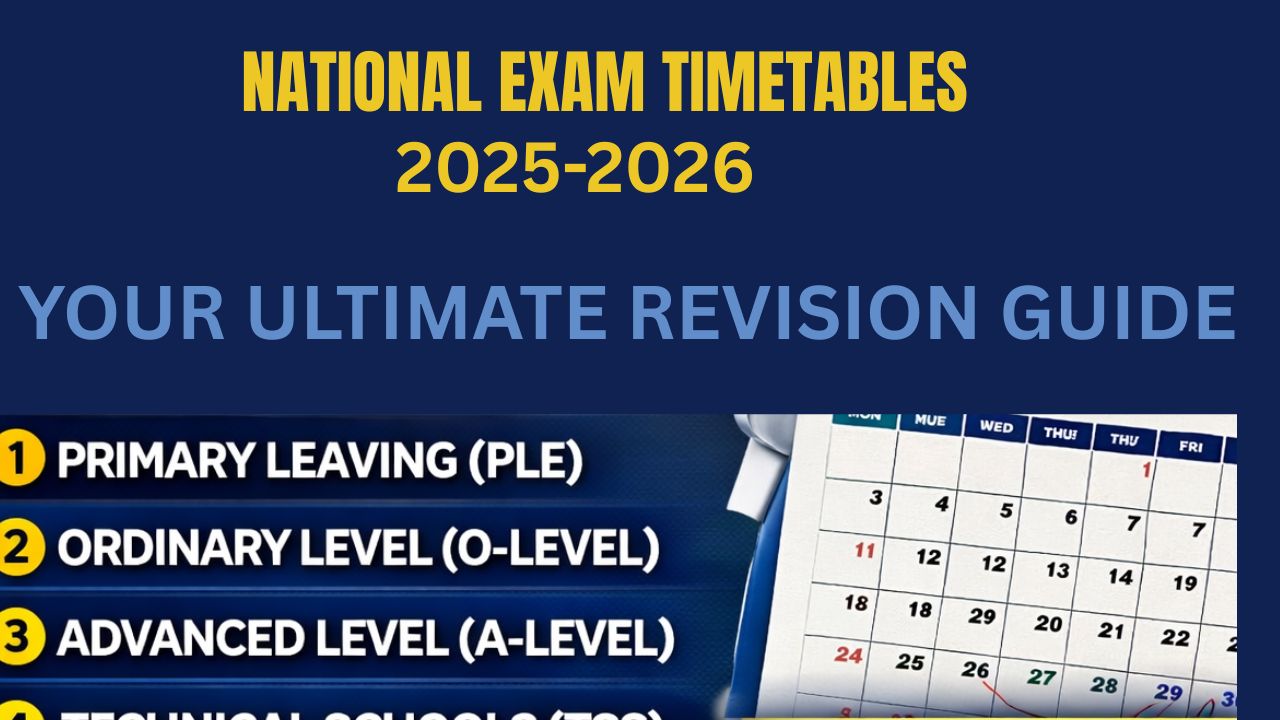
If you are in a terminal year, you already know it. The dates are confirmed. Here is what the 2025/2026 national examination schedule looks like across all levels.
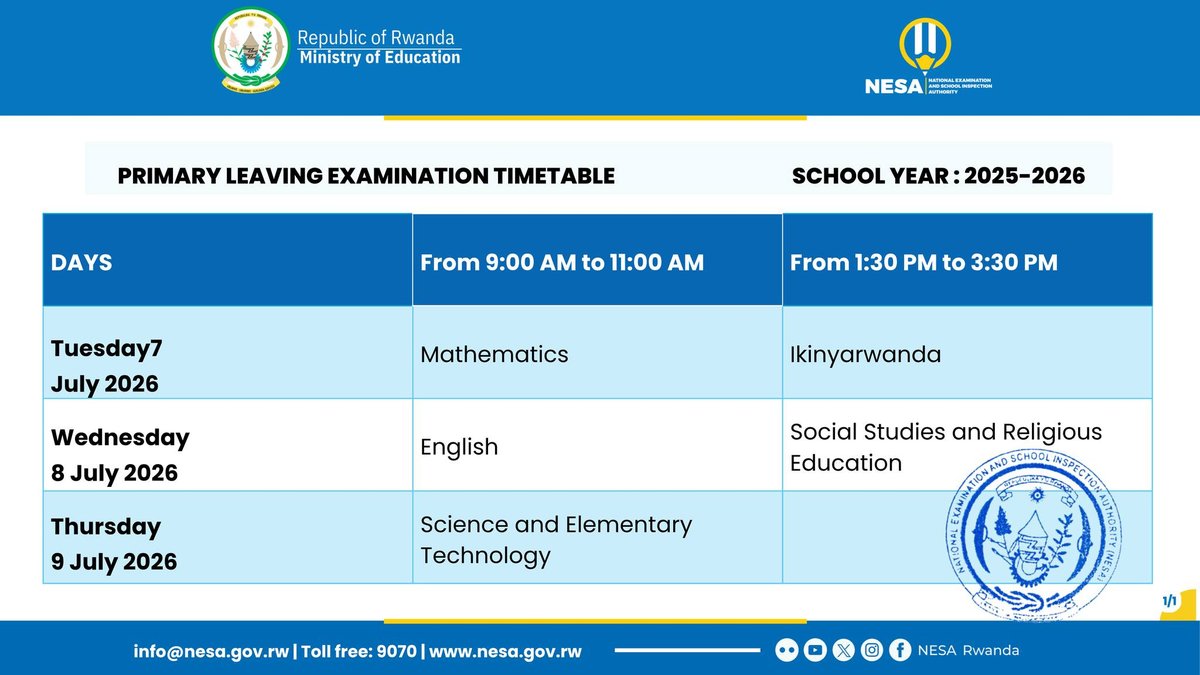
PLE runs Tuesday 7th to Thursday 9th July 2026: Mathematics first, Science and Elementary Technology last.
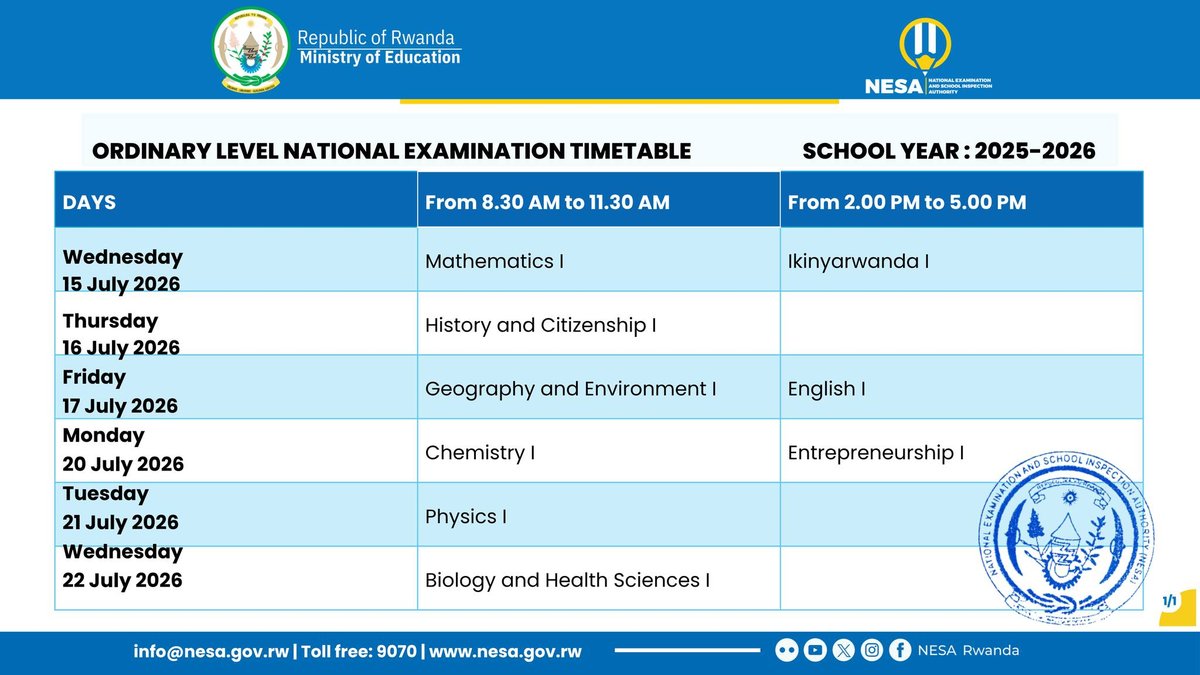
O'Level runs Wednesday 15th to Wednesday 22nd July: Mathematics opens, Biology and Health Sciences closes.
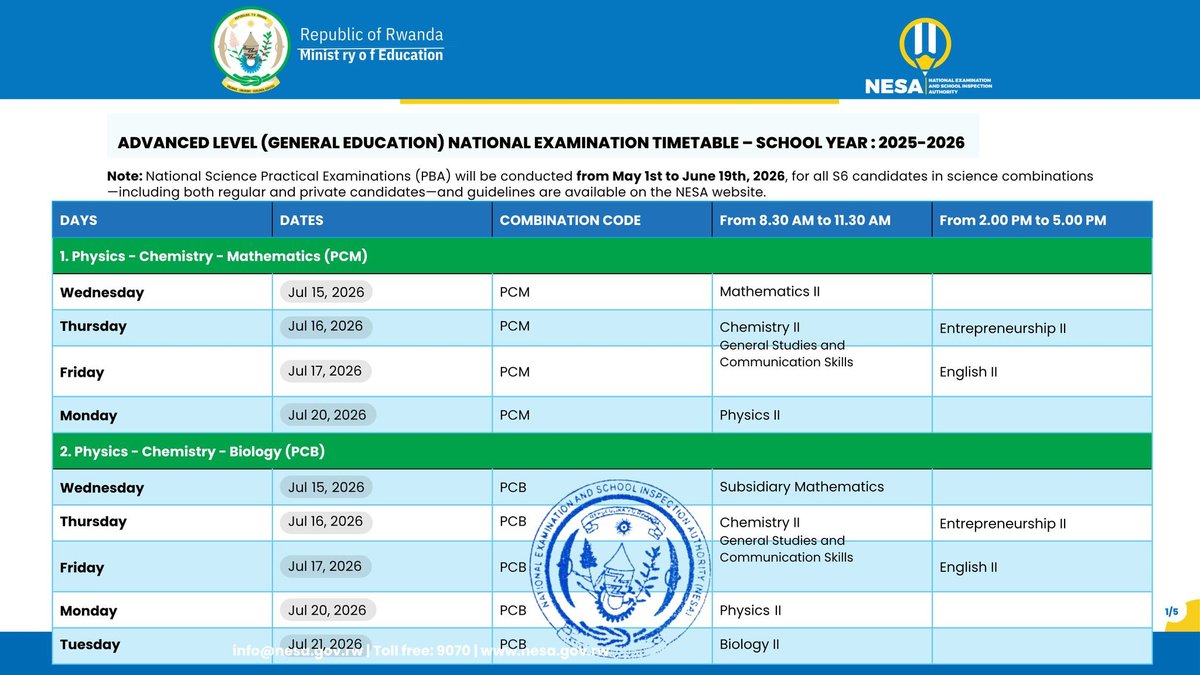
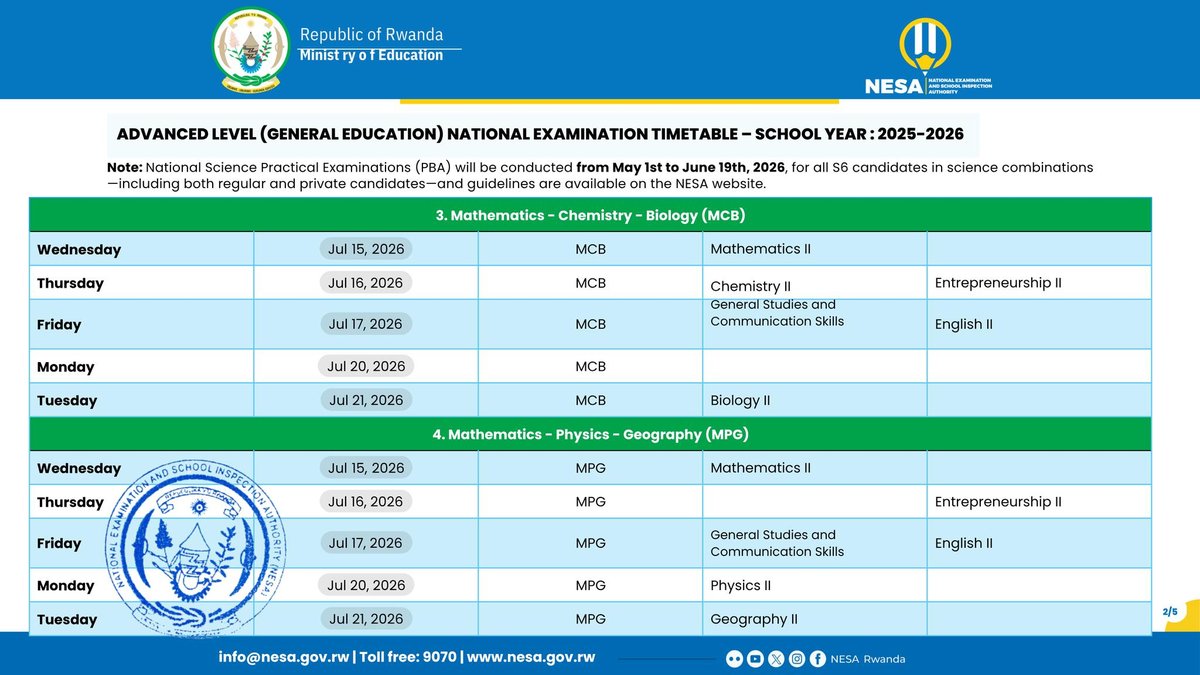
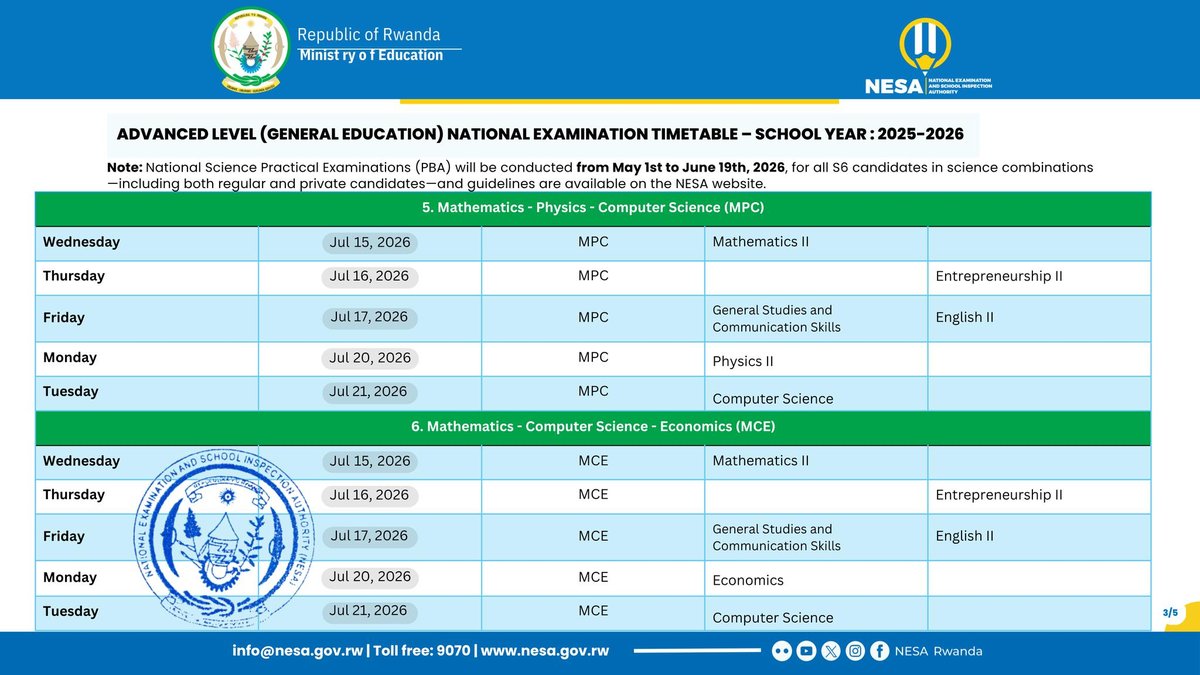
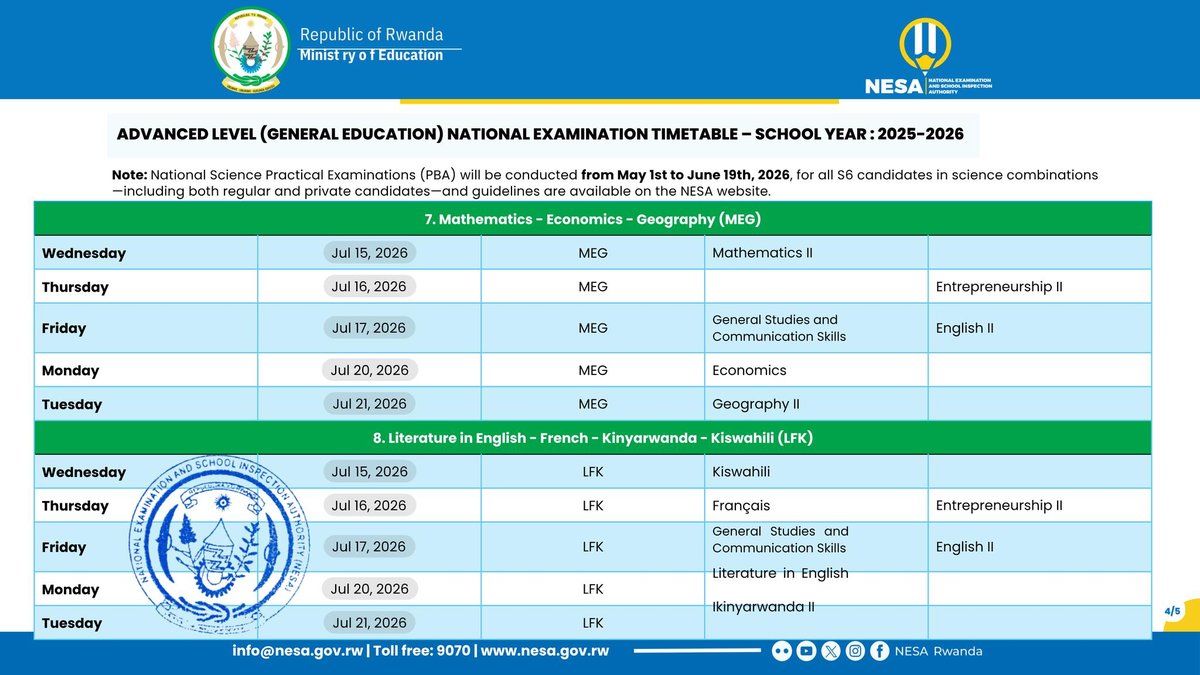
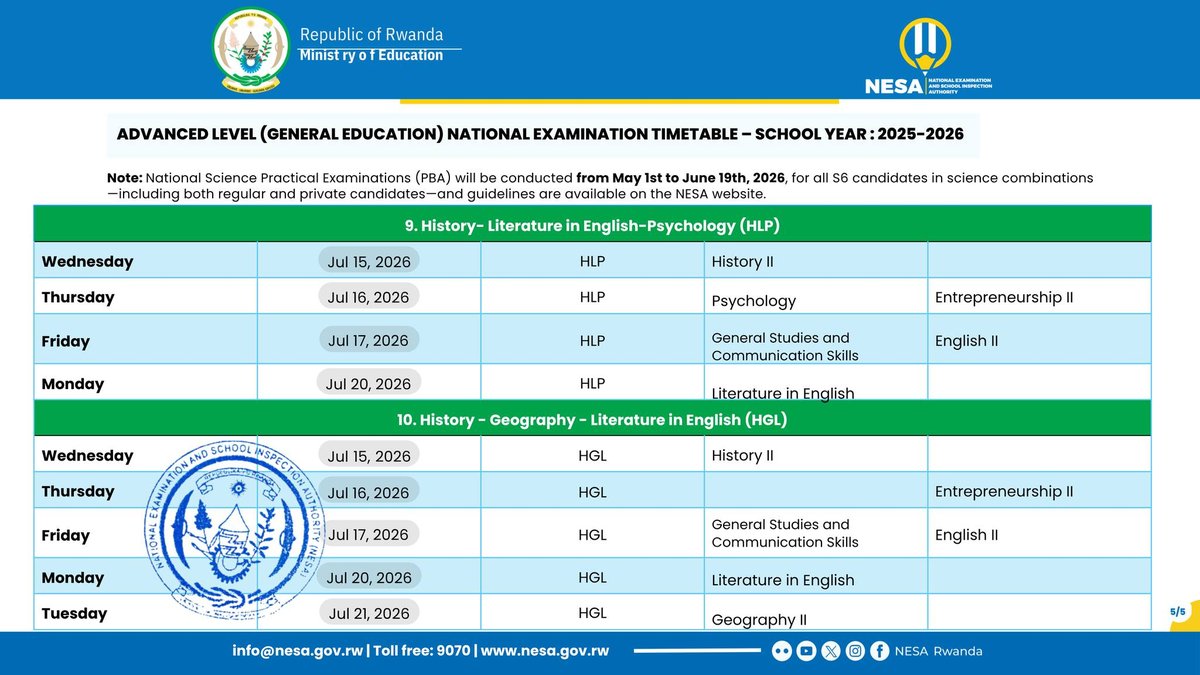
A'Level General Education starts 15th July as well, same day as O'Level, across all combinations. TSS candidates should download their separate timetable directly from NESA.
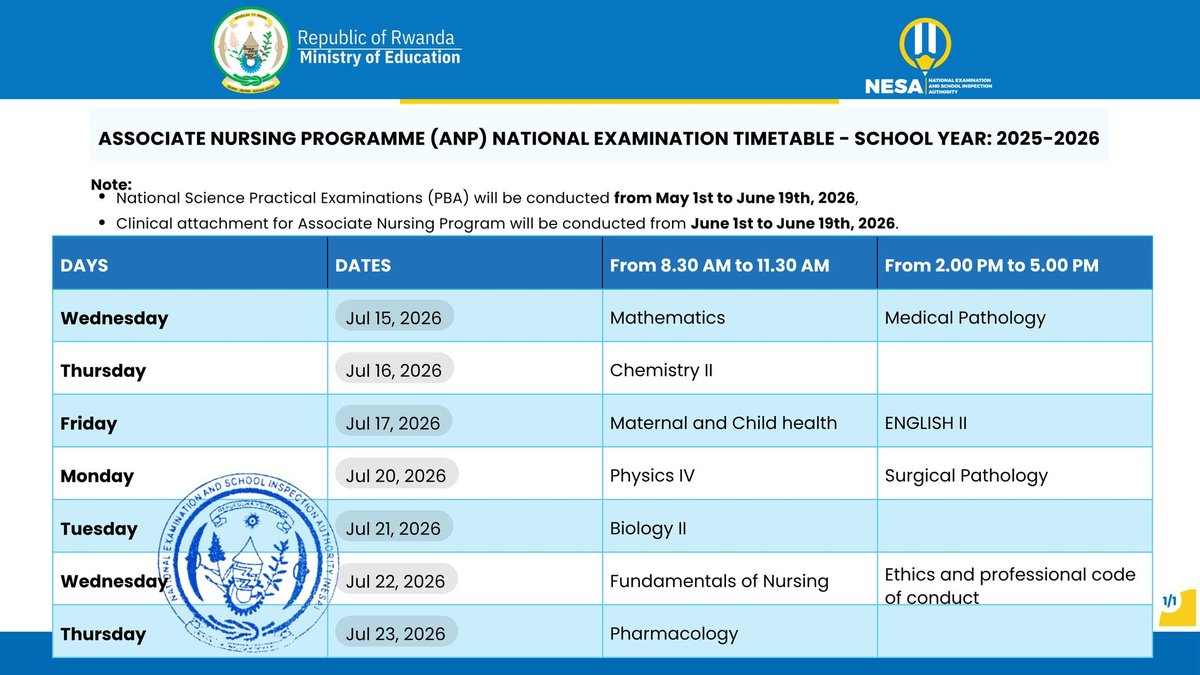
One thing S6 science students need to know right now: the National Science Practical Examinations (PBA) for PCM, PCB, and MCB are already running 1st May to 19th June 2026. That includes private candidates. Do not treat your practical as an afterthought.
The Official 2025/2026 National Examination Timetable
These dates are taken directly from the NESA-issued timetable. They apply to all Advanced Level General Education candidates.
PRIMARY LEAVING EXAMINATION TIMETABLE - SCHOOL YEAR 2025-2026
ORDINARY LEVEL NATIONAL EXAMINATION TIMETABLE – SCHOOL YEAR 2025-2026
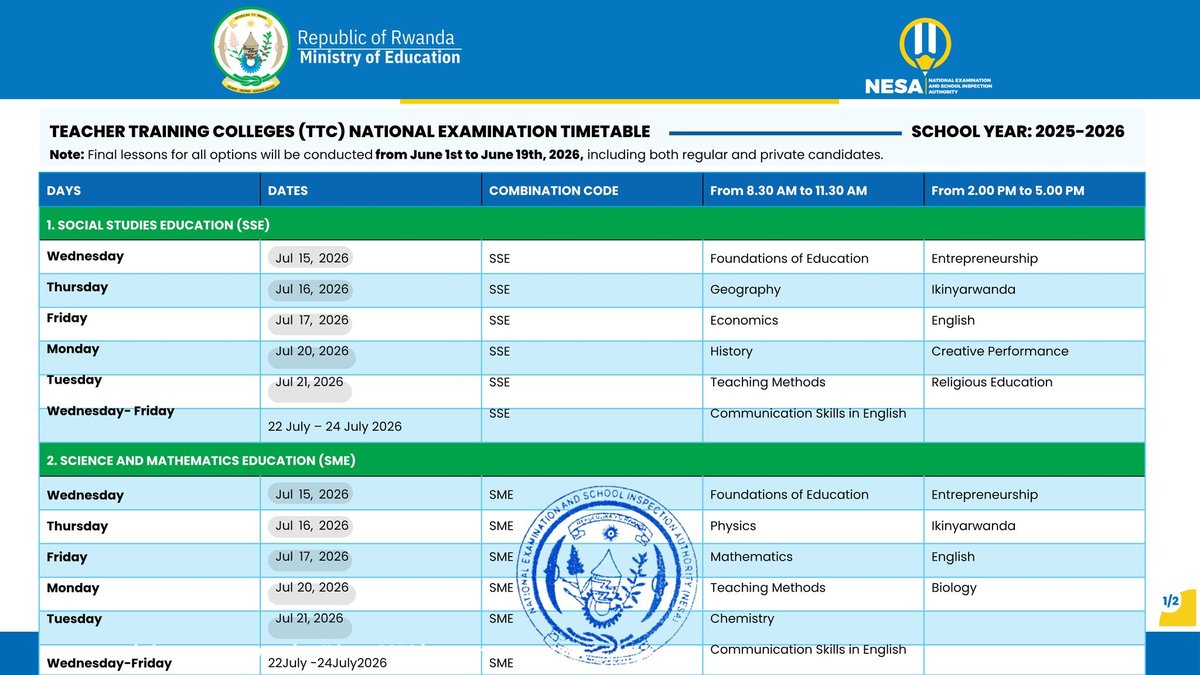
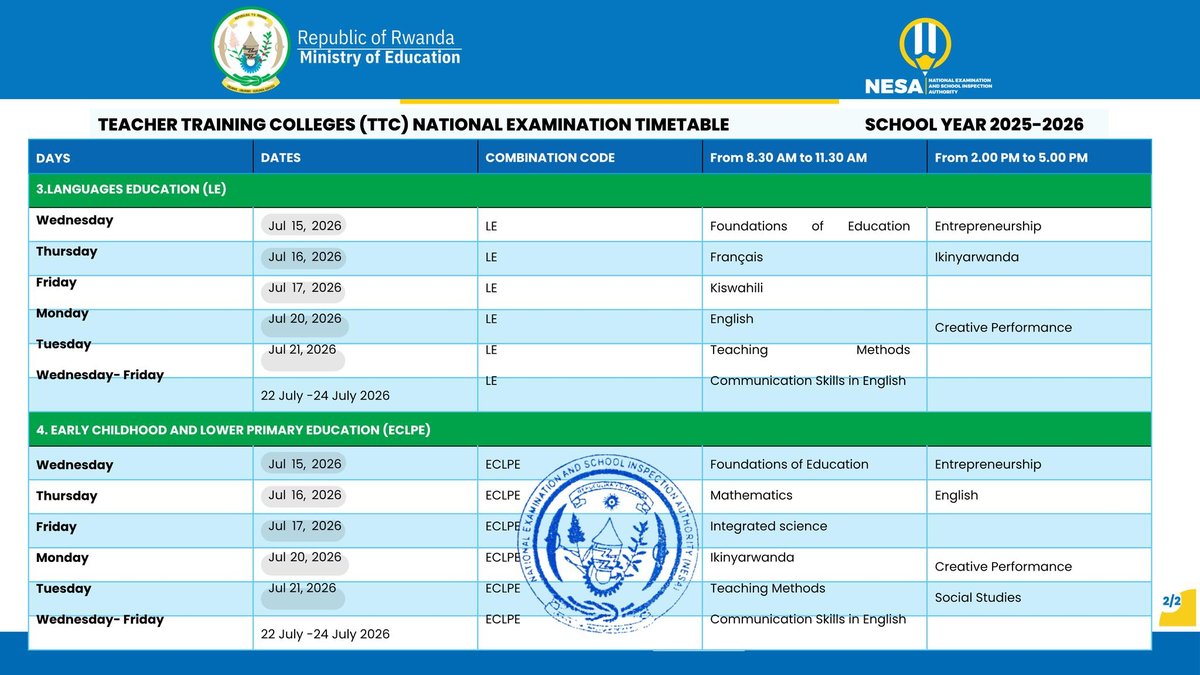
TEACHER TRAINING COLLEGES NATIONAL EXAM TIMETABLE 2025-2026
ASSOCIATE NURSING PROGRAMME NATIONAL EXAM TIMETABLE 2025-2026
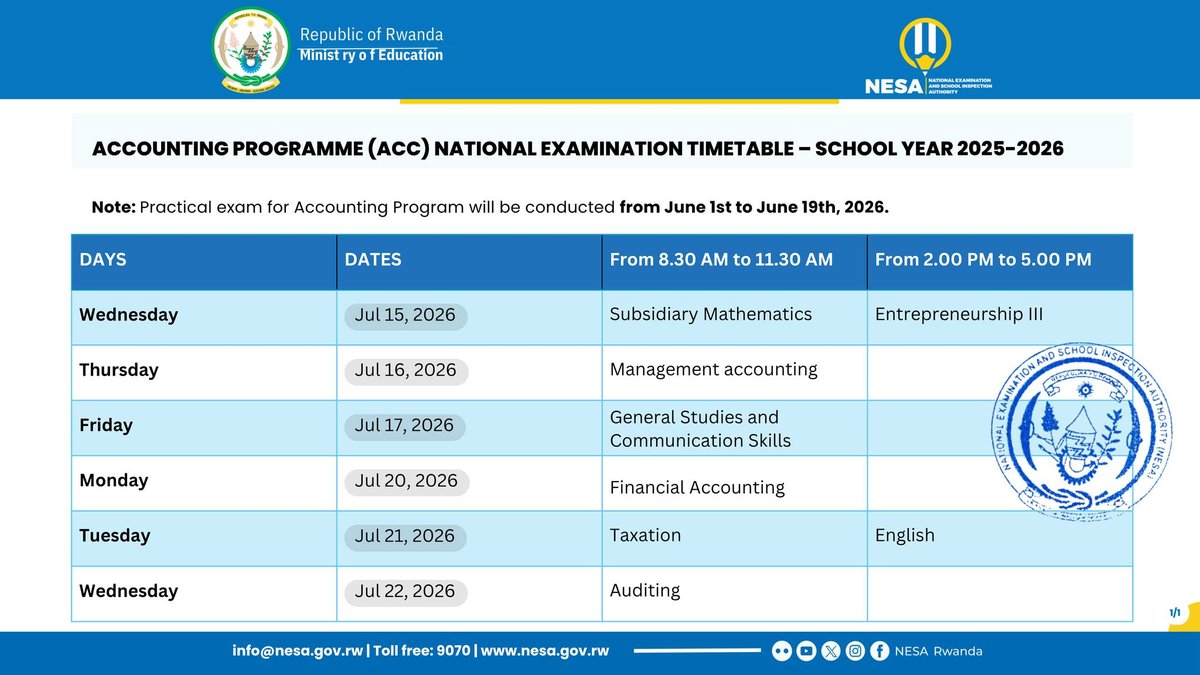
ACCOUNTING PROGRAMME TIMETABLE
ADVANCED LEVEL GENERAL EDUCATION NATIONAL EXAM TIMETABLE 2025-2026
A Realistic 3-Month Study Plan: April to July
Before revising anything, sit a past paper from each of your principal subjects under timed conditions. Not to pass to find out exactly where you are. Mark it yourself using the NESA marking scheme. The topics where you dropped the most marks become your Stage 2 priority list.
Two to three hours on weekdays, a bit more on weekends. Focus on understanding in Science and Mathematics, not just remembering formulas. Organise your notes by topic, not by date you want to flip straight to Organic Chemistry or Trigonometry without hunting through months of class notes.
If you have PBA practicals, treat them seriously. Those marks are final once submitted.
Stage 2: Intensive Practice (Mid-May-Late June)
This is the bulk of the work. School revision sessions are running, Term III is winding down. Move past your class notes and work directly with past NESA papers.
Students who study past papers consistently tend to outperform those who only review notes not because questions repeat identically, but because they learn to read exam questions precisely, manage time, and structure answers the way NESA markers are trained to reward.
Three to four hours daily. Complete at least one full timed past paper per subject before your exams begin. After each paper, go through the marking scheme item by item not just your score, but exactly why marks were awarded or withheld. Put your weakest subjects early in the week when you are fresher.
Stage 3: Refinement and Confidence (Late June-Exam Week)
By late June, everything you need to know should already be in your revision notes. If you are still encountering entirely new topics in July, that is a problem to fix now.
Full past paper simulations under real conditions phone away, same exam timing, pen on paper. In the final two weeks, shift to focused 90-minute sessions rather than long exhausting ones. The night before each paper: light review only, pack your materials, sleep at least seven to eight hours. Sleep is not optional you have to.
Subject-Specific Advice for Common S6 Combinations
A'Level - S6 Combinations
Mathematics (PCM / MCB / MEG / MCE / MPG / MPC)
Go through past papers topic by topic; Algebra, Calculus, Statistics, Mechanics and identify what shows up repeatedly. NESA's Mathematics papers follow recognizable patterns. Never skip showing your working. Method marks exist for a reason.
Physics and Chemistry (PCM / PCB / MCB)
Conceptual understanding matters more than memorising formulas, most of which are given or derivable. Focus on applying concepts to unfamiliar contexts that is where most marks are decided. For Chemistry, nail your organic reaction pathways and be precise with conditions and reagents.
Biology (PCB / MCB)
Cell Biology, Genetics, Ecology, and Physiology carry the heaviest marks. Practice writing structured "explain" and "describe" answers with the right biological terminology. Vague answers lose marks even when the underlying understanding is there.
Economics and Geography (MEG / MCE / HGL)
Answer what the question asks, not what you wish it had asked. Practice planning your answer before writing it. In Economics, every claim needs a named example unsupported assertions do not score.
English (all combinations) Practice essay structure, formal register, and arguing a position clearly. NESA markers reward organised argument and correct grammar over length.
Literature in English (LFK / HLP / HGL)
Know your set texts in detail. Locate a theme, character, or technique and discuss it with quotation and analysis. Do not summarise plot analyse meaning.
O'Level
Mathematics and Sciences
Do not just memorise formulas ,NESA markers want to see you apply them. In Biology and Chemistry, diagrams and standard experiments carry significant marks. Practice writing clear, step-by-step methodologies.
Geography and History These papers test higher-order thinking. Practice explaining the how and why behind geographical formations and historical events, not just listing facts.
Languages (English and Ikinyarwanda)
Prioritise clear letter writing, structured essays, and extracting exactly what comprehension passages ask. Many students lose marks not because they misunderstood the text, but because they answered a slightly different question.
Subject-Specific Advice for Primary Leaving Examinations (PLE)
Mathematics
Accuracy matters more than speed. Most marks are lost to arithmetic errors, not gaps in understanding. Work through operations step-by-step and double-check before moving on.
Science and Elementary Technology
Connect what you have learned to everyday life. Diagrams of the human body, plants, and basic tools come up frequently. review them carefully.
Languages and Social Studies
Practice short, clear sentence construction. For Social Studies, flashcards work well, this material rewards active recall over passive re-reading.
Subject-Specific Advice for Technical Secondary Schools (TSS)
Practical Examinations
Use workshop time as direct exam preparation. Know your safety protocols cold, examiners deduct marks for unsafe practice regardless of how good the final product looks.
Trade Theory and Applied Mathematics
Theory papers test why you do what you do in the workshop. When revising, always connect theory back to practical application.
Entrepreneurship
You should be able to draft a basic business plan, explain a market analysis, and calculate profit margins and project costs with confidence.
Why These Last Three Months Are Important?
The last quarter before national exams is where the gap between students widens most sharply. This is not because some students are more intelligent it is because some students organize their time better, seek support earlier, and work with the exam structure rather than against it.
A private tutor during this period is not a luxury for struggling students. It is a strategic advantage for any student who wants to consolidate difficult topics, practie exam technique, and have someone hold them accountable to their revision plan. One or two targeted sessions per week in a subject you find difficult can make a measurable difference to your final grade.
At Mathrone Academy, we specialize in exactly this pairing students with vetted, qualified tutors who know the NESA curriculum and what the marking schemes reward. Sessions are available online via video call or at home anywhere in Rwanda, and we match you with a tutor within 24 hours.
A Final Word to Every Student or Parent Reading This
Three months is exactly enough time if you use it with intention. Rwanda's best university students are not always the ones who were top of the class in S4. They are the ones who approached S6 with a plan, sought support when they needed it, and showed up consistently over these final weeks. and for S6 and P6 students your path will depend on how you will excel these exams.
You have already done two years of this.
If you need a perfect tutor Sign up in our platform we match you with in 24 hours OR WHATSAPP US ON +250786684285