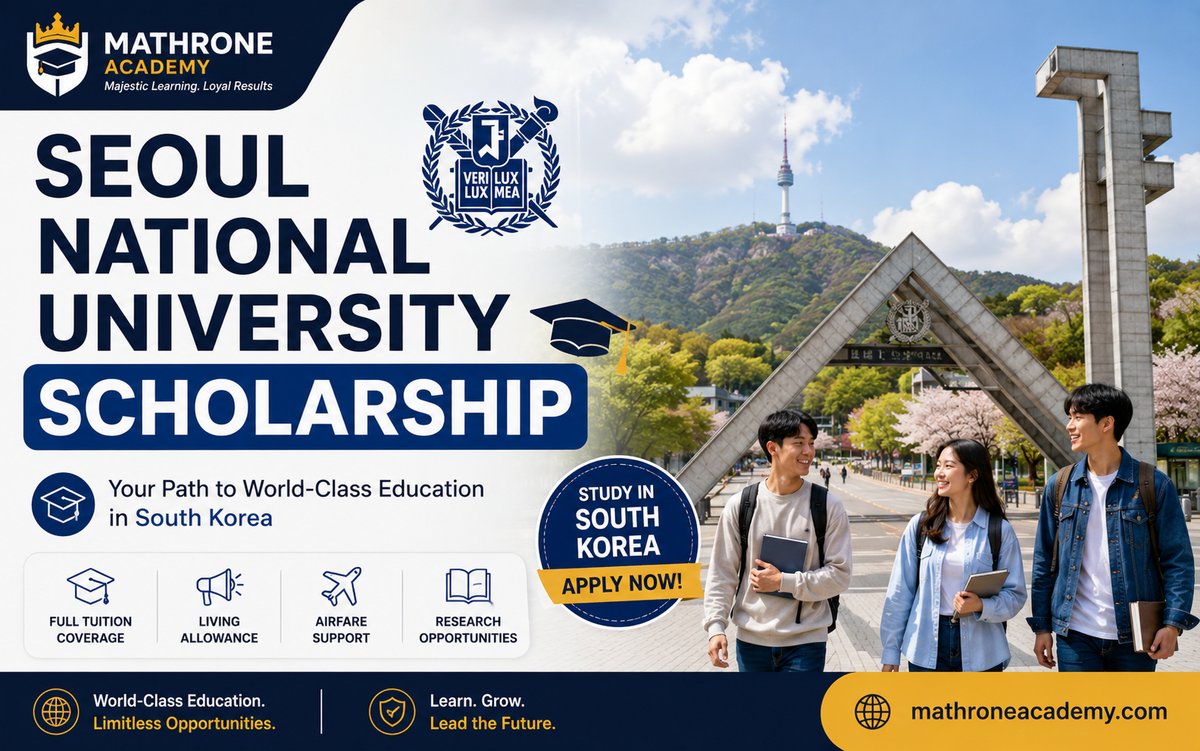
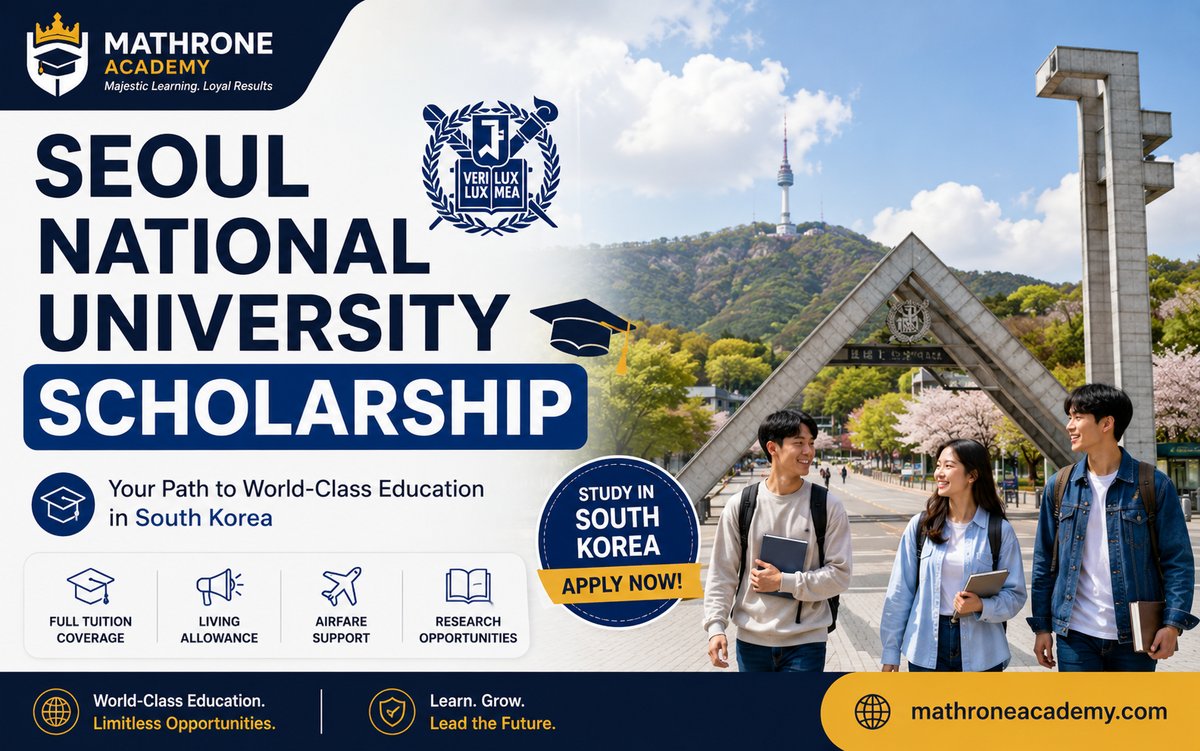
Seoul National University is South Korea's highest-ranked university, QS World Rankings 2024 placed it 31st globally and it runs several scholarship programs that cover full tuition and living costs for international graduate students, including students from Africa. The programs recur every semester. This guide covers all four main options, what each pays, who qualifies, and exactly how to apply.
The Four Scholarship Programs
SNU does not run a single umbrella scholarship. There are four separate schemes, each with different funding sources, eligibility rules, and application routes. Knowing which one fits your situation before you start saves a lot of wasted effort.
1. Korean Government Scholarship Program (KGSP / GKS)
This is the most comprehensive funding package available. It is run by the Korean government through the National Institute for International Education (NIIED), not by SNU directly. Applications go through either the Korean embassy in your country or through SNU's nomination channel, depending on which track your country is assigned to.
What it covers for graduate students:
There is one firm condition: Korean language training is mandatory in the first year. You must achieve TOPIK (Test of Proficiency in Korean) Grade 3 by the end of the language year to progress into the degree program. Students who do not reach Grade 3 lose their scholarship.
2. Graduate Scholarship for Excellent Foreign Students (GSFS)
This is SNU's own institutional scholarship, separate from the government program. It covers full tuition for 4 semesters (Master's) or up to 6 semesters (PhD), plus a monthly living expense allowance. The allowance amount varies by graduate school and major — the minimum is 500,000 KRW per month, but many departments pay more.
Roughly 20 students are selected per intake across the whole university. Competition is high. The list of eligible countries and participating colleges changes every semester, so you need to check the current semester's guide at oga.snu.ac.kr before applying. You apply for GSFS at the same time as your SNU admission application there is no separate window.
3. SNU President Fellowship Program (SPF)
The SPF is specifically for faculty members of universities in developing countries — Asia, Africa, and South America — who are pursuing a PhD and plan to return to teaching afterward. It is the most generous funding package SNU offers directly.
If you are a lecturer or assistant professor at a Rwandan or African university and do not yet have a PhD, this program is worth serious attention. Priority goes to faculty from major universities in developing countries, which matches Rwanda's academic institutions. You apply for SPF simultaneously with your SNU admission application, tick the scholarship application box during online registration.
4. SNU Global Scholarship (GS)
This scheme is for students already enrolled in a graduate program at SNU who want support for an upcoming semester. It is not for new applicants. There are two tiers: GS1 (full tuition plus a monthly stipend) and GS2 (full tuition only, no stipend). Awards last one semester. If you are already studying at SNU and your funding runs out mid-program, this is the route to apply.
Eligibility: What You Actually Need
The core requirements apply across most programs:
- You must not be a Korean citizen.
- You and both of your parents must not be residing in South Korea at the time of application (this rule applies to KGSP and most SNU programs).
- For Master's programs: a completed bachelor's degree before the program starts.
- For PhD programs: a completed master's degree before the program starts.
- Strong academic record — most successful applicants have a GPA of 3.5/4.0 or equivalent.
- Good physical and mental health, confirmed by a medical certificate.
For the SPF specifically: you must be employed as a faculty member at a major university in a developing country and not yet hold a doctoral degree.
English-taught programs do not require Korean language proficiency at the point of application. However, for KGSP recipients, Korean language training in the first year is non-negotiable regardless of the language of your degree program.
Documents Required
Prepare these before the application window opens — the window is 3 to 4 days long, and uploading incomplete documents during that window is the most common reason applications fail:
- Completed SNU online application form
- Personal statement and study plan (usually 2 to 3 pages)
- Two recommendation letters from academic supervisors or professors
- Official transcripts from all universities attended
- Degree certificates (bachelor's and master's where applicable)
- Valid passport copy
- Medical certificate from a licensed hospital
- Language proficiency certificate (TOPIK for Korean programs, IELTS/TOEFL for English programs, if required by your department)
- Portfolio of creative work for applicants to architecture, design, music, or fine arts programs
After completing the online application, you also need to courier the physical documents to SNU's Office of Global Affairs. Check the specific semester guide for the mailing address and deadline — it is usually the same week as the online window.
How to Apply: Step by Step
Step 1: Decide on your route. If you are applying for KGSP, contact the Korean embassy in your country first to confirm whether your country is assigned to the embassy track or the university track. Rwanda applicants should check with the Korean Embassy in Kigali.
Step 2: For GSFS or SPF, visit oga.snu.ac.kr/scholarship-finder and download the current semester's scholarship guide. Confirm that your country and intended college/department appear on the eligible list — this changes every semester.
Step 3: Create an account on SNU's admission portal at admission.snu.ac.kr and select your degree program. During the online form, tick the "Application for Scholarship" box to be considered for GSFS or SPF — this is not automatic.
Step 4: Upload all required documents within the application window. For Spring intake, this window opens in early July and closes 3 to 4 days later. For Fall intake, the window is typically in late March or early April.
Step 5: Courier physical documents to SNU's Office of Global Affairs before the stated postal deadline.
Step 6: SPF applicants who pass the initial screening are invited to an interview. GSFS selection is based on the admission documents alone.
Step 7: Admission results and scholarship decisions come out roughly 6 to 8 weeks after the application window closes.
Application Deadline: How the Cycle Works
SNU runs two admission cycles per year. The Spring intake application window opens in early July for entry the following March. The Fall intake window opens in late March for entry in September. The window is always short — typically 3 to 4 days — so preparation matters more than speed.
For the Spring 2027 intake, the online application window runs 6 July to 9 July 2026. If you are reading this in June 2026, that deadline is days away. Start preparing documents immediately.
For anyone reading this outside that window, the next Fall cycle opens approximately late March 2027. Check SNU's official scholarships page for the exact dates each semester.
Other Fully Funded Options Worth Applying Alongside SNU
Given how competitive SNU scholarships are, most serious applicants apply to several programs simultaneously. Some strong options that are well-matched to the same academic profile:
- Chinese Government Scholarship (CSC) 2027 — covers Master's and PhD across 300+ Chinese universities, fully funded, open to Rwandan students.
- MEXT Japanese Government Scholarship 2026-2027 — Japan's equivalent of KGSP, covering tuition and a monthly stipend at Japanese national universities.
- Germany Fully Funded PhD Scholarships 2027 — multiple routes into German universities, many with no tuition fees and strong research funding.
- DAAD-MIDE Scholarship 2026 (Germany) — ideal for applied sciences and engineering Master's programs at HTW Berlin.
If you need help with your application essays, study plan, or building a shortlist of programs that match your academic background, connect with a Mathrone tutor who specialises in university application support.
Frequently Asked Questions
Can Rwandan students apply for SNU scholarships?
Yes. Rwanda is classified as a developing country for the purposes of KGSP, SPF, and most GSFS eligibility criteria. For GSFS specifically, eligible countries change each semester, so confirm Rwanda appears in the current semester's guide before applying. Contact the Korean Embassy in Kigali to confirm Rwanda's track assignment for KGSP.
Do I need to speak Korean to apply?
Not at the point of application. SNU offers many graduate programs in English, and English language certificates are accepted for those programs. However, if you receive the KGSP award, you are required to complete one year of Korean language training and reach TOPIK Grade 3 before entering your degree program. Students who do not pass TOPIK Grade 3 within that year lose the scholarship.
Is the SNU scholarship open for undergraduate students?
Yes, but the landscape is different. At undergraduate level, KGSP is the main funded option and is the most competitive. The SPF and GSFS are graduate-only programs. If you are an S6 student or recent school leaver targeting South Korea at bachelor's level, KGSP through the Korean Embassy is your primary route.
How many students are selected for GSFS each intake?
Approximately 20 students across the entire university. Given that SNU admits hundreds of international graduate students each semester, the acceptance rate for GSFS is very low. Applying simultaneously for KGSP through the embassy significantly increases your overall chances of receiving funded admission.
What GPA do I need for SNU scholarships?
SNU does not publish a hard minimum GPA for scholarships. In practice, most successful GSFS and SPF recipients have a GPA of 3.5 out of 4.0 or its equivalent. For KGSP, the NIIED evaluates applications using a points system that includes academic records, essays, and the recommendation letters together rather than GPA alone.
Can I apply for multiple SNU scholarship programs at the same time?
You can apply for GSFS and SPF simultaneously with your admission application by ticking the scholarship box during online registration. You cannot receive both at the same time if you qualify for more than one, SNU assigns the higher-value award. You can also apply for KGSP through the embassy as a completely separate application running in parallel.
When are SNU scholarship results announced?
For GSFS and SPF, decisions come through the SNU admission results, usually 6 to 8 weeks after the application window closes. For the Spring 2027 intake, that means results in September or October 2026. KGSP results run on the embassy's own timeline, which varies by country but is typically April to June for a September entry or October to December for a March entry.
Does SNU offer scholarships for students already enrolled?
Yes. The SNU Global Scholarship (GS) is open to currently enrolled international graduate students who need support for an upcoming semester. The application deadline for each semester is December for Spring and June for Fall. Awards last one semester and can be renewed, though renewal is not guaranteed.