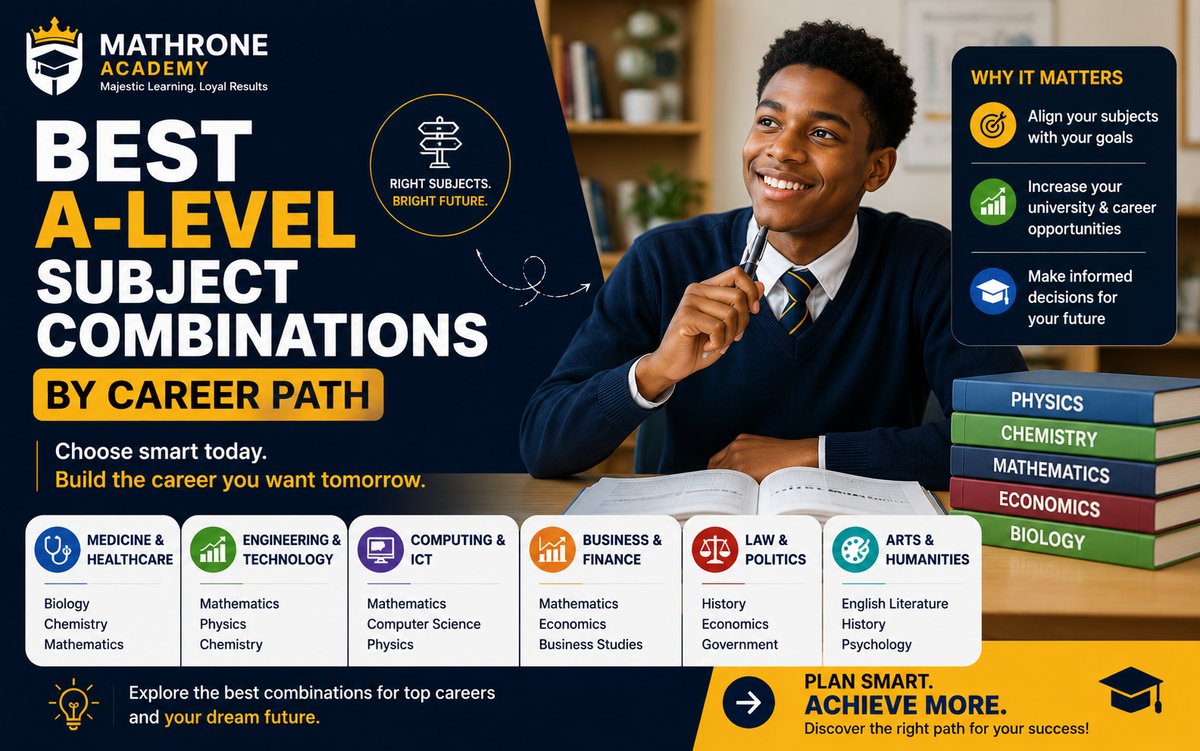
Choosing A-Level subjects at 16 is one of the earliest decisions that genuinely shapes a student's future options, and it's also one of the easiest to get subtly wrong. A student can achieve excellent grades and still find a specific university course closed to them simply because they picked the wrong combination two years earlier. This guide works backward from real career paths and matches them against the actual subject requirements published by leading universities, rather than offering vague general advice.
The Core Principle: Facilitating Subjects
Before looking at specific careers, it's worth understanding a concept that shapes almost every serious piece of university guidance on this topic: facilitating subjects. These are traditional, academically rigorous A-Levels that keep the widest range of degree courses open, because competitive universities consistently value them regardless of which specific course a student eventually applies for. They include Mathematics, Further Mathematics, Physics, Chemistry, Biology, English Literature, History, Geography, and Modern or Classical Languages.
Cambridge's own admissions guidance is explicit that vocational subjects, things like Business Studies, Media Studies, Travel and Tourism, and Photography, are "less useful" preparation for its courses, even though such subjects can be genuinely valuable for other pathways. The practical takeaway for a Year 10 or 11 student who hasn't fully settled on a career yet: choosing at least two facilitating subjects keeps real optionality alive, rather than narrowing your choices before you've had the chance to explore them properly.
Medicine and Veterinary Medicine
Recommended combination: Chemistry, Biology, and Mathematics or Physics
Chemistry is the single most consistently required A-Level for Medicine, essential at the overwhelming majority of medical schools worldwide, with Biology a close second. The University of Cambridge's Medicine course specifically requires Chemistry A-Level, plus two further subjects chosen from Biology, Physics, Mathematics, and Further Mathematics. Most competitive UK medical schools set a standard offer of AAA, with several, including Cambridge, Oxford, Imperial, and UCL, now asking for A*AA.
A smaller number of universities will accept Biology without Chemistry, but choosing that route meaningfully narrows the list of medical schools you can realistically apply to, so it's worth confirming your target universities' exact requirements well before committing to A-Level choices. One practical trap to avoid: most medical schools won't credit two overlapping subjects, such as Biology and Human Biology, or Mathematics and Further Mathematics, taken together, so pick genuinely distinct subjects for your third and fourth choices rather than doubling up on similar content.
Engineering (All Disciplines)
Recommended combination: Mathematics, Further Mathematics, and Physics
This is one of the most rigid subject requirements of any career path on this list. Mathematics and Physics are essential at essentially every Engineering department worldwide, and Cambridge explicitly expects Engineering applicants to take Mathematics, Further Mathematics, and Physics together where all three are available. If a student's school doesn't offer Further Mathematics as a full A-Level, Cambridge will accept Mathematics, Physics, an AS-Level in Further Mathematics, plus a fourth A-Level in Chemistry, Biology, or Electronics as an alternative pathway.
Cambridge's typical offer for Engineering sits at A*A*A, and data from recent admissions cycles shows the large majority of successful applicants actually achieved at least A*A*A* across their subjects, well above the headline minimum. This makes Engineering one of the least flexible pathways on this list: students who know early that they want to pursue it should prioritize securing a place in Further Mathematics classes as soon as their school allows it.
Computer Science
Recommended combination: Mathematics, Further Mathematics, and Physics or Computer Science
Mathematics is non-negotiable for Computer Science at nearly every competitive university, and Cambridge specifically states that Further Mathematics is "essential" for its Computer Science course, not simply useful. A-Level Computer Science itself is a reasonable and increasingly common third or fourth subject, though it's often treated as less critical than the underlying mathematical foundation, since most Computer Science degrees teach programming from the ground up regardless of prior coding experience.
Economics, Business, and Finance
Recommended combination: Mathematics, plus two subjects from Economics, Further Mathematics, or a facilitating subject
The one consistent, hard requirement across almost every strong Economics programme, including Cambridge's, is Mathematics A-Level. Economics A-Level itself is genuinely useful but frequently not compulsory, since many leading Economics departments teach the subject from first principles at university and place more weight on strong quantitative ability than prior Economics knowledge. Further Mathematics is described by Cambridge as "very useful" for Economics applicants specifically, alongside Engineering and the Chemical Sciences.
Business and Finance pathways more broadly are considerably more flexible than Economics itself. Universities generally accept a wide range of academic backgrounds for Business degrees, and a student with strong essay-based subjects like English Literature or History can often transition into Business studies just as smoothly as one with a heavily quantitative profile, since these programmes value written and analytical reasoning alongside numerical skill.
Law
Recommended combination: Any two facilitating subjects, ideally including one essay-based subject
Law is genuinely one of the most flexible pathways on this list. Cambridge's Law faculty does not require A-Level Law itself, and in fact having studied Law at A-Level provides no particular advantage in the application, since the university teaches the subject entirely from scratch. What Cambridge does recommend is at least one strong essay-based subject, such as History, English Literature, or a Modern Language, since Law admissions place heavy weight on a student's ability to construct and defend a written argument.
This flexibility is genuinely good news for students who are drawn to Law but unsure at 16 whether they want a STEM-heavy or humanities-heavy profile: a combination like History, English Literature, and Economics, or History, a Language, and Mathematics, both keep a Law application fully competitive.
Natural Sciences (Biology, Chemistry, Physics Specialisation)
Recommended combination: Two or three of Mathematics, Physics, Chemistry, and Biology
Cambridge's Natural Sciences course covers Physics, Biology, and Chemistry within a single flexible degree, and its entry requirements shift depending on which area a student intends to specialize in. Further Mathematics is specifically flagged as "very useful" for students planning to specialize in Physics within Natural Sciences, while a strong Chemistry and Biology combination suits those leaning toward the biological sciences. Because the course allows genuine specialization after enrollment, students who are torn between two or three science subjects but not yet certain which one they'll pursue most deeply are particularly well served by this pathway, more so than by a narrower, single-subject science degree.
English, History, and the Humanities
Recommended combination: The specific subject itself, plus complementary essay-based subjects
Humanities degrees tend to have the most literal subject requirements on this list: Cambridge's English course requires English Literature or combined English Language and Literature A-Level, and its History course requires History A-Level itself. Beyond that core requirement, universities generally look for a broader profile of strong essay-based subjects rather than a specific rigid combination, valuing depth of reading and independent critical thinking demonstrated through subjects like Philosophy, Classical Civilisation, a Modern Language, or a second Humanities subject.
Psychology and Behavioural Sciences
Recommended combination: At least one of Mathematics, Biology, Chemistry, Physics, or Computer Science
Psychology sits in an interesting middle ground between sciences and humanities, and Cambridge's own guidance reflects that: Psychological and Behavioural Sciences applicants must take at least one subject from Mathematics, Biology, Chemistry, Computer Science, or Physics, following the same general STEM guidance the university gives for its science courses more broadly, even though Psychology itself blends scientific method with social and behavioural study.
A Practical Note for Students Still Deciding
If you're choosing A-Levels at 14 or 15 and haven't settled on a specific career yet, the safest strategy backed by Cambridge's own guidance is to select at least two facilitating subjects and pair them with a subject you're genuinely strong in, rather than guessing at a career this early and locking in an unusually narrow, vocational combination. Most competitive universities expect three A-Levels, occasionally four for strong STEM applicants who add Further Mathematics, and taking four subjects generally doesn't provide an advantage on its own unless the fourth subject is Further Mathematics specifically for a STEM pathway.
It's also worth remembering that individual colleges within the same university can set slightly different requirements from the university's general guidance, particularly at Oxford and Cambridge, so always verify the exact subject expectations for your specific shortlisted universities and colleges directly, rather than relying on general subject-combination advice alone, including this article.
If you're earlier in the Cambridge pathway and still deciding on IGCSE subjects before A-Level even becomes a live decision, our guide on what Cambridge IGCSE actually is covers how Core versus Extended tier choices at IGCSE directly affect which A-Level subjects stay open two years later. And if your child is choosing between an IGCSE Cambridge pathway school in the first place, our comparison of the best Cambridge schools in Kenya and our guide to Cambridge Primary schools in Rwanda are useful starting points for families still choosing a school.
Getting the Right Support at A-Level
Choosing the right combination is only the first step; performing strongly within it, particularly in Mathematics, Further Mathematics, and the Sciences, is what actually determines whether a student meets the offer their chosen university sets. These subjects build cumulatively, so a gap that opens in Year 12 tends to widen rather than close on its own by Year 13. Mathrone Academy provides one-on-one Cambridge A-Level tutoring across Mathematics, Further Mathematics, the Sciences, and other core subjects, for students anywhere in the world, matched to your specific subject combination and target university requirements. For Rwanda-based families, our tutors also support the REB national curriculum alongside Cambridge A-Levels.
Get matched with a tutor:
WhatsApp: +250 786 684 285
Email: [email protected]