Among the decisions that spark debate in choice in child’s education, to choose between boarding and day schools are one of them. ‘CAN I SEND THEM TO BOARDING SCHOOL’ or HAVE THEM HOME EVERY EVENING? The answer is not as simple as either camp would have you believe. Boarding schools are not automatically better for academic performance and also day schools are not automatically better for wellbeing meaning that the right answer depends on your child’s personality, your family’s circumstances, your financial reality, and what kind of person you are trying to help your child become.
This guide cuts through the noise. It draws on the latest research, including a 2025 multilevel study that is the most comprehensive comparison of boarding and day school outcomes published to date, and gives you an honest, specific framework for making this decision well.
What Is the Actual Difference?
In Boarding school, Students live on campus for most or all of the academic year in dormitories, with 24/7 access to classrooms, facilities, faculty mentors, and peers and learning, sports, social life, and personal development all happen in one integrated environment while IN Day school, Students attend classes during set school hours and return home each afternoon and family life remains central where academic and extracurricular activities happen during school hours, with evenings and weekends at home.
Both models exist across a wide spectrum from heavily academic and selective institutions to more relaxed community-focused schools, the model alone does not determine quality and specific school, its teachers, its culture, and its fit with your child are what actually matter.
What the Research Actually Says About Academic Performance
Here is the finding that surprises most parents.
A large-scale multilevel study found that boarding and day students educated in the same classroom showed comparable motivation, engagement, and achievement suggesting that academic outcomes may depend more on student and teaching quality than simply the residential model. In other words, boarding school does not automatically produce better academic results than day school. When the quality of teaching is held constant, the two models perform similarly.
What boarding schools do offer academically is a specific kind of environment: rigorous course offerings including advanced programmes like AP, IB, and specialised electives; a peer-driven academic culture where a student body motivated toward excellence helps create an atmosphere of effort, curiosity, and accountability; and strong college matriculation outcomes, with boarding school graduates historically proceeding to highly selective universities at higher rates. But these advantages belong to selective, well-resourced boarding schools not to all boarding schools by virtue of the model. A boarding school with poor teaching, overcrowded dormitories, and weak pastoral care will not outperform a well-run day school with excellent teachers and engaged parents.
Rather than assuming boarding automatically means better academics, families should evaluate specific school programmes, support services, faculty, student-to-teacher ratio, and fit with the child's learning style.
The Boarding School Advantage
1. Independence and Life Skills
The research practitioner consensus are consistent that student develop life skills from managing their own schedule to handling responsibilities without daily parental direction, boarding students quickly develop life skills self-management, decision-making, and interpersonal responsibility in real-life scenarios rather than theoretical ones. A child who manages their own laundry, homework schedule, conflict with a roommate, and preparation for an exam all in the same week,develops executive functioning and resilience at a pace that is genuinely hard to replicate at home.
This is particularly valuable for children heading toward competitive universities or professional environments where self-direction matters enormously. The boarding school environment accelerates this development not because it teaches it explicitly, but because it requires it daily.
2. Peer Relationships and Social Depth
Boarding schools foster deep peer bonds through daily shared experiences dorm traditions, shared meals, weekend activities, late-night conversations and these relationships are qualitatively different from friendships formed during school hours. Many boarding school alumni describe their school friendships as the deepest of their lives, relationships built through years of shared living rather than shared classroom time.
For children who struggle socially, this immersive environment can be either transformative or overwhelming which is why personality fit matters enormously meaning that an introverted child who values solitude and family closeness may find constant social proximity exhausting while an extroverted, independent child may thrive in it.
3. Structured Environment and 24/7 Resources
At boarding schools, learning does not stop when classes end. Students engage in supervised study hours, collaborative projects, and discussions with peers and faculty throughout the evening. Whether it is late-night studying, extra rehearsals, or impromptu help from a teacher, students do not have to leave campus to get what they need.
For academically driven students particularly those preparing for competitive examinations this 24/7 access to resources, study support, and academic mentoring is a genuine advantage over what most day school students can access at home.
4. Holistic Development
Boarding schools prioritise all-round development beyond academics, extracurricular activities, leadership skills, and personal growth. With 24/7 access to resources like libraries, sports facilities, and mentors, students thrive in an environment designed to nurture their full potential.
The integration of academics, sports, arts, leadership opportunities, and personal development into one continuous environment means a boarding student is rarely idle. Free time is structured into meaningful activity rather than unstructured hours at home.
The Day School Advantage
1. Family Connection and Emotional Security
The most consistent finding in child development research is that secure attachment to parents and family is one of the most powerful predictors of long-term emotional wellbeing and resilience. Day school keeps this attachment central throughout the school years.
Children who return home each evening have daily opportunities to process their experiences with parents, share their challenges, and maintain the relational security that supports learning. This matters especially during difficult periods exam stress, friendship conflicts, adolescent identity formation when parental presence is irreplaceable.
Day schools emphasise family-centred social life and community engagement keeping children embedded in their local community, cultural context, and family relationships throughout their development.
2. Cost
The financial difference between boarding and day school is significant in every school system globally and in Rwanda, it is substantial.
Phillips Academy in the US offers day tuition at approximately $57,190 versus boarding at $73,780 per year a gap of nearly $17,000 annually at a single school. In Rwanda, the difference between day and boarding fees at the same school can represent RWF 2,000,000–6,000,000 per year at secondary level. Over six years of secondary school, that gap becomes financially transformative.
For families where that difference represents a genuine sacrifice or where the boarding premium could alternatively fund private tutoring, enrichment activities, or university preparation — the financial case for day school is compelling.
3. Flexibility and Parental Involvement
Day school gives parents visibility into and influence over their child's academic experience in ways that boarding school does not. You can monitor homework completion, attend parent-teacher evenings, spot early signs of academic difficulty, and intervene promptly. At a boarding school, distance and structure can create reporting lags between a problem arising and a parent knowing about it.
Day school students benefit from a consistent home base particularly for children who thrive with a stable, familiar environment and close family relationships.
4. Individual Personality Fit
Not every child is developmentally ready to leave home during secondary school. Children who are younger, less emotionally independent, strongly family-oriented, or who have existing challenges around anxiety, learning differences, or social confidence may struggle significantly in a boarding environment regardless of how good the school is.
There is no universal "better" choice between boarding and day school only the right choice for your specific child, family, budget, and goals.
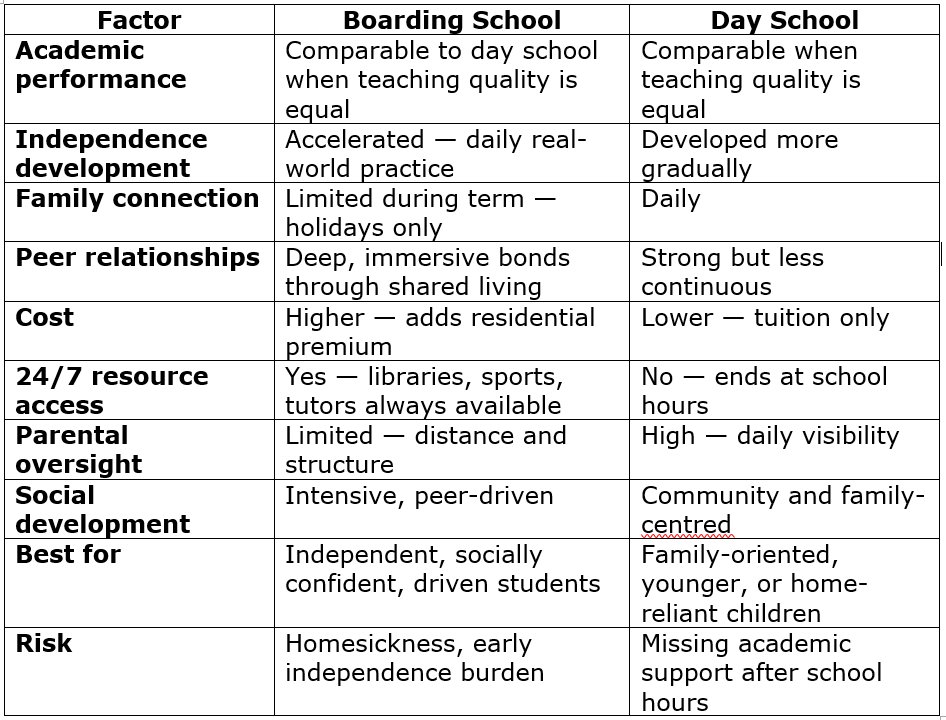
Head-to-Head Comparison
Five Questions to Ask Before Deciding
1. How emotionally independent is your child right now?
Not how independent you hope they will become how independent are they today? A child who calls home daily with anxiety about small decisions is not yet ready for boarding life. A child who navigates social challenges confidently and manages their own time well may thrive.
2. What does your child want?
This is more important than most parents admit. A child who genuinely wants to board who is excited about the independence and the community will adapt and flourish. A child who is sent to boarding school against their wishes may resent it for years.
3. What is the quality of the specific school not the model?
Visit both options. Meet the head teacher. Talk to current students and their parents. Ask about pastoral care, dormitory conditions, weekend activities, and how the school handles homesickness, bullying, and academic struggle. The model matters less than the execution.
4. What does your family's situation require?
Parents who travel extensively, work long hours, or live far from strong day schools may find that a well-run boarding school provides more consistent daily support for their child than they can at home. This is an honest consideration, not a failure of parenting.
5. What is the true total cost and what does that money alternatively buy?
Calculate the full annual boarding cost tuition, residential fees, uniforms, pocket money, transport home during holidays. Then ask: what would the difference between boarding and day school fees fund if redirected? Private tutoring, enrichment activities, university preparation courses? For some families, the day school option with strategic supplementary support produces stronger outcomes at lower cost.
Frequently Asked Questions
Q: Is boarding school better than day school for academic performance?
Research shows boarding and day students perform comparably when teaching quality is held constant. The residential model alone does not produce better grades. What boarding school does offer is 24/7 access to resources, peer academic culture, and structured study time which benefits self-motivated, academically driven students significantly. The quality of the specific school matters far more than the boarding model.
Q: At what age should a child go to boarding school?
Most child development experts suggest that children are generally more ready for boarding from age 13 or 14 onwards when emotional independence, self-regulation, and peer identity are more developed. Sending children under 12 to boarding school carries a higher risk of homesickness, emotional distress, and attachment disruption. However, individual readiness varies enormously some 12-year-olds are genuinely ready; some 15-year-olds are not.
Q: What are the disadvantages of boarding school?
The main disadvantages include: reduced family connection during term time, higher cost than day school, risk of homesickness and emotional difficulty for less independent children, limited parental visibility into daily life, and social challenges of constant peer proximity. For children who are not yet emotionally ready for independence, boarding school can be stressful rather than developmental.
Q: Are there boarding schools in Rwanda?
Yes. Rwanda has both government boarding secondary schools and private boarding options. Several top-performing national examination schools operate as boarding schools. Private schools including some international schools in Kigali offer boarding alongside day options. For a full list of boarding secondary schools in Rwanda, visit our guide to the best private schools in Kigali.
Q: How do I know if my child is ready for boarding school?
Signs your child may be ready include: genuine desire to board (not reluctant compliance), strong social confidence with peers, ability to manage their own time and routines, emotional resilience when separated from family, and a track record of handling challenges independently. Signs they may not be ready include: strong anxiety about separation, heavy reliance on parental support for daily decisions, history of social difficulty, or significant academic struggles that need close parental monitoring.
Read: Best Primary Schools in Rwanda and Kigali 2026 →
Read: Best Private Schools in Kigali 2026 →
Read: Why Your Child Hates Studying — and What Actually Fixes It →
Published by Mathrone Academy — connecting students worldwide with quality education resources and expert tutoring. Visit us at mathroneacademy.com