Your child sits in the room at the desk with open books and then after 15 minutes you work in and you find that they are staring at the ceiling, scrolling their phones or requesting for snacks or whatever for the third time or forth in hour. You have tried everything including rewards, threats, sitting next to them, giving them time, walking away but nothing actually is helping you providing a child who want to study.
What is the problem now? What are you or your child doing wrong? Here is something that might change how you see this entirely: your child is almost certainly not lazy, the resistance you are watching is not a character flaw but a well-researched psychological explanation and once you understand it, the fixes become obvious.

The Real Reason Children Resist Studying
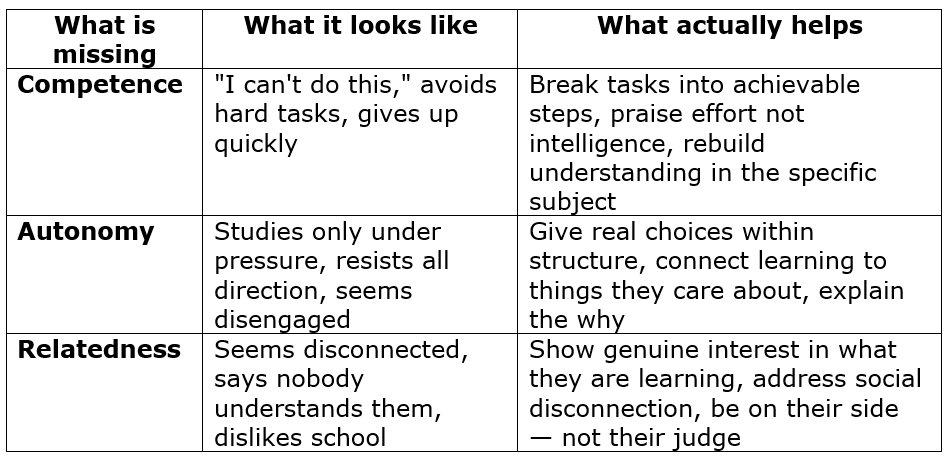
Over decades psychologists have studied academic motivation and the most influential framework they came up to as the result of that research and which has been tested across may countries with different cultures is Self Determination Theory (SDT). This theory was developed by Eduard Deci and Richard Ryan at University of Rochester in United states and their central finding is both simple and profound: human beings have three basic psychological needs which are competence, autonomy, and relatedness and when these needs are satisfied, self-motivation and mental health increases. When they are harmed, motivation diminishes and wellbeing declines. This means that in our context of studying, this means a child who resists their books is almost always missing at least one of these three things, not willpower, not discipline but a fundamental psychological need. Let us explore them one by one ,because the real and reliable solution depends entirely on which one is missing.
Need 1: Competence , “I Feel Like I Cannot Do This”
A sense that one can succeed and grow which is the feeling of mastery is what competence actually concerns. A well structured environment that is helpful for optimal challenges, positive feedback and opportunities for growth is where the need for competence is best satisfied. When your child avoids studying the most common cause is not laziness but a quiet, crushing, belief that they cannot do it and if a subject felt confusing and humiliating enough times to them, their brain begins to associate sitting down with that subject and start saying “ OH THIS IS A FAILURE). Thus the avoidance is not a character problem but the brain protecting itself from predicted bad experience.
This is put together by what Stanford psychologist Carol Dweck calls the fixed mindset. This is the belief that intelligence is a fixed quantity where you either have or do not have and the students who believed their intelligence could be developed a growth mindset outperformed those who believed their intelligence was fixed. Also children with a fixed mindset, when they encounter difficulty, tend to interpret it as evidence that they are simply not smart enough to handle it and they disengage.
Students with a fixed mindset believe that their intellectual ability is a limited quantity and tend to worry about proving their intelligence rather than improvements. When they face challenges and setbacks, this can lead to negative thoughts, feelings and behaviors like thinking “ I AM DUMB, I AM INCAPABLE” or simply give up. This means that the child who says “ I hate maths” never actually hate mathematics but they hate feeling of not understanding, feeling exposed and failing in front of others meaning the subject is not the problem but the problem is the experience of feeling incompetent in that subject
What actually fixes it:
Try breaking tasks into small units and chunks where success is achievable. The page full of quadratic equations is not worth being in front of a child who cant solve quadratic equations . they should be sitting solving steps that are required to solve them they are missing whether expanding brackets, factorizing, isolation variables, … until step is achieved and feels nothing remaining as a constraint. Success at a small step rebuild confidence and sense of competence that makes the next steps achievable. Also you have to change the language you use around mistakes. When your child gets something wrong, the response "what can we learn from this?" is more powerful than any other intervention because it signals that mistakes are information, not verdicts.
Need 2: Autonomy , “I Have No Say in Any of This”
Autonomy concerns a sense of initiative and ownership in one's actions which is supported by experiences of interest and value, and undermined by experiences of being externally controlled whether by rewards or punishments.This is the need that most parents inadvertently destroy. With the best of intentions, many parents create a study environment that is entirely controlled: study now, study this subject, sit at this desk, for this many hours, because I said so. By doing this , every element of autonomy is removed.
Students who are taught with a more controlling approach not only lose initiative but learn less effectively, especially when learning requires conceptual, creative processing. A student who studies because she finds biology fascinating will outperform a student who studies because her parents threatened to take away her phone even if both put in the same hours.
This is not trying to remove the structure so that student can study whenever they feel like it and whatever they feel like but there is a difference between structure and control. Structure creates a framework where a child still has agency where control removes the agency entirely .
What actually fixes it:
Giving your child real choices within study sessions by not forcing them things to do like “ do your homework or else” but something like “Do you want to start with Mathematics or English?” not “ Sit in that desk for 2 hours” “You need to finish these five exercises where and when you do them it’s up to you as long as it is before dinner”. These feel like small concessions. Psychologically, they are enormous and when students experience a sense of choice, they feel more ownership of activities and greater autonomy, resulting in enhanced intrinsic motivation.
You should talk to your child about why they are studying, not just what they are studying. A teenager who understands that Mathematics builds the thinking skills that will help them in whatever they want to do next is more motivated than a teenager who is studying Mathematics because the exam is in three months and that failing is not an option. You have to connect the subject to something they already care about.
Need 3: Relatedness . “Nobody Here Actually Cares About Me”
Relatedness also called connection describes the need to have a sense of belonging and connectedness with others where each one of us needs other people to some degree. In a school context, relatedness means feeling that the teacher knows you, that your peers respect you, and that there is at least one adult in the building who genuinely believes in your potential. In a home context, it means feeling that studying is a shared vision not a lonely punishment imposed by distant authority.
Research shows a positive correlation between social support from significant others, resilience, academic motivation, and academic achievement where a child who believes their parent is genuinely on their side not evaluating them, not disappointed in them, but rooting for them is more motivated to try in everything. Also children who feel disconnected from their teacher, from their peers, from their parents disengage from school not as a choice but as a consequence whereas school becomes a place that produces anxiety rather than belonging. Studying at home reproduces that same anxiety.
What actually fixes it:
You should how genuine curiosity about what your child is learning not about what grades they get , but about the content. “What did you do in Science today?” is a more connecting question than “did you finish your homework?” Ask them to explain something they learned. This improve the sense of relatedness and competence as they explains to you.
If your child is feeling disconnected from a teacher or struggling to fit in socially at school, that is worth addressing directly because no amount of study pressure will overcome a child's sense of not belonging in the learning environment.
The Praise Trap: Why Saying “You're So Smart” Backfires
Parents have instinct to praise a child’s intelligence. Saying this is going to surprise them that things like “ you're so clever”, “you're naturally good at this” which feels like like encouragement. The research shows it is one of the most reliably damaging things you can say. Because when students learn through a structured program that they could “grow their brains” and increase their intellectual abilities, they did better meaning having children focus on the process that leads to learning like hard work or trying new strategies fosters a growth mindset and its benefits.
When you praise intelligence, you inadvertently signal that intelligence is what matters , a fixed quantity to be preserved. And then the child becomes afraid of anything that might reveal they are less intelligent than the praise suggested and in this case they avoid hard problems, they do not ask questions in case it makes them look less smart, they also choose easier tasks to protect their reputation as ‘the clever one.”
When you praise effort, strategy, and process , “I noticed you kept going back to that problem even when it was hard,” “the way you organised your notes this week was really effective” here you signal that growth is what matters, and that the path to competence is through trying, not through being inherently gifted.
The difference in outcomes is not subtle. In schools that fostered climates celebrating academic success and curiosity, the likelihood of failure fell by 8 percent.
What Does Not Work , and Why Parents Keep Trying It Anyway
Threats and punishments: They produce short-term compliance and long-term resentment. A child who studies to avoid being punished is operating from fear whereas a motivational state that research consistently shows produces surface learning, anxiety, and disengagement the moment the threat is removed.
Rewards for grades: Paying your child for an A might seem logical but research says otherwise. External rewards for academic performance have been repeatedly shown to undermine intrinsic motivation, the child stops studying because they find it valuable and starts studying for the prize. This means that when the prize is removed, motivation collapses, controlled motivation by money, or grades in school, or a desire for social approval can actually taint a person's feelings about the basic worth of the project and undermine intrinsic motivation.
Sitting next to them and directing every step: This removes autonomy entirely and signals that you do not trust them to manage their own learning. This can produce short-term compliance but creates a child who cannot study independently,which is what every examination demands.
Comparing to siblings or classmates: “Your sister always finishes her homework on time” is one of the most reliably demotivating sentences a parent can say. Comparison activates shame, not motivation and shame produces avoidance, not effort.
What the Research Says Actually Works
Across all the studies from Self-Determination Theory to growth mindset research to the science of intrinsic motivation the evidence points consistently in the same direction. Children who are most academically motivated share these conditions:
They feel capable of improving ,because the adults in their lives have communicated, consistently and specifically, that effort produces growth.
They have some control over how they learn, even within a structured environment, they experience genuine choice.
They feel genuinely connected to at least one teacher, to their parent, to a study group, to something beyond the transaction of grades.
The learning feels connected to something they care about they can see, however dimly, a line between what they are studying today and something that matters to their future.
They are not afraid of being wrong because the environment at home and at school treats mistakes as information rather than as failure.
None of these conditions requires money,a perfect school but awareness, consistency, and a willingness to focus on the child's experience rather than just their output.
A Note on When the Problem Is Deeper Than Motivation
Sometimes a child's resistance to studying is not a motivation problem but a comprehension problem because a child who genuinely does not understand a subject will resist engaging with it, and no amount of motivational strategy will substitute for the missing understanding.
If your child consistently avoids a specific subject, ask not “how do I make them study?” but “do they actually understand this material?” Sit with them, ask them to explain a concept to you, and listen carefully. If the explanation is vague or circular, if they can repeat the definition but cannot apply it, they are missing the conceptual foundation that makes studying feel possible.
In that case, targeted support in the specific subject from a teacher, a peer, or a tutor is not a reward for bad behavior but a most direct and effective response to the actual problem.
At Mathrone Academy, we work with students at every level across Rwanda not to replace a child's motivation, but to rebuild the sense of competence that makes motivation possible again. A student who finally understands a concept they have been avoiding for months does not need to be told to study. They want to.
WhatsApp us on +250 786 684 285 to find the right tutor for your child within 24 hours.
Request a tutor at Mathrone Academy
Summary: The Three Fixes That Work
READ: How to Study Effectively: Proven Techniques you should know.
READ: The Best Learning Materials for Students in Rwanda.