In Rwanda, Thousands complete their senior 3 national every year examinations and face one of the most important academic decisions in their lives which is choosing what to study after that, whether continuing in general education at senior 4 or studying TVT( Technical and vocational Education and Training). For many families, this decision is made based on incomplete information, social pressure, or the assumption that general education is the very good choice to make which is increasingly outdated.
Rwanda's government has made TVET a strategic national priority and for good reason. This guide gives you the complete, honest picture of both pathways so that students and parents can make an informed decision based on actual strengths, goals, and opportunities.
What Is General Education?
General education is the academic pathway that runs from S1 through S6 and leads to the Advanced Level national examinations conducted by NESA. In the new system introduced for the 2025–2026 academic year, S4 students enter one of three streams: Stream 1 (Mathematics and Sciences), Stream 2 (Mathematics and Sciences 2 ), or the Languages stream.
At the end of S6, students sit for the national examinations and, depending on their results and chosen stream, qualify for higher education at the University of Rwanda, private universities, or universities abroad.
General education produces graduates who go on to study medicine, engineering, law, economics, education, journalism, technology, and a wide range of other degree programmes.
What Is TVET?
TVET Technical and Vocational Education and Training , is a competency-based pathway that equips students with specific, practical, hands-on skills directly aligned with Rwanda's labour market needs. It is overseen by the Rwanda TVET Board (RTB) and implemented through Rwanda Polytechnic (RP) and its five Integrated Polytechnic Regional Centres (IPRCs) located across all four provinces and in Kigali City.
Rwanda officially adopted the Competency-Based Training and Assessment (CBT/CBA) approach for TVET in 2017, meaning every TVET programme is designed around what a graduate must be able to do, not just what they should know.
The Government of Rwanda remains firmly committed to strengthening TVET as a strategic pillar for national development and economic transformation, according to Minister of State for Education Claudette Irere.
TVET operates on the Rwanda Qualifications Framework (RQF) from Level 1 to Level 5 for basic TVET education, and Level 6 and above at Rwanda Polytechnic colleges. Students entering after S3 typically begin at Level 3 and can progress up to Level 5 and beyond into diploma and degree programmes at Rwanda Polytechnic.
TVET Programmes Available in Rwanda
TVET in Rwanda covers a broad and growing range of technical fields. At Level 3 to Level 5, available trades include:
Technology and Engineering
- Automobile Technology
- Electrical Technology
- Electronics and Telecommunication
- Manufacturing Technology
- Building Construction
- Public Works
- Networking and Internet Technologies
Digital and Creative Industries
- Software Development
- ICT and Computer Studies
- Multimedia Production
- Digital Media (through the African Digital Media Academy — ADMA)
Business and Services
- Accounting and Finance
- Hospitality and Tourism
- Entrepreneurship and SME Development
Agriculture and Environment
- Agricultural Technology
- Environmental Management
Health and Community
- Community Health
- Nursing Assistance
Rwanda Polytechnic and accredited TVET schools across all districts offer a wide range of trades depending on location and local labour market needs. Rwanda has institutionalised the mandatory co-creation of training curricula between industry and academia, ensuring that programmes evolve with changes in the labour market.
To find the specific TVET schools and available trades in your district, visit www.rtb.gov.rw or contact your nearest Rwanda Polytechnic IPRC.
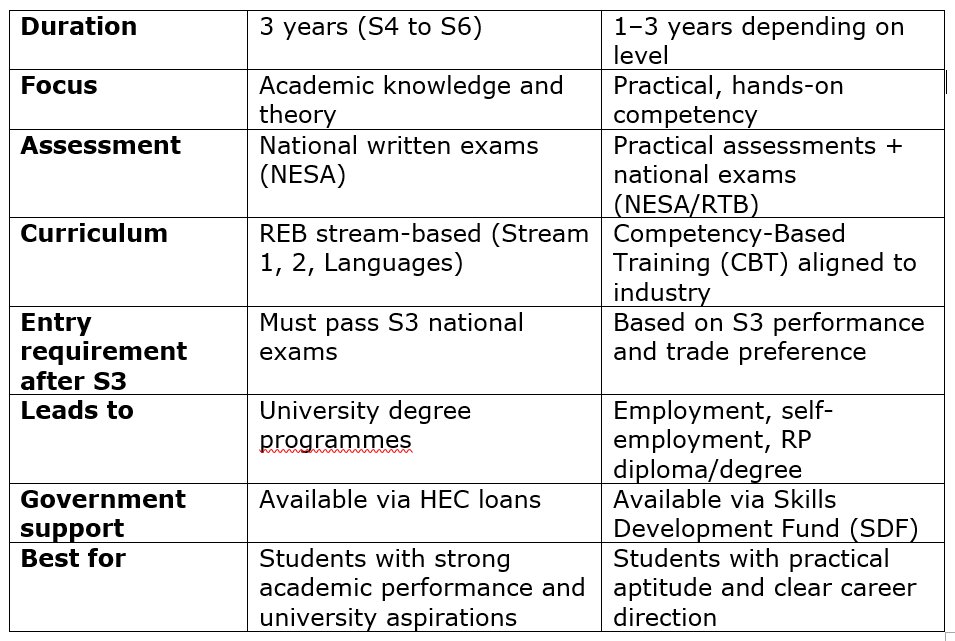
A Direct Comparison: General Education vs TVET
The Real Strengths of General Education
General education is the right choice for students who:
- Have strong academic performance across multiple subjects. The new stream system is designed for students who can engage rigorously with Mathematics, Sciences, Humanities, or Languages at an advanced level. If your S3 results show consistent strength in academic subjects, general education builds on that foundation effectively.
- Have a specific university programme in mind. Medicine, law, engineering, economics, computer science, education, and most degree-level programmes require S6 general education qualifications. If your child has a clear goal that requires a university degree, general education is the necessary path.
- Are aiming for competitive scholarships and government funding. The HEC Government Study Loan like the one currently open until 31st May 2026 and most international scholarships target students with advanced level academic qualifications. These routes are primarily accessible through general education.
- Thrive in structured academic environments. Some students learn best through reading, writing, analysis, and theoretical reasoning. For them, general education is genuinely the better match.
The Real Strengths of TVET
TVET is not a consolation prize for students who struggled at S3. For the right student, it is a smarter, faster, and more direct route to employment, entrepreneurship, and a meaningful career.
TVET leads directly to the labour market. Minister of State Irere highlighted that practical skills enhance employability while fuelling innovation, entrepreneurship, and self-reliance. "Practical skills are not just tools for employment they are the foundation for innovation, self-reliance, and entrepreneurship." TVET graduates with the right trade qualifications are employable immediately upon graduation without the additional four or more years required to complete a university degree.
- TVET supports self-employment and entrepreneurship. Rwanda's economy needs skilled tradespeople , electricians, software developers, construction technicians, mechanics, and digital media professionals ,who can create their own businesses. A TVET graduate named Joselyne Nisingizwe, who had no permanent job before attending a skills programme, is now the founder and CEO of Stand for Them and works as a software automation tester, having generated more than $17,000 to grow her projects. This is not an exceptional story it is becoming a common one.
- Rwanda is actively investing in TVET. Almost 30,000 students 38% of them female have been enabled to pursue long-term TVET and degree programmes in STEM fields through government-supported financing, as part of Rwanda's vision towards industrialisation. The government is putting real money and policy weight behind TVET because Rwanda's economy needs the graduates.
- TVET is now a pathway to higher education too. A common misconception is that choosing TVET closes the door to further academic study. It does not. Rwanda Polytechnic offers diploma and degree-level programmes (RQF Level 6 and above) that TVET graduates can progress into. The pathway is open it simply looks different from the traditional S6-to-university route.
- TVET can be faster and more affordable. A Level 3–5 TVET qualification can be completed in less time than a full S4–S6–university cycle, and the cost is often significantly lower. For families where affordability and speed to employment are real considerations, TVET is a practical advantage.
Who Should Choose General Education?
Choose general education (S4-S6) if your child:
- Performed well consistently in academic subjects at S3 ,especially in Mathematics, Sciences, English, or the humanities
- Has a clear university programme in mind that requires S6 qualifications
- Learns best through reading, writing, research, and academic analysis
- Is targeting scholarships, government loans, or competitive university programmes
- Has the discipline and stamina for three more years of academic study before entering the workforce
Who Should Choose TVET?
Choose TVET if your child:
- Has a genuine aptitude for practical, hands-on work, building, fixing, coding, designing, cooking, caring
- Has a clear career direction in a trade or technical field
- Performed below their potential at S3 but excels in practical settings
- Wants to enter the workforce or start a business within 1–3 years
- Is interested in fields like construction, electrical work, software, automotive, hospitality, or digital media
- Comes from a family where speed to income and lower educational cost are genuine priorities
The Biggest Mistake Families Make
The most common mistake Rwandan families make at this crossroads is choosing general education by default , simply because it is seen as more prestigious, even when the student's actual strengths, interests, and circumstances point clearly toward TVET.
A student who struggled through S1 to S3, has no clear university ambition, and has a genuine talent for working with his hands will almost always be better served by a strong TVET trade programme than by three more years of academic struggle followed by uncertain university prospects.
Rwanda's economy does not need more graduates who endured general education without thriving in it. It needs qualified electricians, software engineers, construction technicians, healthcare assistants, and digital media professionals. TVET produces those people.
Equally, the mistake runs the other way: a student with strong academic performance and a clear university goal should not be pushed into TVET simply because it is shorter or cheaper. The investment in general education and a degree pays off but it requires the right student in the right circumstances.
The honest question to ask is not "which path is better?" but "which path is right for this specific student?"
How to Make the Decision
Step 1: Look at S3 performance objectively. Strong, consistent academic results across multiple subjects point toward general education. Weak academic performance combined with practical aptitude points toward TVET.
Step 2: Have an honest conversation about career goals. What does your child actually want to do? If they cannot answer that question, it is worth taking time before enrolling in either pathway.
Step 3: Visit a TVET school before dismissing it. Many families have never visited a TVET school and base their perceptions on outdated stereotypes. Rwanda's TVET schools , particularly the IPRCs and accredited technical secondary schools are well-resourced, professionally run institutions. Visit before deciding.
Step 4 : Consider the full financial picture. General education followed by university is a 7+ year investment before employment. TVET can lead to employment in 1–3 years. For some families, that timeline matters enormously.
Step 5: Talk to a school counsellor and listen to the student. The student's own sense of where they thrive matters. A student who wants to be an electrician and is being pushed into Stream 2 to study Economics will likely underperform in both. A student who genuinely wants to be a doctor should not be steered into TVET because it is faster.
Useful Contacts and Resources
Rwanda TVET Board (RTB): Website: www.rtb.gov.rw
Rwanda Polytechnic (RP): IPRC admissions: Website: www.rp.ac.rw
TVET Skills Development Fund (SDF) : financial support: Contact through www.rtb.gov.rw
General Education S4 Streams :full guide: Read our article: Choosing Your S4 Stream in Rwanda →
A Final Word
Rwanda's education system is mature enough now to offer multiple strong pathways to a productive, fulfilling career. General education and TVET are both genuine, valued routes ,they simply lead to different destinations by different means.
The best decision is the honest one: the path that matches the student's actual strengths, genuine interests, and realistic goals. Both paths need support, preparation, and commitment to succeed.
At Mathrone Academy, we work with students on both pathways , providing tutoring support for general education students preparing for national examinations, and supporting TVET students who need academic reinforcement in Mathematics, English, and ICT subjects that are compulsory across all TVET programmes and if you want to learn any global skills like programming, marketing, web development, and others we got you covered. we have qualified tutor to help you achieve that.
WhatsApp us on +250 786 684 285 to discuss your child's situation and find the right support.
Request a tutor at Mathrone Academy
Read: Choosing Your S4 Stream Stream 1, Stream 2 or Languages →
Read: How to Study Effectively Proven Techniques for Rwandan Students →
Read: Best learning materials in Rwanda and their Sources