What causes failure to most students isn't that they don't study hard, but whether they use an effective method.
Decades of research confirm that re-reading notes, highlighting sentences, and copying definitions repeatedly are among the least effective ways to prepare for an exam.
Students who outperform their peers aren't necessarily the smartest or the ones who study the longest, but those who study differently.
The most common study habits don't work.
When you re-read your notes, your brain recognizes the material. Recognizing something when you see it and recalling it under exam conditions are different skills, and re-reading only trains the first one.
Highlighting is a passive technique. Your eyes move, your hand moves, but your brain is barely involved. Techniques that build lasting knowledge feel harder in the moment, because that mental effort creates memory.
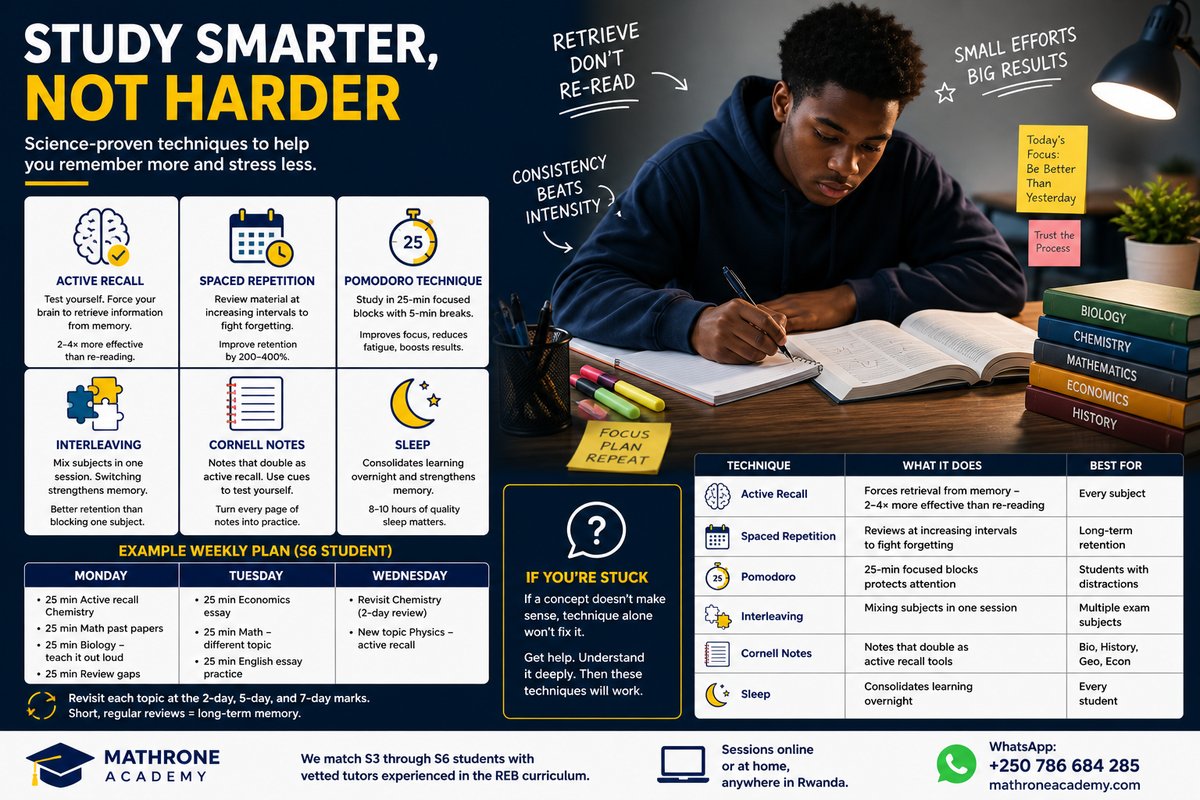
The following are science proven techniques to study effectively
Active Recall
After studying a topic, close your book and force yourself to retrieve it from memory. Research shows it's two to four times more effective than re-reading. Studies tracking retention after 30 days found that passive re-reading produced 15–20% retention, while active recall alone produced 70–85%. Active recall alone: 70–85%. This means that every time you successfully retrieve information from memory, the neural pathway to that memory gets stronger. Your brain treats remembering as important, and reinforces it. Re-reading doesn't ask the brain to do anything, so the brain doesn't bother strengthening anything.
How to do it better?:
Blank page. After studying a topic, close your book and force yourself to retrieve it from memory. Don't check your notes until you've finished. Then compare. The gaps you find are what you study next.
Past papers. Past papers are genuinely useful because every question forces retrieval and application rather than recognition. Don't use them just to mark answers. Use them to practice remembering.
Teach it out loud. Explain a concept as if teaching a classmate. If your explanation goes vague or collapses into repeating definitions, you've found the gap. This is the Feynman Technique named after physicist Richard Feynman and it's one of the most reliable tests of whether you actually know something versus whether you've just read it enough times.
Works especially well for Biology (explain processes without notes), History (recall events and causes from memory), Economics (explain supply and demand to yourself), and Mathematics (attempt a problem from scratch before checking the method).
Spaced Repetition
Review material at increasing intervals over time rather than once in a long session because naturally forget information over time unless we revisit it before it fades and research on this forgetting curve is about 140 years old and remarkably consistent. By returning to material just as you're starting to forget it, you reset and strengthen the memory each time.
Spaced repetition can improve retention by 200–400% compared to cramming. Combined with active recall, retention rates after 30 days can reach 90–95%.
The simplest version: after studying a topic for the first time, review it after 2 days, then 3 days, then 5, then 7 sometimes called the 2-3-5-7 method. Each review takes less time than the last because the memory is progressively stronger.
The most common mistake: studying a subject hard for one week, then not touching it for a month. By exam time, much of that work has faded. Fifteen minutes per subject three times a week outperforms a three-hour single session almost every time.
The Pomodoro Technique
The Pomodoro Technique: Study in 25-minute focused blocks, followed by a 5-minute break. After four blocks, take 15–30 minutes off.
A 2025 meta-analysis found that structured Pomodoro intervals improved focus, reduced fatigue, and improved sustained performance compared to unstructured studying. One study found Pomodoro students scored 82% on average versus 70% for the non-Pomodoro group spending less total time studying (90 minutes vs 120 minutes per session).
Human attention starts declining meaningfully after 25–30 minutes. The Pomodoro structure works with that reality rather than against it.
1. Decide exactly what you'll study in the next 25 minutes. "Study Chemistry" is too vague. "Study Chemistry" is too vague; "Active recall on Unit 3, Chemical Bonding" is specific enough to actually do.
2. Set a timer. No phone, no WhatsApp.
3. When the timer rings, stop. Stand up, stretch, drink water.
4. After four sessions, take a proper break.
This matters especially for students studying in busy households — with family, noise, power interruptions, and social obligations competing for attention. You don't need four hours of silence. You don't need four hours of silence; you need 25 minutes of genuine focus, repeatedly.
Interleaving
Interleaving: Mix subjects within the same study session instead of blocking one subject per day.
Most students block-study: Mathematics on Monday, Chemistry on Tuesday. It feels organised. But research consistently shows that mixing subjects within the same session produces better retention than blocked practice. Switching between subjects forces your brain to retrieve the correct knowledge and apply the right approach each time that extra retrieval effort strengthens memory.
Instead of three hours of Mathematics on Monday evening, try: 50 minutes of Mathematics, 50 minutes of Chemistry, then 30 minutes back on a different Mathematics topic. It feels slightly less comfortable. That's the sign it's working.
For S6 students with multiple principal subjects before July: interleaving is also practical necessity. You can't spend a week on Mathematics and neglect Chemistry.
Cornell Notes
Cornell Notes: Copying what the teacher writes on the board produces notes that are rarely useful. The Cornell system builds active recall directly into note-taking.
Each page is divided into three sections: a large right column for your main notes (written in your own words, not copied verbatim), a narrow left column for keywords and questions added after the lesson, and a bottom section for a 2–3 sentence summary written from memory after the lesson.
When you revise, cover the right column and use the left column questions to test yourself. Every page of notes becomes an active recall exercise rather than a passive text to re-read.
Most useful for Biology, History, Geography, and Economics subjects where the relationships between concepts matter more than isolated facts.
Sleep
During sleep, the brain consolidates information from the day — moving it from short-term to long-term memory, strengthening connections between ideas. Students who sleep fewer than 6 hours before an exam consistently underperform compared to equally prepared students who sleep 8 hours, regardless of how much extra studying they squeezed in.
Don't sacrifice sleep for late-night cramming in the final week. The night before each paper, do a calm review of key points, then sleep. Aim for the same sleep time every night during exam season irregular schedules hurt cognitive function.
For P6 students aged 11–13: 9–10 hours per night. For S3 and S6 students: 8–9 hours.
A realistic weekly plan for S6
Monday evening (2 hours)
• 25 min: Active recall on last week's Chemistry notes (blank page method)
• 5 min break
• 25 min: Mathematics ; past paper questions on Calculus
• 5 min break
• 25 min: Biology : explain a biological process out loud
• 5 min break
• 25 min: Review and correct Chemistry gaps
Tuesday evening (1.5 hours)
- Spend 25 minutes writing a timed past paper essay on Economics.
• 5 min break
• 25 min: Mathematics : different topic (interleaving)
- Take a 5-minute break.
- Spend 25 minutes practicing essay arguments for English.
Wednesday evening
- Briefly revisit Monday's Chemistry topic using spaced repetition, two days after first study.
- Start a new topic: Physics, using active recall after reading.
Each topic gets revisited at the 5-day and 7-day marks after first study.
If you're stuck on a subject
These techniques work only when you understand the material well enough to recall and apply it. If a concept doesn't make sense despite re-reading the textbook, technique alone won't fix it; you need someone to explain it differently, identify where understanding breaks down, and help you rebuild from there.
At Mathrone Academy, we match S6 students with vetted tutors experienced in the REB curriculum. Sessions are available online or at home, anywhere in Rwanda.
📞 WhatsApp: +250 786 684 285
Technique What It Does Best For
Active Recall Forces retrieval from memory, 2-4 times more effective than re-reading Every subject
Spaced Repetition Reviews at increasing intervals to fight forgetting Long-term retention
Pomodoro 25-minute focused blocks protect attention Students with distractions
Interleaving Mixes subjects in one session Students with multiple exam subjects
Cornell Notes Notes that double as active recall tools Biology, History, Geography, Economics
Sleep Consolidates learning overnight Every student
READ: Why Children Hate Mathematics And What the Science Says About Fixing It
READ: Why Your Child Hates Studying, and What Actually Fixes It