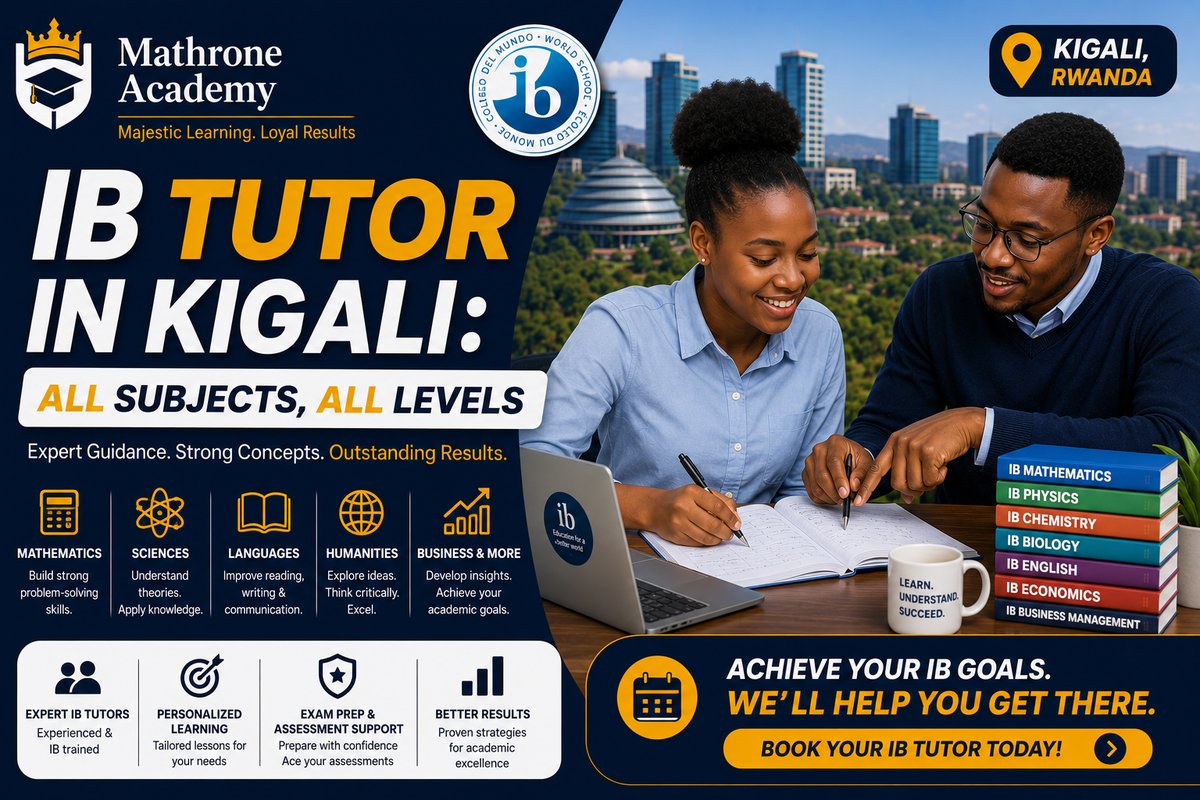
The IB Diploma is structurally different from every other curriculum taught in Kigali, and that difference is exactly why finding the right tutor matters so much. A student isn't studying two or three deep subjects the way an A-Level student is. They're carrying six subjects across six different subject groups, split between Higher Level and Standard Level, on top of three compulsory core components that have no real equivalent in REB/CBC or Cambridge. Finding one tutor in Kigali who can competently cover that entire spread doesn't exist. What a family actually needs is access to several subject specialists who each know one piece of it well.
Mathrone Academy matches IB tutoring requests to specialists across every subject group, at both Higher and Standard Level, and for the Core components that sit outside normal subject teaching entirely. This guide explains how the IB Diploma is actually structured, what each part demands from tutoring, and how to get matched with the right specialist for each piece your child needs.
Why "IB Tutor" Covers More Ground Than Any Other Curriculum
The IB Diploma Programme requires students to take six subjects, one from each of six subject groups: language and literature, language acquisition, individuals and societies, sciences, mathematics, and the arts. Three or four of those subjects are studied at Higher Level, generally involving around 240 teaching hours and significantly greater depth, and the rest at Standard Level, around 150 hours, built for genuine breadth rather than depth.
On top of the six subjects, every IB student completes the Core: Theory of Knowledge, the Extended Essay, and Creativity, Activity, Service. None of these are subject content in the traditional sense. TOK is a critical-thinking course assessed through essay and presentation. The Extended Essay is an independent 4,000-word research paper in a subject of the student's choosing. CAS has no written exam at all, but still has to be completed and documented to earn the Diploma.
This means a family asking for "an IB tutor" is really asking for support across a genuinely wide range of distinct skills: subject teaching at two different depths, academic research and writing guidance for the Extended Essay, and critical-thinking coaching for TOK. Mathrone treats each of these as what it actually is, a distinct kind of tutoring need, rather than assuming one generalist can cover all of it.
Higher Level and Standard Level Subject Tutoring
Every IB subject can be taken at either Higher Level or Standard Level, and the difference between the two is substantial, not a matter of pace. Higher Level asks students to go deeper into content and apply it to more complex, often unfamiliar scenarios, while Standard Level covers a narrower version of the same subject in less depth. A tutor experienced with a subject at Standard Level isn't automatically equipped to teach the same subject at Higher Level, since HL content genuinely goes further, not just faster.
Mathrone matches subject requests to tutors experienced at the specific level a student needs. This applies across the sciences, mathematics, and humanities subjects most commonly taken by students in Kigali's international schools. For Mathematics specifically, both Analysis and Approaches and Applications and Interpretation are matched separately, since they're different courses with different content emphasis, not the same subject with a different name. Families weighing IB against Cambridge more broadly, whether choosing a school or comparing options for a specific subject, can review Mathrone's comparison of the IB and Cambridge curricula.
Internal Assessment Support Across Subjects
Every IB subject includes an Internal Assessment, typically worth around 20 percent of the final subject grade, marked by the student's own teacher and then moderated externally by the IB. IAs vary significantly by subject: a Biology IA is an individual scientific investigation, an English IA is an oral commentary, a Mathematics IA is an extended written exploration, and an Economics IA is a short commentary applying theory to real-world articles. Because IAs are completed over an extended period rather than sat as a timed exam, tutoring support here looks different from standard exam preparation. It's closer to structured mentoring through a research and writing process, with a tutor guiding a student toward a strong topic, methodology, and analysis rather than drilling exam technique.
Extended Essay and Theory of Knowledge Support
The Extended Essay and Theory of Knowledge sit outside every subject group but still carry real weight, together contributing up to three bonus points toward the maximum Diploma score of 45. Extended Essay tutoring focuses on research skill, argument structure, and academic writing discipline over the roughly year-long process of producing a 4,000-word independent paper. TOK tutoring works differently again, focused on the kind of critical, cross-disciplinary thinking the course specifically assesses, which many students find genuinely unfamiliar coming from a REB/CBC or Cambridge background where this style of open-ended reasoning isn't typically taught directly.
Mathrone matches requests for both of these separately from subject tutoring, since neither is really "a subject" in the way Physics or English is, and a strong subject tutor isn't automatically the right person to guide a student through an independent research essay or a TOK presentation.
How Tutor Matching Actually Works on Mathrone
Mathrone doesn't operate as a browsable directory where you scroll through tutor profiles and pick one yourself. It works as a direct matching service. You submit a short request specifying what's needed, a specific subject at HL or SL, IA support for a named subject, or help with the Extended Essay or TOK, along with preferred mode and budget. The Mathrone team reviews the request and assigns a specialist genuinely suited to that specific need.
Because IB students often need support across several of these pieces at once, a family can submit more than one request, for example a Higher Level Chemistry tutor alongside separate Extended Essay guidance, and each gets matched to the right specialist rather than routed to a single generalist expected to cover everything.
Once a request is submitted, it's automatically prepared as a WhatsApp message to the Mathrone team, so follow-up on tutor assignment, scheduling, and pricing happens directly and quickly.
Online or In-Person IB Tutoring
Mathrone supports both formats. For online sessions, tutoring runs through Majestic Lab, Mathrone's live virtual whiteboard, useful across IB's range of needs, from working through Higher Level Mathematics and Sciences content live, to structuring an Extended Essay outline collaboratively in real time. In-person tutoring remains available for families in Kigali who prefer face-to-face sessions, with the same specialist-matched process applying either way.
Getting Matched With an IB Tutor
To request an IB tutor in Kigali, whether for a specific subject at Higher or Standard Level, Internal Assessment guidance, or support with the Extended Essay or Theory of Knowledge, you can register with Mathrone Academy and submit a tutor request specifying exactly what your child needs. The team reviews each request individually to assign a genuinely matched specialist.
If you'd prefer to talk through your child's specific subject combination, IA topics, or pricing before registering, reach out directly on WhatsApp at +250 786 684 285 or by email at [email protected]. The Mathrone team can help you figure out exactly what to specify in your request so the first tutor match is the right one.