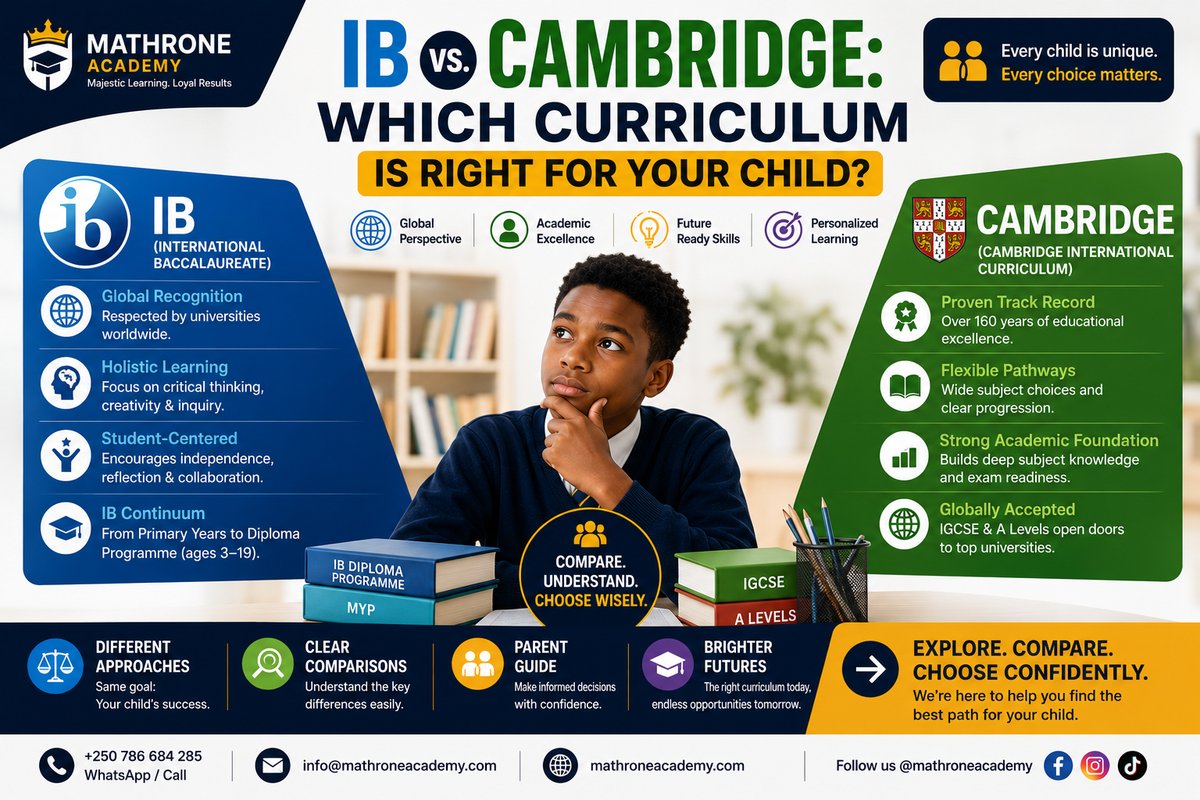
For families anywhere in the world choosing a pre-university pathway, the decision usually comes down to two names: the IB Diploma Programme and Cambridge A-Levels. Both are globally recognized, both open doors to top universities, and both are genuinely rigorous. But they're built on different philosophies, structured differently, and suit different kinds of students. This guide compares them directly, structure, grading, workload, and university recognition, so you can make an informed choice wherever in the world you're reading this from.
The Core Philosophical Difference
Cambridge A-Level is built around specialization. Students typically choose three or four subjects at 16 and study them in real depth over two years, with each subject graded and reported entirely independently. The IB Diploma Programme is built around breadth. Students choose six subjects spanning six different subject groups, three at Higher Level and three at Standard Level, and study them alongside three additional core components, all simultaneously, with a single combined score reflecting the whole package rather than each subject standing alone.
Neither approach is inherently superior; they simply ask different things of a student. A-Level rewards a student who already knows roughly what they want to specialize in and wants to go deep. IB rewards a student who wants to keep multiple academic doors open longer and is comfortable juggling several demanding commitments at once.
Structure, Side by Side
| Cambridge A-Level | IB Diploma Programme | |
|---|---|---|
| Ages | 16-19 (typically two years) | 16-19 (exactly two years) |
| Number of subjects | Typically 3-4 | 6, one from each of 6 subject groups (Higher Level and Standard Level split) |
| Additional core requirements | None | Extended Essay (4,000 words), Theory of Knowledge, CAS (Creativity, Activity, Service) |
| Grading | Each subject graded independently, A* to E | Each subject graded 1-7; combined with up to 3 core bonus points for a total out of 45 |
| Minimum to pass/earn qualification | No combined threshold; each subject stands alone | 24 out of 45 points, plus multiple additional conditions (no grade 1, limited grade 2s and 3s, CAS completed, no E in EE or TOK) |
| Assessment style | Predominantly exam-based, linear, assessed mainly at course end | Mix of external exams and internal assessment (typically 20-30% per subject), plus separately assessed core components |
| Dropping a struggling subject | Generally not possible once committed, though subject count offers some flexibility | Not possible; all six subjects and the full core must be completed together |
How Cambridge A-Level Actually Works
Cambridge A-Level students choose their subjects at the end of IGCSE (around age 16) and typically commit to three or four, occasionally adding a fourth or Further Mathematics for strong STEM candidates, as covered in our guide on the best A-Level subject combinations by career path. Assessment is largely exam-based and linear, meaning the bulk of the final grade comes from exams sat at the end of the two-year course, though certain subjects, particularly Sciences and Languages, include coursework or practical components. Each subject's grade, from A* down to E, stands entirely on its own; there's no combined point total linking subjects together, and a weak grade in one subject doesn't mathematically drag down another.
How the IB Diploma Programme Actually Works
The IB Diploma Programme requires students to choose one subject from each of six groups: Studies in Language and Literature, Language Acquisition, Individuals and Societies, Sciences, Mathematics, and the Arts (though students can substitute an additional subject from another group in place of the Arts). Three subjects are studied at Higher Level (more content, more instructional hours) and three at Standard Level, though schools have some flexibility in exactly how this splits.
Layered on top of the six subjects is the IB "core," three additional required components that exist outside any single subject. The Extended Essay is a 4,000-word independent research paper on a self-chosen topic, graded A to E, and widely regarded as excellent preparation for university-level research writing. Theory of Knowledge is a critical-thinking course examining how knowledge itself is constructed, assessed through a 1,600-word essay and a TOK Exhibition, also graded A to E. Creativity, Activity, Service (CAS) is a two-year portfolio of self-directed activities across three strands, not graded numerically but mandatory for the diploma, meaning strong academic scores cannot compensate for an incomplete CAS record.
Each of the six subjects is graded from 1 (lowest) to 7 (highest), for a maximum of 42 points, and the Extended Essay and TOK combine through a bonus-point matrix worth up to 3 additional points, bringing the maximum possible total to 45. But hitting a high point total alone isn't enough. To actually receive the diploma, a student needs at least 24 points, no grade of 1 in any subject, no more than two grades of 3 or below at Higher Level, no more than three grades of 3 or below overall, at least 12 points from Higher Level subjects and 9 from Standard Level, CAS fully completed, and no grade of E in either the Extended Essay or TOK. A student who scores well overall but fails just one of these conditions receives DP Course Results rather than the full Diploma, a meaningfully different, less internationally weighted outcome that universities specifically look for and treat differently from a completed diploma.
Workload: The Honest Comparison
This is where the two systems feel most different day to day, and it's worth being direct about it rather than glossing over it. IB's six-subjects-plus-core structure means a student is managing internal assessment deadlines, Extended Essay supervision meetings, TOK coursework, and CAS reflection logs simultaneously with regular subject coursework, often across all six subjects at once, with genuinely no option to deprioritize a subject that's going badly, since every subject counts toward the same combined score. Cambridge A-Level's narrower subject count means a student experiencing difficulty in one subject can, in principle, put more relative weight into their stronger subjects, since each is graded independently rather than pooled into one number.
This makes IB a genuinely demanding fit for students who thrive on juggling multiple concurrent commitments and enjoy connecting ideas across different subjects, while A-Level tends to suit students who prefer to go deep in a narrower set of subjects without the added layer of research essays and reflective portfolios running in parallel.
University Recognition: Genuinely Equal, Worldwide
This is one area where families can be reassured without much nuance needed. Universities across the UK (including Oxford and Cambridge), the US (including Ivy League institutions), Canada, Australia, and the Middle East recognize both the IB Diploma and Cambridge A-Levels as rigorous, equivalent qualifications, and neither is systematically favored over the other in admissions decisions. What actually matters more for a specific university application is whether a student's subject choices, whether IB Higher Levels or A-Level subjects, satisfy that particular course's prerequisites, which is exactly why our guide on A-Level subject combinations by career path focuses on matching subjects to specific degree requirements rather than treating the qualification type as the deciding factor.
Some admissions officers do note that a strong IB Diploma score demonstrates sustained breadth and time-management ability across many concurrent demands, while strong A-Level grades demonstrate deep subject mastery; both are genuinely valued, just for slightly different reasons, and neither should be treated as a safer or riskier choice purely on recognition grounds.
Which One Actually Suits Your Child?
Rather than asking which qualification is "better," it's more useful to ask a few honest questions about your child specifically. Does your child already have a strong sense of the subject area they want to pursue at university, whether that's Medicine, Engineering, or Law, and would they benefit from going deeper into fewer subjects sooner? Cambridge A-Level, paired with the right combination for that specific path, tends to suit this student well. Does your child enjoy connecting ideas across different subjects, want to keep options open a little longer, and handle multiple concurrent deadlines comfortably, even under real pressure? IB's breadth-first structure tends to suit this student better, provided the school offering it has strong pastoral and time-management support in place, since the workload genuinely is heavier.
It's also worth being honest about school availability: not every school offers both, and switching schools purely to access one programme over the other is a significant decision in its own right, worth weighing against the academic fit itself.
Moving Between the Two Systems
A common and entirely manageable transition is moving from Cambridge IGCSE directly into the IB Diploma Programme, even without having completed the IB Middle Years Programme beforehand; the IB Diploma is explicitly open to students from any rigorous secondary background, and MYP is not a prerequisite. The first months of DP Year 1 can feel like a genuine step up for any student regardless of background, given the jump from exam-recall-style assessment to IB's emphasis on critical synthesis and independent research, so extra support during that specific transition window tends to pay off more than support spread evenly across the full two years.
If you're earlier in the decision process and still weighing Cambridge as a full pathway from Primary through to this A-Level or IB decision point, our guide on the Cambridge curriculum explained for parents walks through every stage that leads up to this choice, and if Rwanda's own national curriculum is also on the table, our comparison of Cambridge versus CBC covers that specific decision in depth.
Supporting Your Child Through Either Pathway
Whichever path your family chooses, the two-year window from 16 to 19 is high-stakes by design, and subject-specific support at the right moments, particularly around IB's Extended Essay and Internal Assessment deadlines, or Cambridge A-Level's cumulative exam preparation, makes a measurable difference to final outcomes. If you're trying to work out whether your child needs that kind of support right now, our article on signs your child needs a private tutor is a useful starting point.
Mathrone Academy provides one-on-one tutoring for Cambridge IGCSE and A-Level students anywhere in the world, alongside support for Rwanda's own REB national curriculum for families based locally who want guidance across multiple systems from a single team.
Get matched with a tutor:
WhatsApp: +250 786 684 285
Email: [email protected]