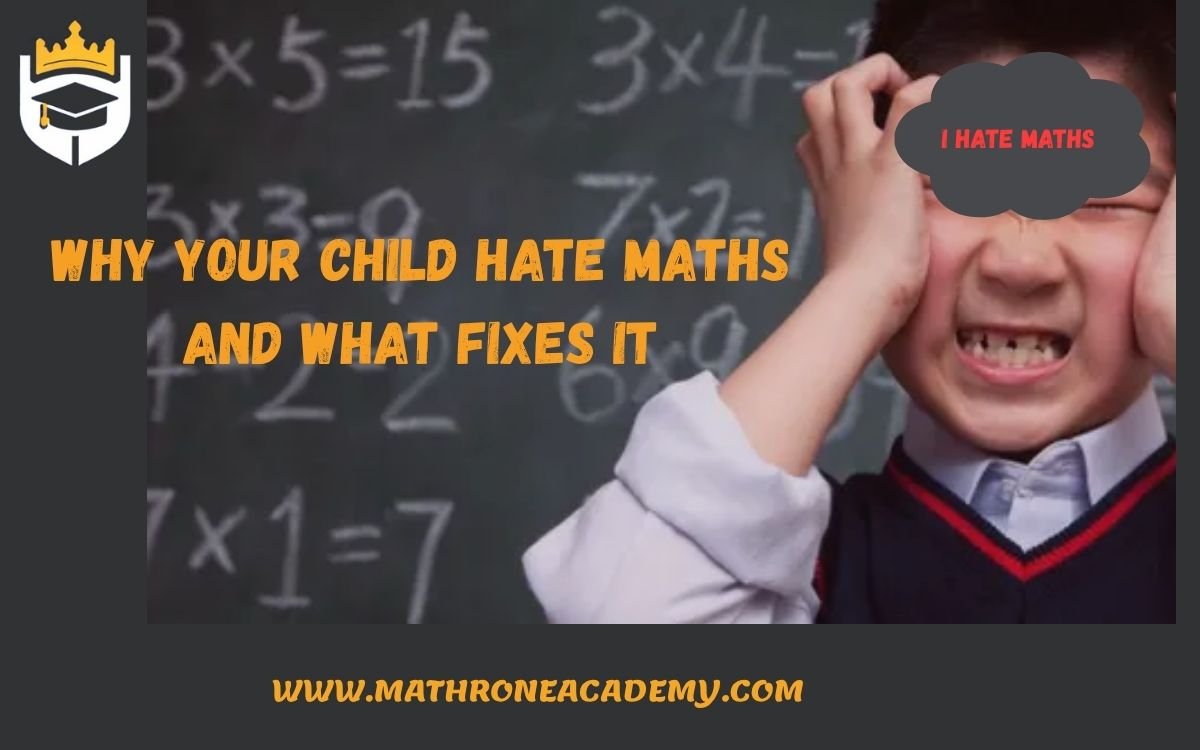
Many adults remember when they were still children saying “I HATE MATHS” and almost every parent has heard it. But why most students hate studying mathematics?
But here is what the latest research tells us: your child almost certainly does not hate mathematics and what they have is something more specific, more measurable, and crucially more reversible than hate and it is is called mathematics anxiety, and it is one of the most thoroughly studied phenomena in educational psychology and understanding what maths anxiety actually is, where it comes from, and what reliably reduces it is the difference between a child who grows up avoiding numbers and one who grows up using them confidently. This article explains the science and what you can do about it today.
What Maths Anxiety Actually Is
Mathematics anxiety is not a learning disability and it is not a sign of low intelligence , is not even, in most cases, caused by a genuine inability to do maths. Maths anxiety is a feeling of apprehension, of dread, when a child is placed in a situation where they have to engage in mathematical problem-solving and can produce measurable physical responses increased heart rate, changes in skin conductance meaning it is both a psychological and physiological reaction, not merely an attitude.
What makes this particularly damaging is the mechanism by which it disrupts performance as when a child experiences maths anxiety, they begin to ruminate “I'M NOT GOING TO BE ABLE TO DO THIS, I'M TERRIBLE AT MATHS.” Those ruminations occupy mental capacity, leaving less room to actually focus on the problem. It creates a dual task: the child is simultaneously trying to solve the maths and manage the anxiety it has triggered and the performance drops not because the child cannot do the maths but because their working memory is consumed by fear. Maths anxiety meets all the criteria of a specific phobia, feelings of tension, stress, frustration, and anxiety when manipulating numbers or solving mathematical problems and critically, it is not only associated with immediate negative emotional reactions. It has detrimental long-term consequences for career choice, employment, and professional success.
Mathematics anxiety is not a minor inconvenience but persistent barrier to effective learning, particularly in primary education and also high levels of mathematics anxiety are consistently linked to poor achievement in mathematics, decreased confidence, and reduced motivation a pattern that has been documented across countries, making it a genuinely global phenomenon.
Where Maths Anxiety Comes From
Maths anxiety often begins to emerge in the early school years, and experiences during childhood and adolescence can shape long-term engagement and achievement in maths. Researchers identify three levels of influence: individual factors, interpersonal factors, and sociocultural factors.
Source 1: The Individual : Early Failure and the Feedback Loop
The most common origin story for maths anxiety is simple: a child struggles with a concept early on, receives negative feedback, begins to associate maths with failure, and starts avoiding it and that avoidance leads to less practice, less practice leads to weaker skills, weaker skills confirm the child's belief that they “CAN'T DO MATHS.” The cycle reinforces itself.
Researchers call this the reciprocal feedback-loop model of maths anxiety where early maths performance, attitudes and beliefs, cognitive disruption, and avoidance interact and reinforce each other over time. And earliest point of intervention is the most powerful. A child who gets support during the first signs of struggle rather than years later when the avoidance pattern is deeply established has a dramatically better outcome.
Source 2: Parents : The Transmission Nobody Talks About
This is the finding most parents are surprised by, and it is one of the most robust in the literature. Parents with high maths anxiety tend to avoid activities involving mathematical content, providing children with fewer opportunities to practise and learn maths competencies in the home environment but the transmission goes deeper than opportunity.
Parents' own maths anxiety and beliefs about mathematics including whether they believe maths ability is fixed or can be developed directly shape how children approach maths challenges and how they respond to setbacks. The parent who sighs and says “I WAS NEVER GOOD AT MATHS EITHER” while helping with homework is not simply commiserating. They are communicating a belief that maths ability is inherited, fixed, and not something effort can change. Children absorb that belief and act on it.
This does not mean parents with maths anxiety cause irreversible damage, It means being aware of the messages you send about mathematics verbally and non-verbally matters enormously and Avoiding comments like “I WAS TERRIBLE AT MATHS” or “MATHS IS JUST HARD” goes a long way.
Source 3: Teachers and the Classroom Environment
The way mathematics is taught shapes whether children develop anxiety or confidence. Two classroom practices in particular are well-documented contributors to maths anxiety:
1. Timed tests. Speed drills and timed arithmetic tests are among the most reliably cited triggers of maths anxiety in research literature. When speed becomes the measure of mathematical ability, children who process thoughtfully but accurately and there are many receive the message that they are failing even when their understanding is strong.
2. Public correction and humiliation. Being asked to solve a problem on the board, getting it wrong, and being corrected in front of peers is a common experience that researchers consistently identify as a formative moment in the development of maths anxiety. The subject becomes associated not just with difficulty but with public failure a far more emotionally charged experience.
3. Fixed ability grouping. Placing children in "low" maths groups early and keeping them there communicates a fixed-ability message. Research consistently shows that children perform up or down to the expectations communicated to them a phenomenon known as the Pygmalion effect.
What Does Not Work
- Saying “JUST PRACTISE MORE.” More practice of a subject that produces anxiety without addressing the anxiety itself is rarely effective because child who is anxious about maths will practise defensively going through the motions without genuine engagement and their skills will not improve meaningfully.
- Offering rewards for maths grades. As with academic performance generally, external rewards for maths grades tend to extinguish intrinsic motivation. The moment the reward disappears, so does the effort.
- Expressing your own maths anxiety. As established above transmitting your own negative relationship with maths to your child is one of the most consequential things a parent can do. It is also one of the most unconscious. Watch for phrases like “maths was never my strong suit” or “I don't have a maths brain.”
- Attributing difficulty to ability. “You're just not a maths person” is one of the most damaging sentences a parent or teacher can say to a child. It closes a door that should remain open.
What Actually Works: The Evidence-Based Fixes
1. Reframe What Maths Is For
Most children experience mathematics as an abstract performance task a series of problems to be solved correctly under time pressure and children who develop a healthy relationship with maths tend to see it differently: as a tool for understanding patterns, solving real problems, and making sense of the world.
This reframing starts at home as cooking involves fractions, shopping involves percentages, Sport involves statistics meaning that pointing these out not as lessons, but as natural observations begins to normalise mathematical thinking as part of everyday life rather than a school subject to be endured.
2. Praise the Process, Not the Result
Carol Dweck's growth mindset research, discussed in depth in our article on why children hate studying, applies with particular force to mathematics because maths is the subject where fixed-ability beliefs are most culturally entrenched. When a child struggles with a maths problem and keeps trying, praising the persistence not the eventual answer builds the belief that effort produces improvement. That belief is both scientifically accurate and the foundation of maths confidence.
Concretely: I noticed you tried three different approaches to that problem” beats “ well done, you got it right.”
3. Remove Speed as the Primary Measure
At home, never time your child's maths practice unless speed is genuinely the specific skill being developed. Allowing children to work through problems at their own pace with accuracy as the goal reduces performance anxiety and allows genuine understanding to develop.
4. Make Mistakes Normal
The classroom culture of maths as a right-or-wrong performance leaves children afraid to attempt problems they are not certain about and at home, you can create a different culture. When your child makes a mathematical error, the most valuable response is curiosity rather than correction: "Interesting — how did you get that?" This models the idea that mathematical mistakes are information, not failure and it develops the analytical thinking that actually produces improvement.
5. Get the Right Support Early
The feedback loop that drives maths anxiety struggle, anxiety, avoidance, weaker skills, more anxiety can be interrupted at any stage, but the earlier the better. A targeted intervention in a specific area of weakness, delivered by someone patient and skilled, can break the cycle faster than months of classroom exposure.
A good maths tutor does not simply reteach what the classroom has already covered but they identify the specific conceptual gap that is driving the difficulty whether it is place value, fraction intuition, algebraic thinking, or something else entirely and rebuild understanding from that point.
At Mathrone Academy, we specialise in exactly this. Our maths tutors work across all levels primary through advanced secondary and are matched to your child's specific needs, learning style, and the curriculum they follow.
WhatsApp us on +250 786 684 285
Request a maths tutor at Mathrone Academy
Frequently Asked Questions
Q: Is maths anxiety a real condition or just an excuse? It is a real, measurable psychological and physiological response documented across thousands of studies over 45 years of research. It meets the criteria of a specific phobia and produces measurable changes in heart rate and cognitive function. It is not an excuse it is a barrier that responds well to the right interventions.
Q: At what age does maths anxiety typically start? Research shows maths anxiety often begins to emerge in the early school years as young as age 6 or 7 and can solidify significantly by age 9 or 10 if not addressed. The earlier the intervention, the better the outcome.
Q: Can a parent's own maths anxiety affect their child? Yes this is one of the most consistent findings in the literature. Parents who express anxiety about maths, avoid maths-related activities, or communicate fixed-ability beliefs about mathematics directly influence their children's maths attitudes and confidence. Being mindful of the messages you send verbal and non-verbal makes a real difference.
Q: What is the single most effective thing a parent can do to help a child who hates maths? Identify the specific point where understanding breaks down not the general subject, but the exact concept that feels impossible. Then address that gap specifically, with patience and without time pressure. Everything else follows from that.
Read: Why Your Child Hates Studying — and What Actually Fixes It →
Read: How to Talk to Your Child After a Bad Exam Result →
Read: How to Study Effectively — Proven Techniques Every Student Should Know →
Published by Mathrone Academy — connecting students worldwide with quality education resources and expert tutoring. Visit us at mathroneacademy.com