Window 2 of the Joint Japan/World Bank Graduate Scholarship Program (JJ/WBGSP) 2026 closes on 29 May 2026. If you are a development professional from a developing country who has already secured admission to one of the 44 participating Master's programmes you have less than two weeks to act as this is one of the most prestigious and genuinely impactful scholarship programmes in the world. Funded by the Government of Japan and administered by the World Bank, the JJ/WBGSP has been building development leadership since 1982 supporting over 7,000 development professionals and scholars who have returned to their home countries to transform institutions, shape policy, and drive economic and social progress.
This guide gives you every verified detail: what the scholarship covers, who is genuinely eligible, how the application process actually works, the scoring criteria, key deadlines, and what makes a competitive application. Read every section because this scholarship has critical eligibility requirements that most articles fail to explain clearly.
What Is the JJ/WBGSP?
The Joint Japan/World Bank Graduate Scholarship Program is a fully funded scholarship supporting mid-career development professionals from eligible developing countries to pursue Master's degrees at leading universities in the United States, Europe, Africa, Oceania, and Japan and the programme has a singular, clearly stated mission: to invest in professionals who will return to their home countries after graduation and apply their advanced knowledge to national development priorities whether in economic policy, public administration, infrastructure, environmental governance, or related fields.
This is not a scholarship for recent graduates looking for their first international experience, it is a programme designed for working professionals with demonstrated commitment to development people who are already contributing to their country's progress and want to deepen their expertise to contribute more effectively. This scholarship is administered by the World Bank's Development Economics Vice Presidency (DEC) and is an important component of the World Bank's efforts to promote economic development and shared prosperity through investing in human capital and capacity building in the developing world.
2026 Application Windows
The JJ/WBGSP 2026 cycle has two application windows for developing country nationals, Window 1 application started in 15 January to 27 February 2026 and it is now closed also window 2 , application started 30March and will end 29 May 2026
Critical note on how the application link works: The JJ/WBGSP application form link is not publicly available and it is only communicated directly to candidates who have already been unconditionally admitted to one of the 44 participating programmes AND have been shortlisted as eligible by that participating university and you cannot apply to the World Bank directly the university nominates you first and this means if you have not yet secured admission to a participating programme, the 29 May deadline effectively cannot be met. Begin preparing for the 2027 cycle instead and use the rest of this guide to plan your application strategy.
What the Scholarship Covers
The JJ/WBGSP is genuinely fully funded. Here is exactly what every selected scholar receives:
Full tuition fees and associated academic charges at the participating university
Monthly subsistence allowance to cover all living expenses accommodation, food, books, and daily costs. The amount varies by host country and is calibrated to local cost of living
Round-trip economy class airfare between your home country and the host university at the start of the programme and immediately following the end of the scholarship period
USD $600 travel allowance per trip for incidental travel expenses
Basic medical insurance obtained through the university
Coverage duration: The full duration of the graduate programme or a maximum of two years whichever is less
This scholarship will not cover:
- Expenses related to research, supplementary educational materials, field trips, or participation in workshops and seminars outside the curriculum
- Educational equipment such as computers
- Any expenses outside the defined scholarship period
- Family members' travel or living costs
Important: The JJ/WBGSP scholarship may supplement but does not duplicate any other source of financial support so, if you have been awarded another scholarship or fellowship, you must disclose this to the JJ/WBGSP Secretariat as The scholarship will only cover costs not already funded by other sources.
The 44 Participating Programmes
This is the most important structural fact about the JJ/WBGSP that many ignores ignore: you cannot apply to any university you choose. The scholarship is only available for 44 specific Master's programmes at 24 universities worldwide. these programmes are concentrated in key development-related fields including:
- Economic Policy Management
- Public Administration and Governance
- Infrastructure Management and Urban Planning
- Environmental and Natural Resource Management
- Tax Policy and Administration
- Agricultural Development and Food Security
- Health Systems and Public Health Policy
- Development Studies and International Relations
- Data and Technology for Development
Participating universities span the United States (including Columbia University SIPA, Harvard Kennedy School, and Johns Hopkins SAIS), Europe (including LSE, Sciences Po, and University of Birmingham), Africa, Oceania, and Japan and the complete and current list of 44 participating programmes is published on the World Bank scholarships website at worldbank.org/en/programs/scholarships. Before doing anything else, verify that your target university and programme appear on this list for the 2026 cycle. Programmes available in Window 1 and Window 2 may differ confirm which programmes are available in the current window.
Eligibility Criteria
The JJ/WBGSP eligibility requirements are strictly enforced. No exceptions are made Just read every point before preparing your application:
For Developing Country Nationals:
Citizenship: You must be a citizen of a World Bank member developing country those with dual citizenship who also hold citizenship of a developed country are not eligible. Check the official eligible countries list on the World Bank scholarships website.
Admission: You must be unconditionally admitted (except for financing) to at least one of the 44 JJ/WBGSP participating Master's programmes for the upcoming academic year at a university located outside your country of citizenship and country of residence. Conditional admissions do not qualify.
Current employment: You must be employed in a paid, full-time development-related position at the time of submitting your scholarship application. Unpaid, volunteer, or consultancy positions do not satisfy this requirement.
Work experience: You must have at least 3 years of paid development-related employment since earning your bachelor's degree, and this experience must have been acquired within the past 6 years from the application deadline date.
Bachelor's degree: You must hold a bachelor's degree or equivalent university degree earned at least 3 years prior to the Application Deadline.
Age: You must be 45 years old or younger at the time of application.
Return commitment: You must commit to returning to your home country after completing your studies and contributing to its development. This is a condition of the scholarship, not merely an aspiration.
You are NOT eligible if:
- You are a staff member (or any type of employee) of the World Bank Group, International Monetary Fund, or any other international financial institution
- You are a spouse or close relative of a World Bank Group Executive Director or Board member
- You have previously been offered a JJ/WBGSP scholarship and declined it
- You have previously received a JJ/WBGSP scholarship but did not graduate
- You are currently enrolled in a graduate programme (unless applying in the current enrolled student category verify specific rules)
How the Application Process Actually Works
This is the most misunderstood aspect of the JJ/WBGSP and understanding it is essential for a successful application.
The process runs through the participating university, not directly through the World Bank.
Step 1: Identify your target participating programme Review the official list of 44 participating programmes. Select the programme most aligned with your professional background, development focus, and career goals.
Step 2 : Apply for admission to the university Apply for and secure unconditional admission to your chosen programme. Each university has its own application timeline and requirements — for Window 2, most participating universities required admission applications by February or March 2026. For the 2027 cycle, begin this step by October–November 2026.
Step 3 :Notify the university of your scholarship interest When applying for admission, clearly indicate your interest in being considered for the JJ/WBGSP scholarship. Each participating university has a quota of candidates it can nominate — typically between 5 and 30 candidates depending on the institution.
Step 4 : University shortlists eligible candidates The admissions office reviews applications and shortlists candidates who meet all JJ/WBGSP eligibility criteria. Only shortlisted candidates are contacted with the application link.
Step 5: Submit the JJ/WBGSP scholarship application Once shortlisted by the university, you receive the application form link directly. Complete the online application and upload all required documents before 29 May 2026 (Window 2).
Step 6 : Independent scoring and selection Two qualified assessors independently review each eligible application and score it on a scale of 1 to 10. Final selection also considers geographic distribution, gender balance, and financial need.
Step 7 : Steering Committee approval and notification The JJ/WBGSP Steering Committee composed of World Bank Board of Directors members and World Bank management reviews and approves the final list of scholars. Winners are notified shortly after approval.
How Applications Are Scored
Understanding the scoring criteria is essential for a competitive application as every eligible application is independently scored by two assessors across four weighted areas:
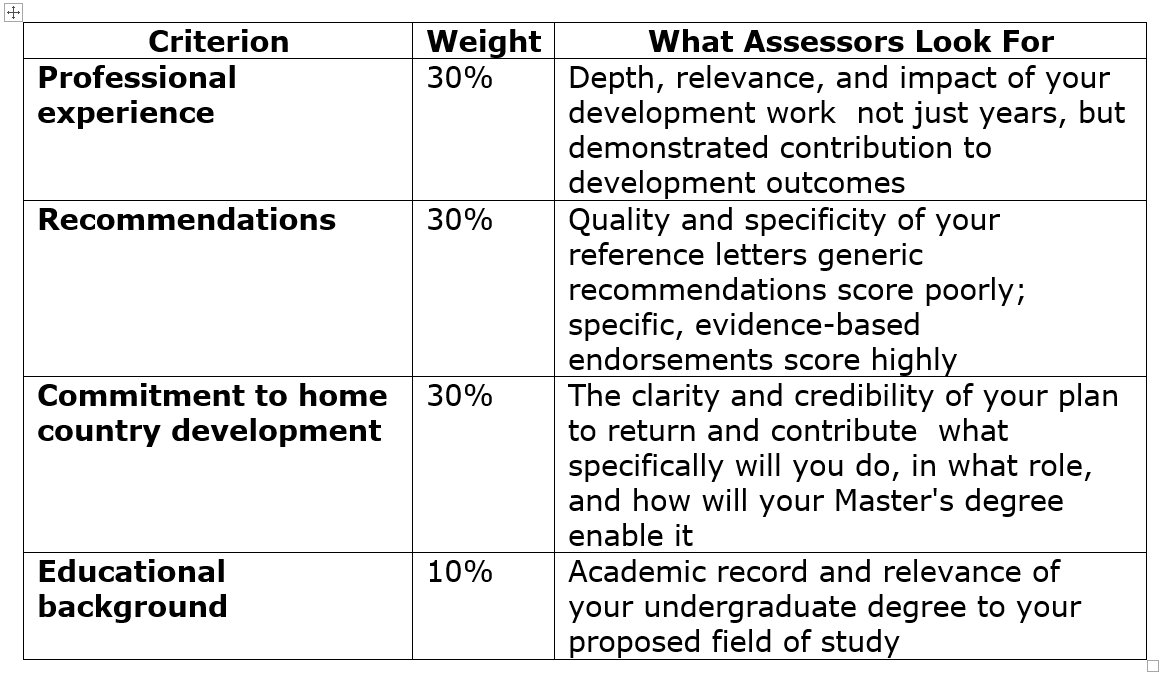
Geographic distribution, gender balance, and financial access also factor into final decisions candidates from countries or regions that are underrepresented in the current scholar cohort may receive additional consideration, all else being equal.
The scoring structure reveals something important: your development commitment and professional experience matter three times more than your academic record. This is a scholarship for practitioners not for students with the highest GPA.
Required Documents
Prepare the following before the scholarship application deadline and note that document requirements may vary slightly by participating university confirm with your specific institution:
Unconditional admission offer letter from the participating university
Academic transcripts and degree certificates for all previous university study
Employer verification letter confirming your current full-time paid employment in development-related work
Professional recommendations — typically two letters from supervisors or senior colleagues who can speak to your development work and leadership potential
Personal statement on development commitment — explaining your professional background, the specific development challenges you work on, and how the Master's degree will strengthen your ability to contribute to your home country's development upon return
Curriculum Vitae: comprehensive, with clear focus on development-related roles and responsibilities
Passport copy confirming your citizenship
English language proficiency results if required by your participating university
Tips for a Winning JJ/WBGSP Application
Write a development commitment statement that is specific and credible. The single biggest differentiator between strong and weak JJ/WBGSP applications is the quality of the personal statement on development commitment. Assessors can immediately identify vague statements written to sound good (“I want to contribute to my country's development”) from specific, credible plans built on real professional experience and a clear post-graduation role. Name the institution you will return to, describe the policy challenge you will work on and explain how the specific skills from your chosen Master's programme will directly enable that work.
Invest in your recommendation letters. Recommendations account for 30% of your score equal to professional experience So, letter from a senior government official or respected development organisation leader who writes specifically about your work, your impact, and your potential is vastly more valuable than a generic endorsement. Brief your recommenders fully share your personal statement with them and ask them to speak to the specific dimensions that align with the JJ/WBGSP scoring criteria.
Choose your participating programme strategically. Select a programme that directly builds on your existing professional expertise not the most prestigious name you can gain admission to and a programme that clearly connects your past development work with a specific future role at home is far more compelling to assessors than an unexplained shift in field.
Apply in Window 1 for the 2027 cycle. Window 1 typically opens in January and runs through late February and Universities nominate candidates in order of their internal shortlisting process early applicants within a university's intake have more time to be nominated and processed. Do not leave the admission application until the last minute.
Contact the participating university early. Each university has its own JJ/WBGSP coordination process and internal quota. Contact the admissions or financial aid office of your target programme at least 8-10 months before the scholarship deadline to confirm the university's internal timeline for JJ/WBGSP nominations.
Frequently Asked Questions
Q: What is the deadline for the Joint Japan World Bank Graduate Scholarship Program 2026? Window 2 the current and final application window for developing country nationals in 2026 closes on 29 May 2026. Window 1 closed on 27 February 2026. The scholarship application link is only shared with candidates already shortlisted by a participating university contact your target university immediately if you have received unconditional admission.
Q: Can I apply directly to the World Bank for the JJ/WBGSP scholarship? No. The JJ/WBGSP application link is only communicated to candidates who have already been unconditionally admitted to a participating programme and shortlisted as eligible by that university. You cannot apply to the World Bank directly. The process begins with your university admission application notify the university of your JJ/WBGSP interest at that stage.
Q: Do I need to be currently employed to apply for the JJ/WBGSP? Yes. You must be employed in a paid, full-time development-related position at the time of submitting your scholarship application. Additionally, you must have at least 3 years of paid development-related employment since earning your bachelor's degree, acquired within the past 6 years of the application deadline. Unpaid, volunteer, or consultancy roles do not satisfy this requirement.
Q: Which universities and programmes participate in the JJ/WBGSP? 44 Master's programmes at 24 universities across the United States, Europe, Africa, Oceania, and Japan participate in the JJ/WBGSP. The complete current list is published on the World Bank scholarships website at worldbank.org/en/programs/scholarships. Not all programmes are available in both application windows verify which are open in Window 2 before applying.
Q: What does the JJ/WBGSP scholarship actually cover? The scholarship covers full tuition fees, a monthly subsistence allowance calibrated to the cost of living in the host country, round-trip economy class airfare, a USD $600 travel allowance per trip, and basic medical insurance. Coverage lasts for the programme duration or a maximum of two years, whichever is less. Research costs, computers, and expenses outside the defined scholarship period are not covered.
Q: Can I apply for another scholarship at the same time as the JJ/WBGSP? The JJ/WBGSP may supplement but does not duplicate other scholarships. If you receive another scholarship or fellowship, you must disclose it to the JJ/WBGSP Secretariat. The programme will only cover costs not already funded by other sources. Holding a full scholarship from another source may reduce or eliminate JJ/WBGSP funding.
Q: What happens if I previously received a JJ/WBGSP scholarship and did not complete my degree? You are permanently ineligible to apply again. Individuals who previously received a JJ/WBGSP scholarship but did not graduate, or who were offered a scholarship and declined it, cannot apply in any future cycle. There are no exceptions to this rule.
Q: Must I return to my home country after completing the scholarship? Yes. All JJ/WBGSP scholars are required to return to their home country after completing their studies and apply the knowledge and skills gained toward national development priorities. This return commitment is a condition of the scholarship not simply a preference or aspiration.
Read: Germany PhD Fully Funded Scholarships 2027 — Every Major Pathway Explained →
Read: Melbourne Research Scholarship 2026 — Complete Guide for International Students →
Read: LASOMA Fully Funded Masters and PhD Scholarships for African Students →
Browse all scholarships and opportunities →
Published by Mathrone Academy connecting students and professionals worldwide with quality education resources and scholarship opportunities. Visit us at mathroneacademy.com