
Scoring above 80% in S6 Mathematics in Rwanda is achievable without a private tutor and many achieves it but it requires the right materials, a clear understanding of exactly what NESA tests, consistent daily practice, and honest self-assessment.This guide gives the exact exam structure, the topic areas you must master, a realistic study plan, common mistakes that cost students marks, and the free resources that make private tuition unnecessary for a disciplined, self-directed learner. That’s why you are requested to read it carefully and take action accordingly.
First, Understand Exactly What the S6 Mathematics Exam Looks Like
You have to have a clear understanding of exam structure, as you cannot prepare for an exam you do not understand. The NESA S6 Mathematics paper (Mathematics II, code 029) has a specific, consistent structure that has remained largely stable across years meaning that knowing this structure is the first step to scoring above 80%.
The paper has two sections:
Section A: Compulsory (attempt ALL questions) This section tests core competencies across the full syllabus you have studied and every question in it must be attempted. Missing a Section A question costs marks that cannot be recovered in Section B. Section A typically tests sequences, limits, complex numbers,matrixes, equation of line, logarithm, derivatives, integrals, and other fundamental topics at a foundational to intermediate level.
Section B :Choose ANY THREE questions
Section B offers a selection of longer, more complex questions which you choose three to answer and this is where strategic topic selection matters enormously, students who have deeply mastered three or four specific topic areas can target their strongest questions and score very well, even if their knowledge in other areas is weaker.
Total exam duration: 3 hours
This structure has a critical implication: you do not need to be equally strong in every topic to score above 80%. You need to be very strong in the Section A fundamentals, and deeply competent in at least three topic areas for Section B. That is the realistic strategy.
The Seven Topic Areas in the S6 Mathematics Syllabus
The Advanced Level Mathematics syllabus covers seven topic areas: Trigonometry, Algebra, Analysis, Linear Algebra, Geometry, Statistics, and Probability and these topic areas are found across all three grades: S4, S5, and S6. At S6 specifically, there are 9 units.
Here is what each area covers at S6 level and its typical weight in the national examination:
1. Analysis (Calculus)
This is the most heavily examined topic area in S6 Mathematics and appears in both Section A and Section B of every past paper. It covers:
1. Limits of sequences and functions, including indeterminate forms
2. Derivatives differentiation rules, chain rule, implicit differentiation, higher-order derivatives, applications (tangent lines, rates of change, optimisation)
3. Integrals indefinite and definite integration, techniques (substitution, integration by parts, partial fractions), area under curves
4. Differential Equations first-order separable, linear differential equations, applications
What NESA rewards: Correct method shown step by step. A wrong final answer with correct working still earns method marks. A correct answer with no working earns zero.
Key habit: Never skip steps, write every line of working, even when the step feels obvious.
2. Algebra
Algebra at S6 includes:
1. Complex Numbers algebraic form, modulus and argument, polar form, De Moivre's theorem, roots of complex numbers
2. Sequences and Series arithmetic and geometric progressions, convergence, sum to infinity
3. Polynomial Functions factorization, remainder theorem, rational functions
Complex numbers appear in nearly every S6 Mathematics paper and are one of the most reliable Section B topics. Students who master the algebraic, trigonometric, and exponential forms of complex numbers can reliably score full marks on those questions.
3. Linear Algebra
1. Matrices operations, determinants, inverse matrices
2. Systems of Linear Equations , Gaussian elimination, Cramer's rule
3. Linear Transformations — geometric interpretation, matrix representation
Linear Algebra questions in Section B tend to be structured and methodical meaning a student who knows the procedure well can work through them systematically and score very high marks.
4. Trigonometry
Most advanced trigonometry was covered in S4 and S5 means at S6, Trigonometry appears mainly in the context of Analysis and Complex numbers rather than as standalone questions and you have to ensure you are comfortable with all standard identities, inverse trig functions, and their derivatives and integrals.
5. Geometry
Includes coordinate geometry of lines, circles, and conics (parabola, ellipse, hyperbola) in 2D, and some 3D vector geometry and this topic area appears less frequently in Section B than Analysis or Algebra but can provide a reliable option for students who have practiced it well.
6. Statistics
Statistics covers measures of central tendency, dispersion, probability distributions (including binomial and normal distributions), and data interpretation. Statistics questions in Section B are often among the most accessible because they follow clear procedures and do not require the deep conceptual fluency that Calculus demands. If you find Analysis difficult, Statistics is a strong Section B fallback.
7. Probability
Probability at S6 includes conditional probability, Bayes' theorem, and probability distributions which is combined with Statistics, this topic area provides reliable, procedure-based marks for well-prepared students.
Your 3-Month Study Plan: April to July 2026
The national written examinations begin on 15 July 2026. That leaves approximately 10 weeks of serious study time after accounting for school sessions, holidays, and other subjects and Here is how to distribute that time.
Weeks 1-2: Diagnose and Organise
Before studying anything new,sit a complete past paper from 2022 or 2023 under timed conditions of 3 hours, no notes, no phone marking it strictly using the official marking scheme from NESA and do not adjust your marks generously. After that calculate your raw score and identify which topics cost you the most marks these become your priority list. A student who loses 30 marks in Analysis and 15 marks in Complex Numbers has a very different revision priority to a student who loses marks evenly across all topics.
Download and organise the following during these two weeks:
1. Your REB Advanced Mathematics S6 Student Book (free at elearning.reb.rw)
2. NESA past papers for S6 Mathematics from 2016 to 2024 with marking schemes (free at nesa.gov.rw and rwandapapers.co.rw)
3. A dedicated exercise book for Mathematics practice — separate from your class notes
Weeks 3-6: Topic Mastery (Focus on Analysis and Algebra)
Spend these four weeks rebuilding your understanding of the two highest-weight topic areas which are Analysis and Algebra from the ground up if necessary.
For each sub-topic, follow this sequence:
Step 1: Read the REB Student Book explanation. Do not just skim it, you have to read the worked examples slowly, cover the solution, and attempt each example yourself before checking. If the REB book's explanation is unclear, search for the same topic on Khan Academy the calculus and algebra sections are directly relevant to the REB S6 syllabus.
Step 2: Attempt the exercises in the book. The REB S6 Mathematics Student Book contains exercises after every section and these exercises are aligned with the competency-based curriculum and closely mirror the type of questions NESA uses. Complete every exercise and do not skip the ones that look difficult.
Step 3: Find the same topic in past papers. Once you have completed the textbook exercises for a topic, find every question on that topic from past papers (2016-2024) and attempt them. Comparing how NESA phrases questions to how the textbook presents them helps you understand exactly what the examiners want to see and help you to learn them accordingly.
Step 4 : Study the marking scheme carefully. After attempting each past paper question, compare your answer to the marking scheme line by line where you identify where method marks were available and whether you would have earned them. This is where most self-study students improve most rapidly.
Daily target during Weeks 3-6: 90 minutes of focused Mathematics with no phone, no interruptions and use the Pomodoro method: 25 minutes of focused work, 5-minute break, repeat and do this every day including weekends.
Weeks 7-8: Linear Algebra, Statistics, and Geometry
Having consolidated Analysis and Algebra, shift your focus to your chosen Section B topics. For most students, the strongest Section B combination is:
- Complex Numbers (Algebra)
- Linear Algebra (Matrices and Systems of Equations)
- Statistics and Probability
Choose three topic areas where you feel most confident and drill them deeply so that by the end of Week 8, you should be able to complete a full Section B question in each of your three chosen topics within 25-30 minutes.
Weeks 9-10: Full Paper Practice and Refinement
Now its time to stop learning new content, everything you need to know should already be in your notes and your head by now.
These final two weeks are entirely dedicated to:
- Sitting one complete past paper per week under strict exam conditions (3 hours, pen on paper, timed)
- Marking each paper against the official marking scheme immediately after
- Identifying and reviewing only the specific areas where marks were lost
- Practising time management , 3 hours for a full paper means approximately 35–40 minutes for Section A and 25–30 minutes per Section B question
Common Mistakes That Cost Students Marks, and How to Avoid Them
Mistake 1: Not Showing Working
This is the single most costly mistake in NESA Mathematics. The marking scheme awards method marks at every step of a solution. A student who writes only the final answer for a calculus question — even if the answer is correct — may score 1 out of 8 marks. A student who shows every step but makes an arithmetic error at the end may score 6 out of 8.
The rule is simple: Write every step. Never skip a line of working. Use the phrase "therefore" or "∴" to connect steps clearly.
Mistake 2: Attempting All Section B Questions Instead of Choosing Three
Every year, students waste precious time attempting more than three Section B questions thinking it will help their score. It will not. Only your three best answers count. Spending 15 minutes on a weak fourth answer costs you revision time on your three chosen questions.
The rule: Choose your three questions in the first 5 minutes. Read all options quickly, identify your strongest three, and commit. Do not switch mid-exam.
Mistake 3: Studying Topics in Isolation Without Connecting Them
Many students memorise differentiation rules without understanding how they connect to integration, or master complex number algebra without connecting it to polar form and De Moivre's theorem. NESA questions frequently combine sub-topics within a single question — for example, a question that requires differentiation to find the equation of a tangent, then integration to find an area.
The fix: After completing each topic, ask yourself: "How does this connect to what I already know?" Practice cross-topic questions from Section B past papers.
Mistake 4: Relying on Memorisation Instead of Understanding
Formulas can be derived. Procedures can be reconstructed under exam conditions if you understand why they work. Students who only memorise formulas without understanding them freeze when a question is phrased slightly differently from what they expect.
The fix: For every formula you use, ask "where does this come from?" The derivation of the quadratic formula, the product rule for differentiation, and the formula for the sum of a geometric series should all be things you can reconstruct from first principles.
Mistake 5: Skipping Section A Questions
Section A is compulsory and tests foundational competencies that appear every year. Students who skip a Section A question because they find it difficult lose certain marks — and these are often the most straightforward marks on the paper.
The fix: Attempt every Section A question. If you are stuck, write what you know, show partial working, and move on. Return to it at the end if time permits. Partial marks are real marks.
Free Resources That Replace Private Tuition
If you study consistently with these resources, you have everything a private tutor would use:
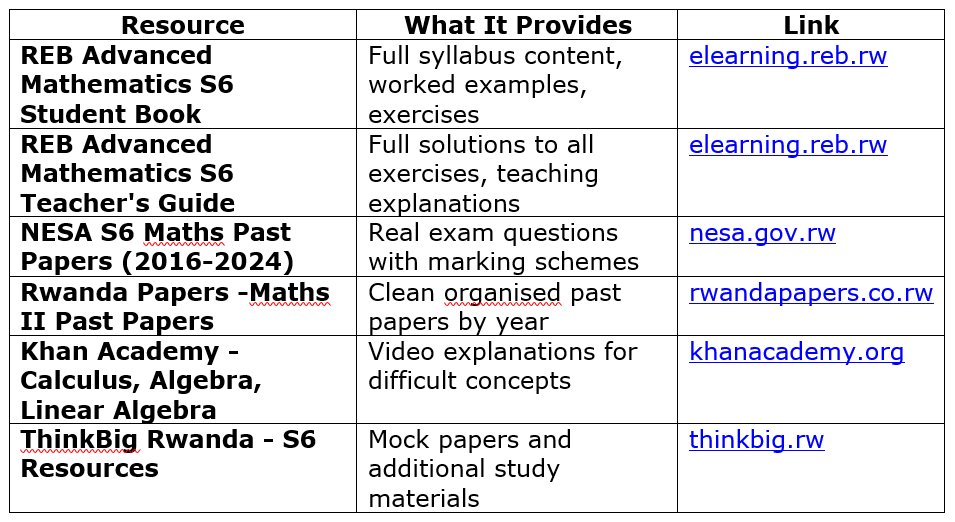
The Teacher's Guide is the most underused resource in Rwanda. It contains fully worked solutions to every exercise in the Student Book — the equivalent of a tutor marking your work and showing you the correct method. Download it, use it, and mark your own work against it after every practice session.
A Honest Word About When Private Tuition Does Help
This article is titled "without private tuition" — and everything above is genuinely sufficient for a self-disciplined student who follows it consistently.
But there are two situations where a tutor makes a real difference even for capable students:
When you have hit a genuine conceptual wall. Some students can read a chapter on differential equations three times and still not understand why the method works. A tutor can identify the exact point where understanding breaks down and rebuild from there in a single session — something that can take weeks of self-study to resolve alone.
When your discipline is inconsistent. A tutor provides accountability. If you know that Wednesday evening is a tutoring session, you are far more likely to do Tuesday's preparation. For students who struggle to maintain a study routine independently, that external structure is worth a great deal.
If either of those situations describes you, a tutor is not a luxury — it is the pragmatic choice.
At Mathrone Academy, we match S6 Mathematics students with qualified, exam-experienced tutors who know the REB syllabus and what NESA marking schemes reward. Sessions are available online or at home, and can be scheduled as rarely as once a week for targeted support rather than full-time coaching.
WhatsApp us on +250 786 684 285 to find the right Mathematics tutor within 24 hours.
Request a tutor at Mathrone Academy
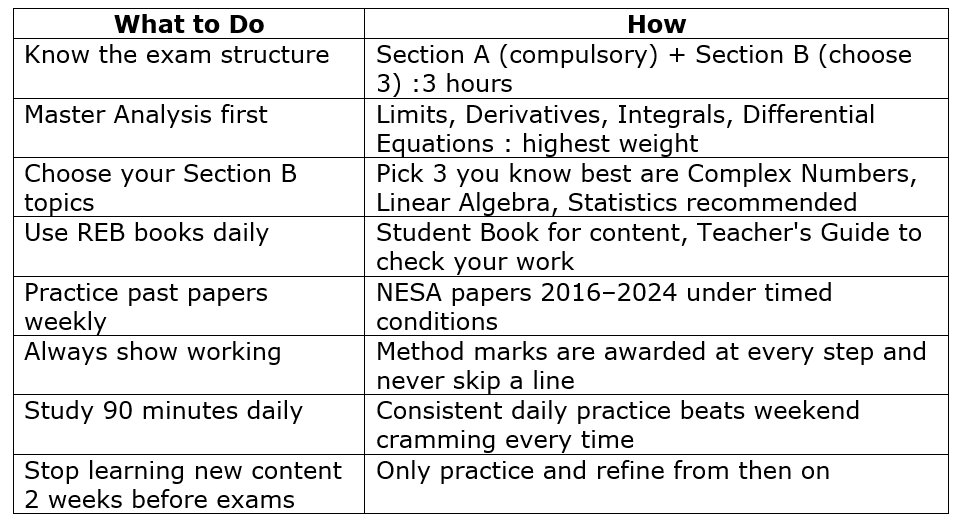
Summary: Your Roadmap to 80% and above in S6 Mathematics
Read: S6 National Exams Timetable — July 2026 →
Read: Best Learning Materials for Rwandan Students in 2026 →
Read: How to Study Effectively Proven Techniques for Rwandan Students →