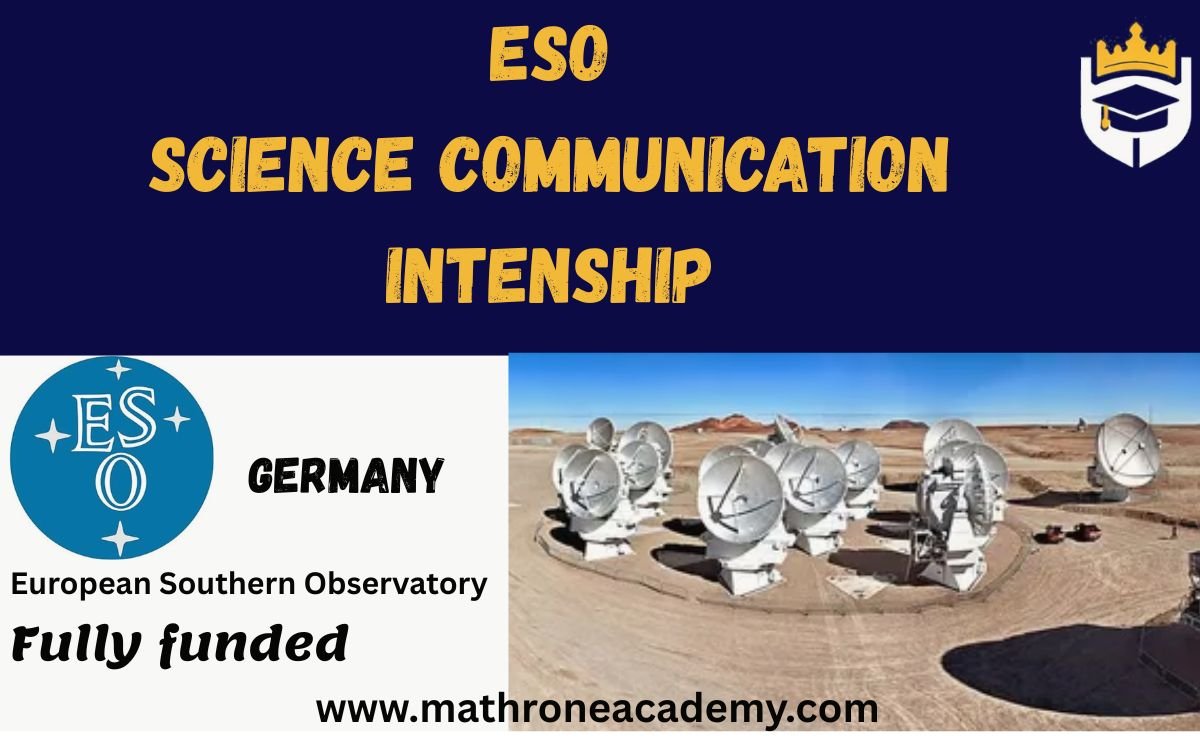
If you have a background in science or science communication, a genuine fascination with astronomy, and the ability to explain complex ideas clearly to a general audience, one of the most prestigious and fully funded internship opportunities in Europe is accepting applications right now, and has no fixed closing date.
The ESO Science Communication Internship is offered by the European Southern Observatory (ESO) which is one of the world's leading astronomical research organisations at its headquarters in Garching near Munich, Germany and it places interns within ESO's Department of Communication for 3 to 6 months, producing science journalism content for global audiences while receiving full financial support.
This guide gives you every verified detail: what the internship involves, what it covers, the rolling application process, who qualifies, what writing samples to submit, and what makes a competitive application.
About ESO and the Science Communication Internship
The European Southern Observatory was established in 1962 as an intergovernmental organisation dedicated to astronomical research and today it operates the world's most advanced ground-based telescopes including the Very Large Telescope (VLT) in Chile and the under-construction Extremely Large Telescope (ELT), which will be the largest optical telescope ever built. ESO is supported by multiple member states and is a global benchmark for excellence in astronomical observation and research.
The Science Communication Internship is housed within ESO's Education and Public Outreach Department (ePOD), the team responsible for translating cutting-edge astronomical discoveries into content that reaches global audiences across television, print, digital media, and public exhibitions and know that this is not a ceremonial internship as interns contribute directly to ESO's communication output writing real press releases, news articles, video scripts, and exhibition materials that are published globally. Your work reaches millions of people who follow ESO's research communications worldwide.
What the Internship Involves
Interns work within ESO's Department of Communication on a daily basis, contributing to the full range of the department's outreach activities. Typical tasks include:
Writing and editorial:
- News articles covering astronomical discoveries for public audiences
- Press releases distributed globally to international media
- Video scripts for ESO's social media and YouTube channels
- Exhibition text and educational materials
- Web content and social media posts
Media and production support:
- Supporting broadcast material production for television and online media
- Coordinating with photographers and graphic designers
- Contributing to ESO's image and video archive with appropriate captions and descriptions
Event and outreach support:
- Supporting public engagement events and astronomy outreach activities
- Contributing to ESO's educational programme development
- Liaising with media representatives during major astronomical announcements
The common thread across all tasks is the ability to understand complex scientific content including reading and interpreting ESO scientific papers and translate that content into engaging, accurate, and accessible communication for non-specialist audiences.
What the Internship Covers
The ESO Science Communication Internship is fully funded. Here is exactly what every selected intern receives:
- Monthly living allowance; a regular stipend to cover day-to-day living expenses in Munich/Garching and the exact amount is not publicly listed contact ESO directly at [email protected] to confirm the current rate before applying
- Accommodation, housing is provided or arranged for the duration of the internship
- Round-trip travel the cost of a return trip from your home station to Garching is covered by ESO at the start and end of the internship
What is not covered:
- Visa application fees and administrative costs
- Personal expenses beyond the living allowance
- Internal travel within Germany or Europe during the internship period
- Any expenses outside the defined internship duration
A note on the Germany location:
Garching is a university and research town immediately adjacent to Munich, home to multiple major research institutions including the Max Planck Institute and the Technical University of Munich. The area has a strong international academic community, excellent public transport into Munich, and is one of the most intellectually vibrant research environments in Europe.
The Rolling Application: No Fixed Deadline
This is the most important and most misunderstood aspect of the ESO Science Communication Internship and it is consistently reported incorrectly by most articles.
There is no fixed application deadline.
The ESO Science Communication Internship operates as a rolling position applications are accepted continuously throughout the year and reviewed every 4 to 6 months. There is no single “apply by” date after which the window closes. Applications submitted at any point enter the next review cycle.
What this means practically:
- You can apply at any time of year, January, April, August, December it does not matter
- Applications are batched and reviewed by the selection committee every 4–6 months
- You should indicate your preferred start date in your application
- Applying earlier within a review cycle may give your application more processing time before the next review meeting
The “31 December 2026” deadline cited by many articles is incorrect: it appears to be a date from a different ESO programme or an older announcement that has been incorrectly applied to the Science Communication Internship. Do not rely on that date. The official position is rolling.
To confirm current availability and the next review cycle: Contact ESO's recruitment team at [email protected]
Two Locations: Germany and Chile
Most articles discuss only the Germany internship. There is also a Chile-based option, though with important differences:
Garching, Germany (primary location):
- Open to international applicants of all nationalities
- Full benefits: monthly allowance, accommodation, return travel
- Rolling applications, no fixed deadline
- English is the primary working language
Chile (Paranal/Santiago):
- The Chile variant appears directed specifically at students enrolled in South American universities, and a specific summer 2026 deadline of 2 October 2025 was previously advertised for that cycle
- Conditions differ from the Germany placement , verify directly with ESO
- A special allowance is offered for Chile-based interns
For international applicants from Africa, Asia, Eastern Europe, or the Americas who are not enrolled at South American universities, the Germany placement is the relevant and accessible option.
Eligibility Criteria
Academic background:
The internship is open to students currently pursuing or recently graduated with a degree in:
- Science (any discipline, physics, astronomy, biology, chemistry, environmental science)
- Science Communication
- Science Journalism
- Science Education
You do not need to be an astronomer and you need to have a science background that allows you to understand scientific papers, and the communication skills to translate that understanding for a general audience.
English proficiency:
Strong written and spoken English is required, this is the primary working language at ESO's Garching headquarters. While German language skills are helpful for daily life in the Munich area, German is not a hard requirement for the Science Communication internship specifically and proficiency in English is the essential language criterion.
Technical skills:
Strong MS Office skills, Word, Excel, and PowerPoint are required as stated in the official internship description.
Nationality:
Open to all nationalities. Preference is given to nationals of ESO member states Australia, Austria, Belgium, Czech Republic, Denmark, Finland, France, Germany, Ireland, Italy, Netherlands, Poland, Portugal, Spain, Sweden, Switzerland, and the United Kingdom. Applicants from other countries including all African nations can and do apply, but should be aware of this preference in the selection process.
Duration availability:
You must be available for a minimum of 3 months and ideally up to 6 months and also you have to indicate your availability and preferred start date in your application.
Required Documents
This is the requirement most often understated or omitted which is that Writing samples are not optional, they are a mandatory component of the application.
The full application requires:
1. Motivation Letter, maximum 1 page
Explain your interest in science communication, your relevant background, and why you want to work specifically at ESO. One page only not more you have to be concise and specific.
2. Curriculum Vitae (CV), maximum 2 pages
Your academic background, relevant work or internship experience, language skills, and any science communication outputs (articles, videos, blog posts, etc.). Two pages maximum.
3. Writing Samples, each sample maximum 5 pages
Each writing sample must demonstrate your ability to communicate science to a wider audience. Scientific papers or theses targeting a scientific audience are explicitly NOT accepted.
Your samples should be pieces you have already written not created for this application. Ideal samples include:
- Magazine or newspaper articles about science topics
- Blog posts or online articles explaining scientific concepts to non-specialists
- Press releases for scientific organisations or university departments
- Exhibition text or educational materials
- Science podcast scripts or video scripts
If you do not yet have formal writing samples, begin creating them now write 2 to 3 science communication pieces for your own portfolio. A well-written 3-page blog post explaining a recent astronomical discovery in accessible language is a valid and appropriate sample.
How to Apply
Step 1: Visit the official ESO recruitment portal at eso.org/sci/facilities/paranal/cfp/cfp.html or the ESO careers page at eso.org/public/jobs
Step 2: Locate the Science Communication Internship listing in the vacancies section
Step 3: Prepare your application documents, motivation letter (1 page), CV (2 pages), and writing samples (each max 5 pages, science communication focus only)
Step 4: Complete the online application form in English
Step 5: Upload all documents and submit. Applications are reviewed on a rolling basis every 4–6 months. Indicate your preferred start date.
Step 6: The selection committee reviews shortlisted applications and contacts successful candidates. Due to the volume of applications, only shortlisted candidates are typically contacted.
For questions about the internship or current availability: 📧 [email protected]
What Makes a Competitive ESO Science Communication Application
Your writing samples decide everything.
The selection committee is evaluating one thing above all else: can this person explain science clearly and compellingly to a non-specialist audience? Your motivation letter and CV provide context. Your writing samples provide evidence. Invest the most time in choosing and preparing the right samples.
Demonstrate genuine astronomy knowledge.
You do not need a PhD in astrophysics, but you do need to show you can read and understand ESO scientific papers. In your motivation letter, reference a specific recent ESO discovery or research output that interested you and briefly explain what made it compelling. This signals that you have engaged with ESO's actual work rather than simply applying to a generic internship.
Science communication experience is more valuable than academic credentials.
A candidate with a biology degree who has written 20 science blog posts, produced a science podcast, or contributed to a university science magazine is a stronger candidate than a candidate with a perfect GPA who has never communicated science publicly. Build your portfolio before applying.
Keep your motivation letter to one page.
ESO specifies this clearly. Submitting two pages signals that you cannot follow instructions not a strong start for a role built on clear communication.
Apply strategically; not impulsively.
Since applications are rolling, take the time to prepare a genuinely strong package rather than rushing to submit immediately. A polished application submitted in three weeks is significantly more competitive than a rushed application submitted today.
Why This Internship Is Worth Pursuing
ESO's global profile.
ESO's communications reach scientists, journalists, educators, and astronomy enthusiasts across 190+ countries. Content produced by ESO communication interns is seen globally. A press release you write could be published in Nature News, BBC Science, or The Guardian. This is a real, high-visibility platform.
Unique professional credential.
“Science Communication Intern at the European Southern Observatory” is a credential that stands out in any science journalism or science communication career. ESO's reputation in the scientific community is equivalent to CERN, immediately recognisable as world-class.
Munich as a base.
Garching sits within the greater Munich ecosystem, one of Europe's most innovative and liveable cities, with excellent museums, a vibrant international community, outstanding public transport, and proximity to the Alps. Six months here is a genuinely enriching personal experience alongside the professional development.
A career pathway into science media.
ESO interns who perform well leave with professional writing samples published by one of the world's leading scientific institutions, direct references from ESO's communication team, and a network that connects them to the international science communication community. Alumni of this internship have gone on to careers at major science media organisations, universities, and research institutions worldwide.
Frequently Asked Questions
Q: What is the deadline for the ESO Science Communication Internship 2026?
There is no fixed deadline. The ESO Science Communication Internship is a rolling position applications and are accepted year-round and reviewed every 4 to 6 months. Indicate your preferred start date when applying. The “31 December 2026” date cited by some articles is incorrect. Apply as soon as your application documents are ready and strong.
Q: Is the ESO Science Communication Internship open to students from Africa and developing countries?
Yes. The internship is open to all nationalities in principle. Preference is given to nationals of ESO member states (Australia, Austria, Belgium, Czech Republic, Denmark, Finland, France, Germany, Ireland, Italy, Netherlands, Poland, Portugal, Spain, Sweden, Switzerland, UK), but applicants from all countries including all African nations can apply.
Q: Do I need to speak German to apply for the ESO Science Communication Internship?
No. English is the primary working language at ESO's Garching headquarters and the essential language requirement for the Science Communication internship. German language skills are helpful for daily life in the Munich area but are not a hard requirement for this specific position.
Q: Are writing samples required for the ESO Science Communication Internship?
Yes, writing samples are mandatory. Each sample must be a maximum of 5 pages and must demonstrate your ability to communicate science to a wider, non-specialist audience. Scientific papers or theses targeting a scientific audience are explicitly not accepted. Samples should be journalism pieces, blog posts, press releases, or educational materials you have already written.
Q: What does the ESO Science Communication Internship cover financially?
The internship covers a monthly living allowance, accommodation in Garching/Munich, and the cost of a return trip from your home station. The exact monthly allowance amount is not publicly specified, contact ESO at [email protected] to confirm the current rate before applying.
Q: Do I need a background in astronomy to apply?
You do not need to be an astronomer. You need a science background sufficient to understand ESO scientific papers, meaning a degree in any science discipline, science communication, or science journalism. You must also demonstrate a broad knowledge and interest in basic astronomy, including how telescopes work, key astronomical objects, and the fundamentals of observational astronomy.
Q: How long is the ESO Science Communication Internship?
The duration is 3 to 6 months. You should indicate your available dates and preferred duration when applying. ESO's internship positions are typically for 3 months minimum shorter durations are generally not considered.
Read: METI Japan Internship Program 2026 — Complete Guide →
Read: CERN Short Term Internship 2026 — Verified Guide →
Read: Germany PhD Fully Funded Scholarships 2027 →
Browse all scholarships and opportunities →
Published by Mathrone Academy — connecting students and professionals worldwide with quality education resources and scholarship opportunities. Visit us at mathroneacademy.com