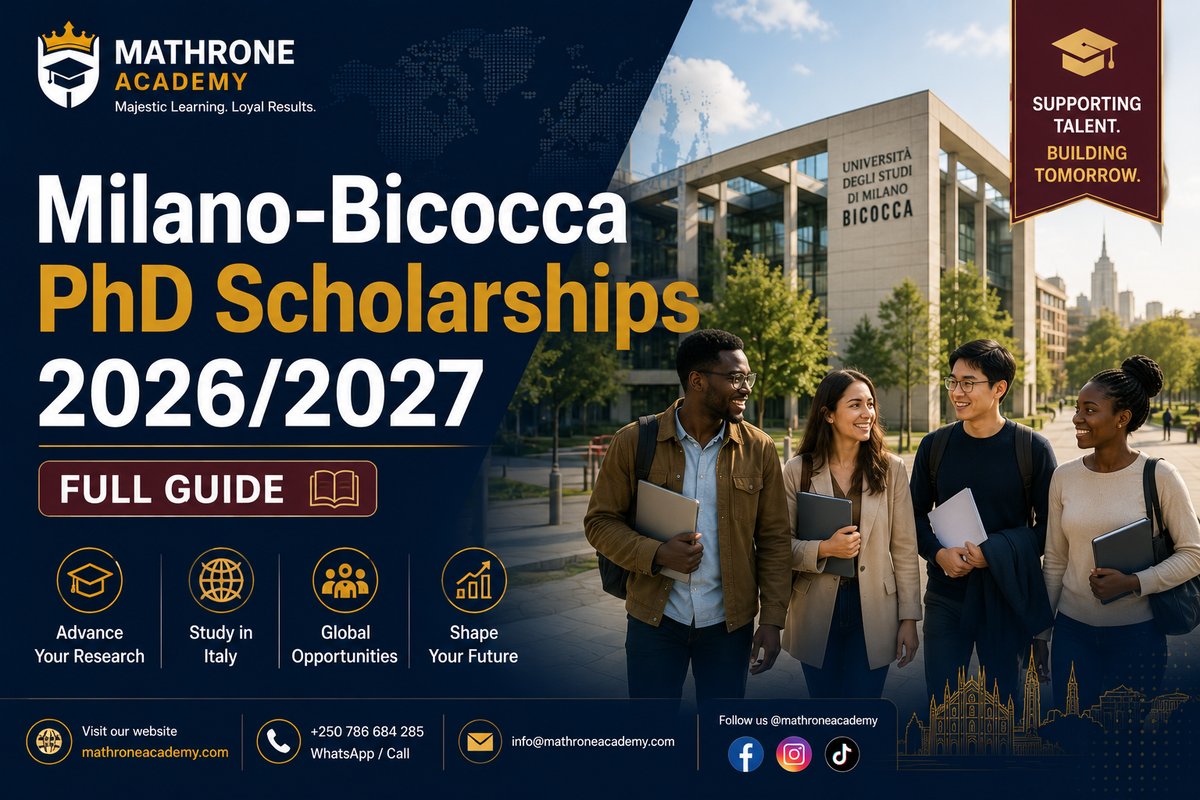
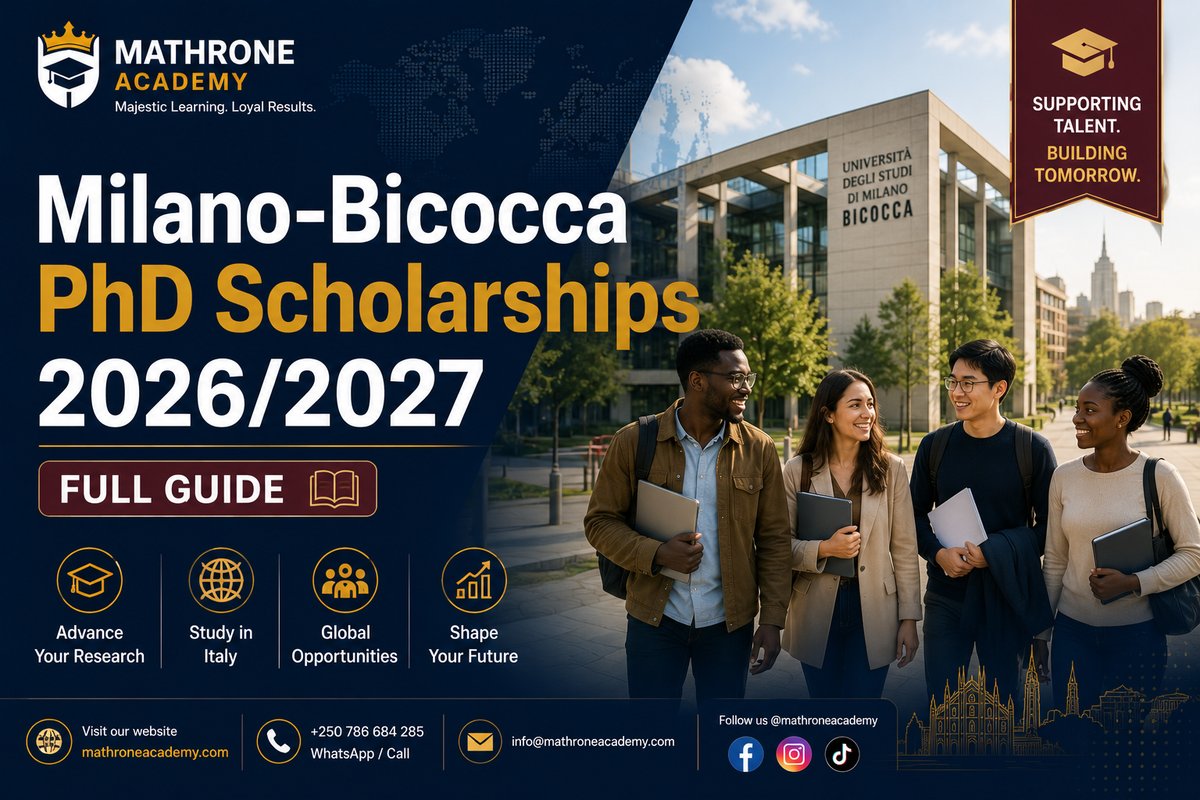
The University of Milano-Bicocca has opened one of Italy's largest doctoral recruitment rounds for the 2026/2027 academic year, offering funded PhD positions across nearly every major research field. It's worth being precise about the naming here, since it affects when you should actually apply: this is the university's 2026/2027 academic year call, its 42nd (XLII) doctoral cycle, not a separate "2027" programme as some scholarship-listing sites describe it. This guide explains exactly who's eligible, what the funding actually covers, and how the two-session application process works, including the currently open second session.
What This Scholarship Round Actually Is
Milano-Bicocca's 2026/2027 PhD call opened with 139 funded doctoral positions in its first session, spanning mathematics, physics, chemistry, medicine, psychology, engineering, computer science, social sciences, law, economics, environmental sciences, statistics, and more. Founded in 1998 and based in Milan, Milano-Bicocca has built a strong reputation for research output and industry collaboration in a relatively short institutional history, and its PhD call is structured in two separate application sessions rather than a single annual deadline.
Session I ran from 18 March to 17 April 2026 and covered the main body of funded positions. Session II, which opened on 1 July 2026 and closes on 22 July 2026, is specifically for positions that received additional funding from companies, external institutions, or university departments after Session I was already published, so it doesn't necessarily include every programme that appeared in the first round. As of this writing, Session II is currently open, making this a genuinely timely opportunity for eligible students who missed the April deadline or whose ideal research area only received funding after Session I closed.
Who Can Apply
Candidates of any nationality are eligible to apply, and there is no separate nationality-based restriction limiting this round to Italian or EU applicants. To be eligible, applicants generally need to hold one of the following qualifications:
- A postgraduate (second-cycle) degree, such as a Master's
- An old-system Italian degree predating the 1999 reform
- A Master's degree from an AFAM (Higher Education in Art, Music, and Dance) institution
- A foreign degree recognized as equivalent in duration, level, and subject area, as assessed by the relevant Selection Board
Students who haven't yet completed their Master's degree can still apply, provided they obtain the qualifying degree by 31 October 2026, and confirm their final degree details to the university by 4 November 2026. Applicants already enrolled in the same PhD programme at Milano-Bicocca cannot reapply to it. It's also worth knowing that certain positions are specifically reserved for foreign candidates residing abroad; where this applies, the application requires selecting that category explicitly and uploading an official document confirming foreign residence alongside standard identification.
What the Funding Actually Covers
The standard Milano-Bicocca PhD scholarship is set at 16,243 euros gross per year, translating to an indicative net payment of roughly 1,200 euros per month, paid in twelve monthly instalments and renewed annually upon passing required progress evaluations. Positions funded through a company, external research project, or partner institution may carry different financial terms or additional research allowances, so it's essential to check the specific funding entry on each individual programme's description sheet rather than assuming every listed position carries identical terms; some positions in the call are explicitly marked "without scholarship," meaning admission alone doesn't guarantee funding. All funded PhD programmes run for a maximum of 36 months (three years) and are aimed at early-stage researchers, generally those with zero to four years of post-graduate experience. Scholarship recipients are permitted to earn additional income alongside the stipend, provided it doesn't exceed the annual scholarship amount itself.
How to Apply
The full application runs entirely online through Milano-Bicocca's Online Secretariat portal, with no paper documentation accepted, and it cannot be submitted by email under any circumstances, even close to a deadline. The general process follows these steps:
- Create an account on the Online Secretariat (existing or former Milano-Bicocca students use their existing login credentials)
- Carefully read the individual description sheet for the specific programme or project you're applying to, since Session II positions in particular are often tied to a defined research topic, industrial placement, or partner laboratory, meaning a strong general academic profile alone isn't enough if it doesn't genuinely match the advertised project
- Gather required documents: a valid ID, a recent digital ID photo, degree certificates or self-certifications, a research project proposal tied to the chosen position, and, for foreign degrees, a comparability certificate from CIMEA or ENIC-NARIC where applicable, along with translations if documents aren't already in English or Italian
- Pay the 10 euro application fee per programme through the PagoPA payment system, submitting a separate application and fee for each individual programme you apply to if applying to more than one
- Review and submit before the session deadline; once an application is finally submitted, it cannot be edited, resubmitted, or withdrawn simply to swap out a document, so it's worth double-checking everything carefully before that final step
- Attend the selection process, which evaluates qualifications, the submitted research project, and typically an oral examination; many programmes accommodate candidates living outside Italy through videoconference interviews, though this isn't guaranteed for every single programme
One detail worth knowing in advance for the oral stage: Milano-Bicocca's own guidance notes that selection panels commonly ask about a candidate's Master's thesis, research methods, motivation, and specifically how well their background fits the proposed project, and candidates are expected to be able to defend their methodological choices in discussion, not simply present a rehearsed pitch.
Why English-Language Study Is Possible Without Italian
Italy has increasingly positioned itself as an accessible destination for international doctoral students, and Milano-Bicocca's PhD programmes include research tracks conducted partly or entirely in English. A candidate applying to an English-language PhD programme generally doesn't need Italian language proficiency for academic admission, unless the specific programme's call explicitly states otherwise, so it's worth checking the individual description sheet for language requirements rather than assuming. That said, even without an academic requirement, basic Italian remains genuinely useful for day-to-day life in Milan: housing, healthcare appointments, and general administration are considerably easier to navigate with at least conversational Italian.
Why This Kind of Scholarship Matters for Students Aiming Abroad
For students following the Cambridge A-Level or Rwanda's REB pathway or any curriculum with sights set on postgraduate study abroad, opportunities like Milano-Bicocca's PhD call are a useful, concrete reminder of what a strong undergraduate and Master's foundation eventually opens up. Getting to the point of a competitive PhD application starts years earlier, with the specific A-Level or advanced-level subject combination a student chooses at 16 or 17. Our guide to the best A-Level subject combinations by career path is worth reading well before this stage becomes relevant, since the sciences and mathematics-heavy combinations it covers are precisely the foundation most competitive for research-focused postgraduate funding later on.
Building the Academic Foundation That Competitive Funding Requires
Opportunities like this are won years in advance, through consistently strong grades, genuine subject depth, and the kind of academic record that makes a research proposal credible to a selection panel. If your child is earlier in that journey and building toward strong IGCSE or A-Level results, our article on spotting the early signs a child needs extra academic support is a useful starting point for making sure that foundation stays solid.
Mathrone Academy provides one-on-one tutoring across Cambridge IGCSE, A-Level, and Rwanda's REB national curriculum, for students anywhere in the world, helping build the kind of strong, consistent academic record that competitive scholarships like this one ultimately look for.
Get matched with a tutor:
WhatsApp: +250 786 684 285
Email: [email protected]