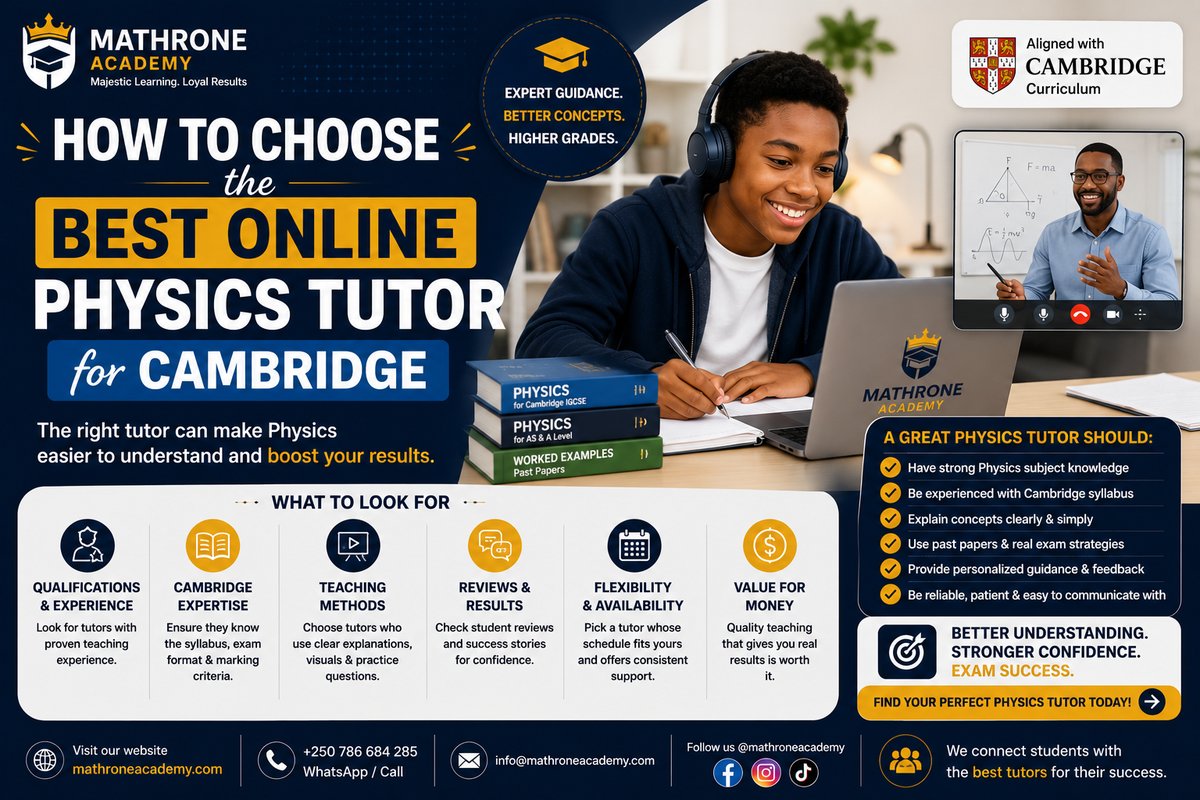
Physics consistently ranks among the subjects students most often seek tutoring for, and it's not hard to see why. It combines dense conceptual understanding with genuinely demanding mathematics, and Cambridge's own IGCSE and A-Level Physics syllabuses move quickly, layering new ideas on top of ones a student needs to have already mastered. Search for "best online Physics tutors" and you'll mostly find marketplaces where anyone can list a profile, with little independent guidance on how to actually judge quality. This guide fills that gap: what genuinely separates an effective Cambridge Physics tutor from a generic one, real cost ranges, the specific topics where students most often get stuck, and the questions worth asking before you commit.
Why Physics Specifically Needs a Specialist, Not a Generalist
Physics sits in an unusual position compared to other Cambridge subjects. It demands strong mathematical fluency, since much of IGCSE and A-Level Physics is really applied mathematics wearing a physics label, particularly in mechanics and electricity. It also demands genuine conceptual intuition, the ability to visualize forces, fields, and waves rather than just manipulate equations, which is precisely where many capable students who are strong at pure mathematics still struggle. A tutor who's excellent at Mathematics but only generally competent at Physics often misses this second piece entirely, drilling equations without building the physical intuition that actually lets a student handle an unfamiliar exam question rather than just a rehearsed one.
On top of this, Cambridge Physics includes a substantial practical and data-handling component, tested directly in specific papers at both IGCSE and A-Level, and this is a skill set many otherwise strong tutors have surprisingly little direct experience teaching, since it involves experimental method, error analysis, and graph interpretation rather than pure problem-solving.
What Actually Makes a Cambridge Physics Tutor Effective
Genuine command of the mathematics underneath the physics. A tutor should be entirely comfortable with the mathematical techniques Cambridge Physics actually requires: vectors, trigonometry, exponential and logarithmic relationships at A-Level, and increasingly, calculus-based reasoning for the most demanding topics. If a tutor is visibly working out the maths alongside the student rather than guiding it fluently, that's worth noticing.
The ability to build physical intuition, not just recite formulas. Strong Physics teaching connects an equation back to what's physically happening, why a force behaves the way it does, why a wave interferes constructively here and destructively there, rather than presenting formulas as things to memorize and plug numbers into. This is usually the clearest sign of a tutor who deeply understands the subject rather than one who's simply worked through the syllabus themselves.
Direct experience with practical and data-handling papers. Ask specifically whether a tutor has taught the experimental and practical components of the syllabus, not just the theory papers, since these carry real marks and are frequently under-prepared for compared to pure theory.
Comfort with past papers and command word precision, the same principle that applies across every Cambridge subject: understanding exactly what "state," "explain," "calculate," and "describe" each specifically require in a Physics mark scheme, since Physics examiners are particularly exacting about showing correct working and using the right units and significant figures.
Common Topics Where Cambridge Physics Students Get Stuck
Certain topics come up again and again as genuine sticking points, and it's worth knowing them in advance, both to gauge whether a prospective tutor speaks about them with real specificity, and to help identify where your own child might need the most focused support.
Mechanics, particularly forces, moments, and circular motion, is often the first place students hit a genuine wall, since it demands translating a word problem into a correct diagram and equation setup before any calculation even begins.
Electricity and circuits trip up students who can recite Ohm's Law but struggle to reason through more complex series-parallel combinations or apply Kirchhoff's laws confidently under exam pressure.
Waves and optics, especially interference and diffraction, are conceptually abstract in a way many students find genuinely hard to visualize without strong diagrams and physical analogies.
Fields, gravitational, electric, and magnetic, at A-Level specifically, are widely regarded as one of the most demanding topics on the entire syllabus, since they require holding several related but distinct concepts in mind simultaneously.
Practical and data-handling questions catch out students who are strong on theory but have had limited hands-on lab experience, particularly around uncertainty, error propagation, and drawing conclusions from graphs with proper justification.
What Online Physics Tutoring Actually Costs
Pricing for Physics tutoring specifically tends to run slightly higher than more generalist subjects, reflecting the smaller pool of tutors genuinely comfortable with both the mathematics and the conceptual demands of the subject at Cambridge level.
Open marketplaces with minimal vetting generally start around 3 to 15 USD per hour, though as with any open marketplace, the range in actual teaching quality at that price point is considerable.
Specialist tutoring services and experienced independent tutors with specific Cambridge Physics experience typically charge 30 to 50 USD per hour, often reflecting qualifications like a Physics degree, a PGCE, or direct examiner experience with Cambridge or Edexcel.
Premium tutors, frequently university lecturers, former Heads of Physics, or examiners with extensive specific track records, can charge 50 to 80 USD or more per hour.
Physics is one of the subjects where paying for genuine specialization tends to be worth it more consistently than in some other areas, precisely because the gap between a generalist Science tutor and a genuine Physics specialist tends to show up quickly in how a student handles unfamiliar problems, not just rehearsed ones.
Questions Worth Asking Before You Commit
- Do you have a Physics-specific degree or teaching qualification, or is Physics one of several Sciences you cover generally?
- Which exam board have you specifically taught, Cambridge (CAIE), Edexcel, or Oxford AQA, and at which level, IGCSE or A-Level?
- How do you approach the practical and data-handling papers specifically, not just the theory content?
- Can you walk me through how you'd teach a specific topic my child is struggling with, right now, in a trial session?
- What mathematical background do you expect a student to already have, and how do you handle it if that foundation has gaps?
If your child is still deciding on their exact IGCSE tier or A-Level subject combination, and Physics specifically is on the table as an option, our guide to A-Level subject combinations by career path covers exactly where Physics fits into Engineering, Natural Sciences, and other STEM pathways, since it's one of the subjects universities weigh most heavily for those specific degrees.
Physics-Specific Study Habits That Actually Work
Beyond finding the right tutor, a few study habits consistently separate students who close Physics gaps quickly from those who stay stuck. Working through past papers under timed conditions matters more in Physics than almost any other subject, since exam technique, particularly showing correct working, using appropriate significant figures, and including units, accounts for real marks independent of whether the final numerical answer is correct. Building a habit of sketching a diagram before attempting any mechanics or fields problem, even when the question doesn't explicitly ask for one, tends to prevent the setup errors that cause most mark loss in these topics. And treating practical papers as a distinct skill to practice deliberately, not an afterthought bolted onto theory revision, closes one of the most common and avoidable gaps in final grades.
Getting Physics Support Built Around Your Child's Syllabus
If you've worked through this guide and you're ready to find a tutor rather than keep comparing marketplace profiles, the most reliable next step is a direct conversation about your child's specific syllabus and current sticking points. Mathrone Academy provides one-on-one online Cambridge Physics tutoring, matched to your child's exact exam board and level, IGCSE or A-Level, for students anywhere in the world, alongside support across Mathematics, Chemistry, Biology, and other core subjects. For Rwanda-based families, our tutors also support the REB national curriculum alongside Cambridge. If you're still weighing whether tutoring is the right next step, our article on spotting the early signs a child needs extra support is a useful place to start, and our guide to choosing an online IGCSE tutor more broadly covers the same principles across other core subjects if Physics isn't the only area of concern.
Get matched with a tutor:
WhatsApp: +250 786 684 285
Email: [email protected]