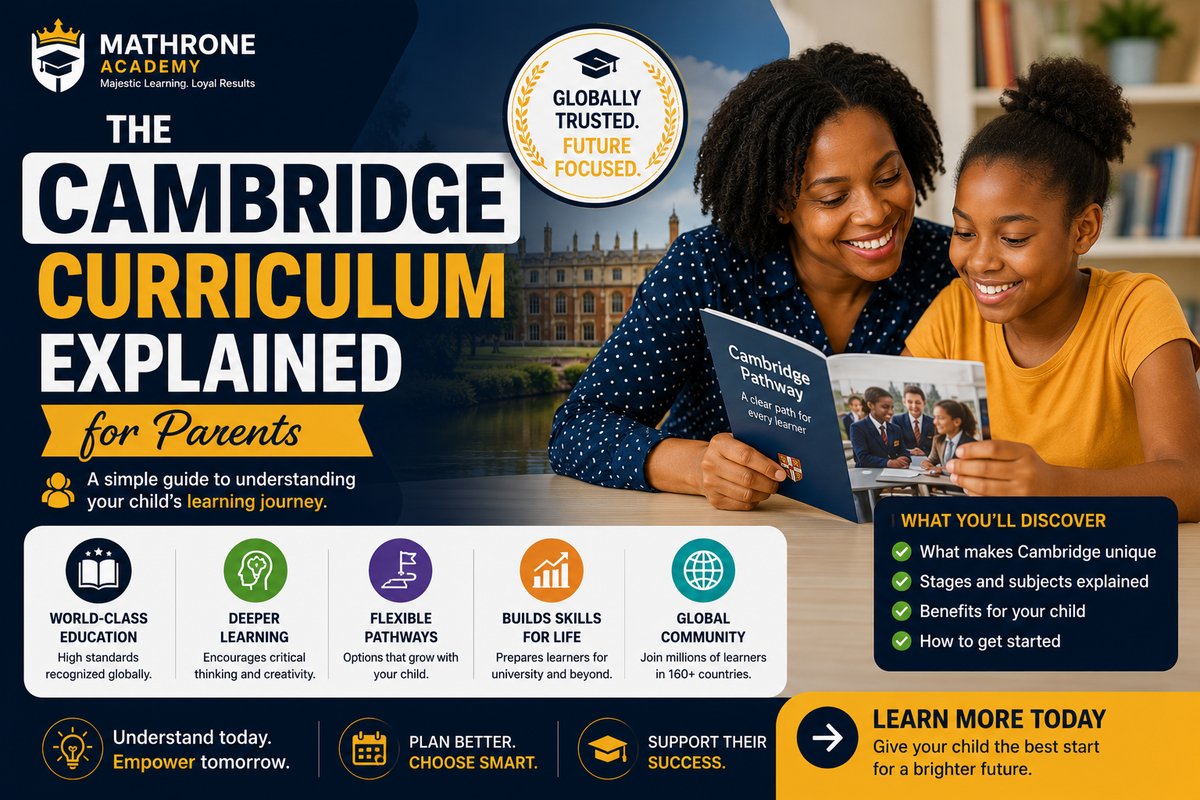
"Cambridge curriculum" is one of those phrases that gets used constantly by schools and parents, but rarely explained clearly. Many parents assume it simply means IGCSE, or picture one single fixed programme, when in reality it's a structured five-stage pathway spanning ages 3 to 19, with different qualifications, assessment styles, and goals at each stage. This guide walks through the whole pathway clearly, explains how Cambridge is actually assessed compared to other boards, and gives you a practical checklist for verifying that a school is genuinely teaching what it claims to.
The Cambridge Pathway: Five Stages, One Continuum
The full Cambridge Pathway is built around five sequential stages, developed by Cambridge Assessment International Education, part of the University of Cambridge. Schools can offer all five stages, or only a selection of them, which is one of the most important things for a parent to check before enrolling, since not every "Cambridge school" runs the full continuum from the very beginning.
- Cambridge Early Years: ages 3 to 6
- Cambridge Primary: ages 5 to 11
- Cambridge Lower Secondary: ages 11 to 14
- Cambridge Upper Secondary (leading to Cambridge IGCSE): ages 14 to 16
- Cambridge Advanced (leading to AS and A-Levels): ages 16 to 19
Each stage builds directly on the one before it, and the curriculum frameworks are used by more than 10,000 schools across roughly 160 countries, which is exactly what gives a Cambridge education its international portability: a family that studies Cambridge Lower Secondary in one country can move to a Cambridge school almost anywhere else in the world and continue at broadly the same point.
Cambridge Early Years (Ages 3-6)
This is the foundational stage, focused on building early language, number sense, social skills, and curiosity through structured play and guided exploration rather than formal exams. It's designed to prepare children for the more structured academic expectations that begin at Cambridge Primary, without introducing formal testing at this early age. Not every school offers this stage as a distinct Cambridge programme; some run a general early-years curriculum before formally adopting Cambridge Primary, which is worth clarifying if a very early start on the Cambridge pathway specifically matters to your family.
Cambridge Primary (Ages 5-11)
Cambridge Primary develops learner skills and understanding across ten subjects: English as a first or second language, Mathematics, Science, Art & Design, Digital Literacy, Music, Physical Education, Cambridge Global Perspectives, and ICT. This stage focuses on building strong foundations in literacy and numeracy, alongside the habit of explaining ideas, asking questions, and completing small independent projects, skills that matter as much for later Cambridge stages as the subject content itself.
At the end of Cambridge Primary, schools can choose to enter students for Cambridge Primary Checkpoint, an externally marked assessment covering English, Mathematics, and Science, plus a team-based Global Perspectives project. Checkpoint is optional, not every school offers it, so it's worth asking directly whether your child's school runs it if formal, internationally benchmarked feedback matters to you at this stage. For a deeper look at how Checkpoint specifically works, and a comparison of schools that genuinely run this stage well, our guide on Cambridge Primary schools in Rwanda covers it in more detail.
Cambridge Lower Secondary (Ages 11-14)
Lower Secondary is where learning becomes noticeably more "secondary-style." Subjects deepen, expectations around independent work rise, and students are gradually taught to manage their own study more directly rather than relying entirely on close teacher guidance. This stage carries real weight for a reason many parents underestimate: it's often the point at which a child either builds genuine academic confidence or begins to quietly struggle, and that outcome tends to shape how manageable IGCSE feels two years later.
If you're a relocating family joining a Cambridge school partway through this stage, it's worth paying particular attention to how well the school supports the transition, since children moving between curricula at this age can be bright and curious but still feel overwhelmed by new academic language and expectations. As with Primary, schools can offer an optional Cambridge Lower Secondary Checkpoint at the end of this stage, giving another externally benchmarked progress check before IGCSE begins. It's also worth knowing that a learner following Cambridge Lower Secondary won't necessarily cover exactly the same topics in exactly the same year as a learner on a different national curriculum at the same age; the overall ground covered by the end of the stage is broadly comparable, but the sequencing can differ, which matters specifically for families transferring schools mid-stage.
Cambridge Upper Secondary and IGCSE (Ages 14-16)
This is the stage most parents already recognize, largely because IGCSE has become a globally known qualification in its own right, and it can feel like the more concrete milestone compared to the earlier stages. Cambridge Upper Secondary is a two-year programme, and students choose a set of subjects, typically between 7 and 10, to study toward final Cambridge IGCSE examinations, sat externally rather than marked by the school itself.
Assessment at this stage becomes considerably more exam-focused than in earlier years, though well-run schools prepare students gradually through structured practice and feedback rather than a sudden jump in difficulty. If you want a full breakdown of exactly how IGCSE works, including subject choices, Core versus Extended tiers, and grading, our dedicated guide on what Cambridge IGCSE actually is covers this stage in complete depth.
Cambridge Advanced: AS and A-Levels (Ages 16-19)
The final stage of the pathway, Cambridge Advanced, is where students specialize significantly, typically narrowing down to just three or four subjects studied in much greater depth than at IGCSE. This stage is explicitly designed to prepare students for university-level study, and the subject combination chosen here has a direct, sometimes decisive, effect on which university courses remain realistically open. If your child is approaching this stage, our guide on the best A-Level subject combinations by career path breaks down exactly what leading universities, including Cambridge itself, actually look for in each subject area, from Medicine and Engineering through to Law and the Humanities.
How Cambridge Is Actually Assessed, and How It Differs From Edexcel
One thing that genuinely surprises many parents is that "Cambridge" isn't the only British international curriculum in the market, and the differences between boards go beyond just the name on the certificate. The main alternative most families encounter, particularly outside Africa in places like the UAE and Southeast Asia, is Pearson Edexcel. Understanding this distinction matters because some schools use Cambridge for IGCSE but switch to Edexcel for A-Level, or vice versa, and the assessment style genuinely affects how a course feels day to day.
Cambridge is generally described as more traditional and exam-heavy, following what's called a linear structure, meaning most of the final assessment happens at the end of the two-year course rather than being spread throughout it. This style rewards long-term recall and sustained exam endurance, and it places a strong emphasis on critical thinking, independent analysis, and conceptual depth. Cambridge also tends to offer schools more coursework and practical assessment options in certain subjects, particularly Sciences and Languages, compared to Edexcel.
Pearson Edexcel, by contrast, is generally more modular, especially at A-Level, where the International Advanced Level (IAL) allows students to sit exams in smaller units at different points across the year, with the option to retake individual units without waiting for the full course to end. This structure tends to reduce the pressure of a single, high-stakes final exam and suits students who benefit from more frequent, incremental feedback rather than one long build-up to a final assessment.
Importantly, universities generally do not favor one board over the other. Grades are treated as equivalent by UK universities (including Oxbridge and the Russell Group), US universities, and universities across the Middle East and Africa, since both boards are regulated to comparable academic standards. The practical choice, where a family or school has one, tends to come down to a student's learning style rather than which board carries more prestige: a student who is strong under sustained exam pressure and enjoys deep, connected analysis may thrive more naturally under Cambridge, while a student who benefits from regular checkpoints and the ability to retake individual units may find Edexcel's structure less stressful.
Does My Child Have to Start From the Beginning?
No, and this is one of the most common misconceptions parents have. Because each Cambridge stage has clear entry points, a student can join the pathway at any point, including transferring directly into IGCSE at 14 from a completely different national curriculum. Many students move into Cambridge schools partway through their education without major long-term disruption, though the transition tends to go more smoothly the earlier it happens relative to a stage's final assessments, simply because there's more time to adjust before exams begin.
Is Cambridge the Same as IGCSE?
No, and this confusion is extremely common. IGCSE is one specific qualification, taken at the Upper Secondary stage of the Cambridge Pathway, roughly ages 14 to 16. It is not the entire Cambridge system. Cambridge also includes the earlier Primary and Lower Secondary stages before IGCSE even begins, and the more advanced AS and A-Level stage afterward. A school that only offers "Cambridge from Grade 9" is technically offering Cambridge, but only starting at the Upper Secondary stage, with a different, often non-Cambridge, curriculum in the earlier years. Neither approach is wrong, but it's exactly the kind of detail worth confirming directly with a school rather than assuming from general marketing language.
How to Verify a School Is Genuinely Teaching Cambridge
Because "Cambridge" and "international school" are so often used almost interchangeably in casual conversation, it's worth confirming several specific things directly with any school you're considering, rather than relying on the word "Cambridge" appearing on a prospectus alone:
- Exactly which stages of the Cambridge Pathway the school offers, and from which grade each one begins
- Whether the school is officially registered with Cambridge International, which can be checked through Cambridge's own school directory
- Whether Cambridge Primary Checkpoint and Cambridge Lower Secondary Checkpoint are actually administered, if internationally benchmarked feedback at those stages matters to your family
- Whether the school uses Cambridge or Edexcel at IGCSE and A-Level specifically, since some schools mix boards across stages
- What proportion of each subject's final grade comes from coursework or practicals versus final written exams, since this varies meaningfully by subject even within Cambridge itself
This kind of verification matters more than it might seem: some well-known "international" schools run American, IB-only, or entirely different national curricula throughout, with no Cambridge stage at all, despite strong general reputations. Our comparison of the best Cambridge schools in Kenya covers exactly this issue in more depth, including a well-known Nairobi school that's frequently assumed to be Cambridge but genuinely isn't, and the same due-diligence approach applies wherever you're searching, whether that's Kenya, Rwanda, or elsewhere.
What This Means Practically, Stage by Stage
Pulling the whole pathway together, here's a practical way to think about each transition point rather than treating the five stages as an abstract list. Moving from Early Years into Primary is mostly about the introduction of structured subjects and the first formal expectations around reading and number work. Moving from Primary into Lower Secondary is where independent study habits genuinely start to matter, since this is the stage that most directly determines whether IGCSE two years later feels manageable or overwhelming. Moving from Lower Secondary into IGCSE is the first point where external, Cambridge-marked exams carry real weight, and subject choice becomes consequential rather than exploratory. And moving from IGCSE into A-Level is where the stakes rise sharply again, since subject combination decisions made at 16 directly shape university options at 18.
Each of these transitions is also where a gap, if left unaddressed, tends to compound rather than resolve on its own. A shaky grasp of fractions at Lower Secondary becomes a shaky grasp of algebra at IGCSE, which becomes a genuine barrier to A-Level Mathematics two years after that. This is exactly why timing support around transitions, rather than waiting until a student is visibly struggling mid-stage, tends to produce the best outcomes.
Supporting Your Child Through the Cambridge Pathway
Whichever stage your child is currently in, the biggest single factor in how smoothly they move to the next one is whether earlier foundations were genuinely solid, not just passed. Gaps that seem manageable at Lower Secondary tend to resurface, harder, at IGCSE, and IGCSE gaps resurface again at A-Level, since each stage builds directly on the content and study habits developed in the one before it. If you're trying to work out whether your child needs extra support at their current stage, our article on signs your child needs a private tutor is a useful starting point, and our guide on free AI tools for learning English is worth a look if language support specifically, rather than subject tutoring, is the more immediate need.
Mathrone Academy provides one-on-one tutoring across every stage of the Cambridge Pathway, Primary through A-Level, for students anywhere in the world, alongside support for Rwanda's own REB national curriculum for families based locally who want guidance across both systems from a single team.
Get matched with a tutor:
WhatsApp: +250 786 684 285
Email: [email protected]