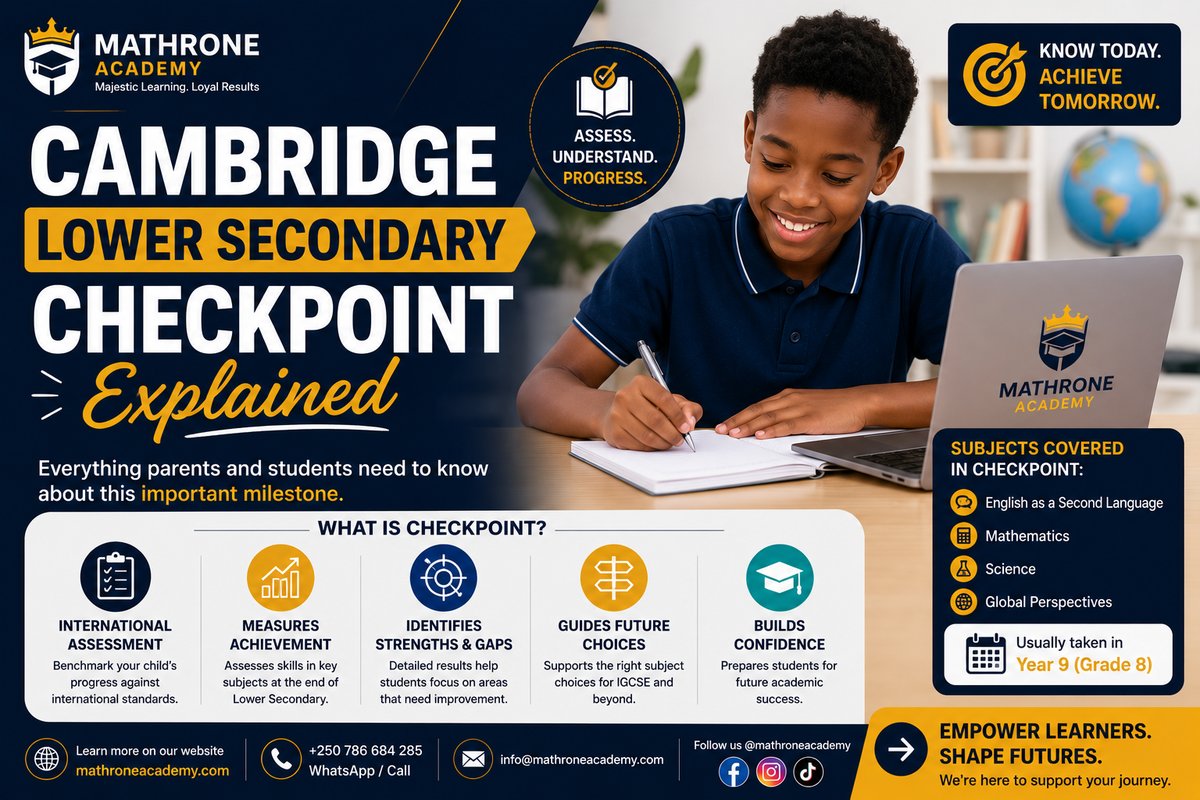
Cambridge Lower Secondary Checkpoint is one of the least understood parts of the Cambridge Pathway, mostly because it sits quietly between two much better-known milestones: Cambridge Primary and Cambridge IGCSE. Many parents only hear the word "Checkpoint" for the first time when a school mentions it in a Year 9 newsletter, with little explanation of what it actually is or why it matters. This guide explains exactly what Checkpoint tests, how it's scored, who can and can't take it, and what a parent should actually do with the results once they arrive.
What Cambridge Lower Secondary Checkpoint Actually Is
Cambridge Lower Secondary Checkpoint is a diagnostic testing service, not a pass-or-fail exam, taken at the end of Cambridge Lower Secondary, typically in Year 9, when students are around 14 years old. It assesses skills and knowledge built up across Years 7 to 9, and it exists specifically to give schools, parents, and learners an international benchmark of performance before students move into the considerably higher-stakes environment of Cambridge IGCSE. Tests are available in four subjects: English, English as a Second Language, Mathematics, and Science, with an additional Global Perspectives option assessed through an individual research report rather than a written exam.
Crucially, Checkpoint is optional. Schools decide whether to enter their students, and while many schools strongly encourage participation, particularly at Year 9, a student who doesn't sit Checkpoint faces no consequence for their later IGCSE grades. It functions purely as a feedback and readiness tool, not a gatekeeping exam standing between a student and the next stage of their education.
What the Tests Actually Look Like
For each subject, Checkpoint consists of two question papers, each taking roughly one hour to complete, though timing varies slightly by subject. The tests are fully marked externally by Cambridge International itself, not by the student's own teachers, which is exactly what gives the results their internationally comparable weight. Because the tests are held under formal external examination conditions, Checkpoint also doubles as genuinely useful early practice for the exam discipline, timing, and pressure a student will encounter properly for the first time at IGCSE two years later.
The Global Perspectives Checkpoint works differently from the other four subjects: it's assessed through an Individual Research Report rather than a written exam paper, marked initially by the student's own teacher and then moderated by Cambridge, rather than being marked externally from the start.
How Checkpoint Scoring Actually Works
This is the part that confuses the most parents, so it's worth walking through carefully. Since the May 2023 test series, Cambridge Lower Secondary Checkpoint results are reported on a 0 to 50 scale, replacing an older 0.0 to 6.0 scale that some parents with older children may still remember. Alongside the numerical score, each subject result is also classified into one of five performance bands:
| Performance Band | Score Range (0-50 scale) | What It Generally Means |
|---|---|---|
| Basic | 1-10 | Limited understanding of curriculum content; would benefit from focused support across most areas |
| Aspiring | 11-20 | Shows a mix of basic and good performance |
| Good | 21-30 | Secure understanding of most curriculum content, with specific areas identified for further focus |
| High | 31-40 | Shows a mix of good and outstanding performance |
| Outstanding | 41-50 | Demonstrates an outstanding level of understanding, knowledge, and skill |
One detail worth understanding clearly, since it trips up plenty of parents comparing scores across subjects: the 0-50 score is not simply half of a percentage mark. Cambridge converts raw test marks into this standardized score using a statistical technique called Rasch analysis, which accounts for how difficult that particular year's questions were. This means the same score genuinely represents the same underlying level of skill and understanding across different subjects and different test series, even though the number of raw marks needed to reach a given band can differ meaningfully between subjects. English, for example, tests productive writing directly, so a student can sometimes reach the Outstanding band with fewer raw marks than in a subject assessed more heavily through multiple-choice or short-answer questions.
Reports also break results down by strand, the specific topic or skill areas within a subject, rather than giving only a single overall number. This strand-level detail is genuinely the most useful part of a Checkpoint report for a parent: it shows exactly where a student is strong and where they need focused support, rather than just a single score that hides which specific areas actually need attention. A report will also show the types of questions that best illustrate a learner's particular strengths and weaknesses compared to similar-ability learners internationally, which is a level of detail most school-set internal tests simply can't offer.
Who Can (and Can't) Take Checkpoint
One detail that catches families off guard, particularly those used to how IGCSE and A-Level registration works: Cambridge Lower Secondary Checkpoint is not open to private candidates, unlike IGCSE and A-Level, which can be sat independently through an approved exam centre. This isn't a bureaucratic oversight; Cambridge is explicit that the diagnostic feedback Checkpoint produces is calibrated against the specific teaching group a student studied in, so a private candidate outside any teaching group simply wouldn't get feedback that means anything useful. In practical terms, this means Checkpoint can only be taken through a school that is itself a registered Cambridge International centre offering the Lower Secondary programme, which is one more reason it's worth confirming a school's exact Cambridge registration status directly, something covered in more depth in our full breakdown of how the Cambridge pathway fits together.
What Changed in 2026
Cambridge introduced a meaningful scheduling change for the 2026 series onward: schools can now choose from three test windows each year, March, May, and October, rather than the more limited set of series previously available. Schools are free to make entries in any of these series, and can even enter learners across more than one series in the same year, giving considerably more flexibility in how Checkpoint fits around a school's own academic calendar. It's worth noting that from 2026, a learner who misses their scheduled test can no longer sit it on a different day, a tightened rule introduced specifically to protect the security of the updated test content, so attendance on the actual test day now matters more than it once did. English, Mathematics, and Science are assessed in all three series, while Global Perspectives remains available only in the May and October windows.
How Checkpoint Connects to Cambridge Primary Checkpoint and IGCSE
Cambridge deliberately designed the 0-50 scale so that a student progressing at a broadly expected rate should land in roughly the same performance band at Lower Secondary Checkpoint as they did at Cambridge Primary Checkpoint, which gives schools a genuinely useful way to track a learner's trajectory across both stages rather than treating each Checkpoint in isolation. If your child is still at the earlier stage, our comparison of Cambridge Primary schools in Rwanda covers how the equivalent Primary Checkpoint works and what it looks for.
Looking forward rather than back, Checkpoint results are explicitly designed to flag exactly the kind of gaps that, left unaddressed, tend to resurface at IGCSE in a much higher-stakes form. A student who lands in the Basic or Aspiring band for a specific Mathematics strand at Checkpoint is very likely to struggle with the more advanced version of that same strand two years later at IGCSE, unless the gap is deliberately closed in the intervening period. This is really the entire point of Checkpoint existing at all: catching and correcting these gaps while there's still comfortable runway before the external, genuinely high-stakes IGCSE exams begin. Our complete breakdown of what Cambridge IGCSE actually involves is the natural next read once your child has Checkpoint results in hand, since it explains exactly what the next two years will demand.
What Parents Should Actually Do With a Checkpoint Report
A Checkpoint report is only genuinely useful if it changes what happens next, rather than simply being filed away. A few practical steps are worth taking once results arrive.
First, look past the single headline performance band and read the strand-level breakdown carefully, since this is where the report actually tells you something specific and actionable. A student marked "Good" overall in Mathematics might still be sitting in the Basic band for a single strand like geometry or algebra, and that specific gap is far more useful to know about than the general headline figure.
Second, treat a Basic or Aspiring band in any strand as an early, low-stakes opportunity to close a gap, not as a discouraging label. Checkpoint exists precisely to surface these gaps while there's still time before IGCSE, and reacting to a lower band with targeted support tends to produce far better outcomes than either ignoring it or treating it as a fixed judgment on a child's ability.
Third, compare results across the four subjects rather than looking at each in isolation. A student who lands in a noticeably lower band in one subject than the others has a genuinely useful, specific signal about where extra support would help most, rather than spreading revision time evenly across subjects that don't equally need it.
Fourth, use the school-level comparison context sensibly. Checkpoint reports also show how a learner performed relative to their own class, their whole school, and all learners internationally who sat that same series. A student who is strong relative to their own class but only average against the full international cohort is a genuinely different situation from a student who's below average even within their own school, and the two scenarios call for different kinds of support.
Preparing for Checkpoint Without Overloading a Year 9 Student
Because Checkpoint is diagnostic rather than a high-stakes gatekeeping exam, it doesn't warrant the same intensity of preparation as IGCSE. That said, since it's held under formal external exam conditions, some light familiarization genuinely helps: working through Cambridge's own released past papers builds comfort with the format and timing, and simply understanding that the test is diagnostic, not pass-or-fail, tends to reduce unnecessary anxiety for students encountering formal external assessment for the first time. Overloading a 14-year-old with intensive exam drilling for a diagnostic test tends to be counterproductive; the goal at this stage is familiarity and confidence, not the same exam-technique intensity a student will eventually need for IGCSE. If you're weighing how the Cambridge pathway as a whole fits together around this stage, our complete guide to the Cambridge curriculum places Checkpoint clearly within the full five-stage journey from Early Years through A-Level.
Supporting Your Child Through Lower Secondary and Beyond
Whether your child has just received a Checkpoint report or is approaching the Year 9 test series for the first time, the most effective response is targeted, strand-specific support rather than generic revision, since Checkpoint's whole value lies in how specifically it identifies where help is actually needed. If you're unsure whether your child's current performance suggests they'd benefit from that kind of targeted support, our article on spotting the early signs a child needs extra academic support is a useful place to start, and if a specific subject combination decision is already on the horizon for later, our guide to the best A-Level subject combinations by career path is worth reading well ahead of time, since strand-level strengths spotted now at Checkpoint often point toward a natural A-Level direction two or three years later.
Mathrone Academy provides one-on-one tutoring across the full Cambridge Pathway, including Lower Secondary Mathematics, Science, and English, for students anywhere in the world, with support specifically built around closing the kind of strand-level gaps a Checkpoint report reveals. For Rwanda-based families, our tutors also support the REB national curriculum alongside Cambridge and we provide tutoring also Home.
Get matched with a tutor:
WhatsApp: +250 786 684 285
Email: [email protected]