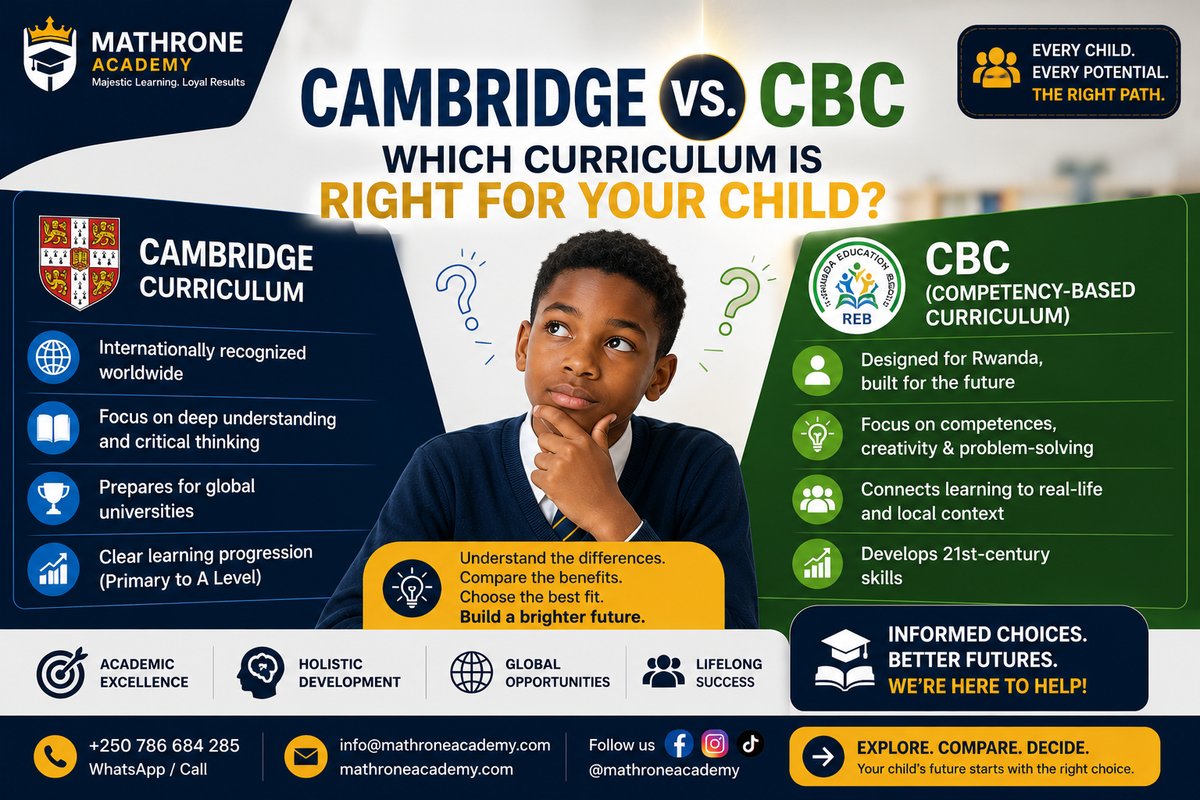
For families in Rwanda, few education decisions carry as much weight, or as much genuine cost difference, as choosing between Cambridge and Rwanda's own Competence Based Curriculum (CBC). This isn't a question with one right answer; it depends on your family's specific plans, budget, and how internationally mobile you expect to be. This guide compares both systems directly: structure, cost, grading, and what each pathway actually opens up, so you can make the decision with real numbers in front of you rather than general impressions.
The Core Difference in One Sentence
CBC is Rwanda's national curriculum, delivered through government, government-subsidized, and private schools, built specifically around Rwanda's own development goals and aligned with Rwandan national examinations and university placement. Cambridge is an international curriculum, developed by Cambridge Assessment International Education (part of the University of Cambridge), taught in over 10,000 schools across roughly 160 countries, and built for portability across borders. Everything else in this comparison flows from that core distinction.
Structure, Side by Side
| Rwanda's CBC | Cambridge Pathway | |
|---|---|---|
| Structure | 6-3-3: Primary (P1-P6), Ordinary Level (S1-S3), Advanced Level (S4-S6) | 5 stages: Early Years, Primary, Lower Secondary, IGCSE, AS/A-Level |
| Ages | 7-18 (P1 starts at age 7) | 3-19 (Early Years starts at age 3) |
| National/External exams | End of P6, S3, and S6, set by NESA | Optional Checkpoint at end of Primary and Lower Secondary; compulsory external exams at IGCSE and A-Level |
| Language of instruction | Kinyarwanda (P1-P3), then English (P4 onward) | English throughout, from the first stage |
| Grading | Numerical marks (commonly out of 100), aggregated into divisions | A*-G scale at IGCSE (or 9-1 in some regions), A*-E at A-Level |
| Global portability | Recognized regionally through East African Community curriculum harmonization | Recognized directly by universities in over 150 countries |
Cost: The Difference Is Larger Than Most Parents Expect
This is where the two systems diverge most dramatically, and it's worth stating the real numbers plainly rather than vaguely. Rwanda's government has capped fees at public and subsidized primary and secondary schools at roughly RWF 85,000 (about $\)85) per term, meaning a full year of public CBC schooling costs a small fraction of what a single term at most Cambridge schools costs. Public pre-primary and primary education in Rwanda is entirely free, with parents responsible only for basic supplies and a school feeding contribution.
Cambridge-curriculum private schools in Kigali, by contrast, span a wide range depending on tier: budget-tier Cambridge schools generally run from roughly RWF 2,500,000 to 5,500,000 per year at primary level, mid-tier schools from RWF 6,500,000 to 12,000,000, and premium-tier schools from RWF 13,500,000 up to RWF 22,000,000 or more annually, with secondary and exam years typically priced higher still. On top of tuition, most Cambridge schools charge separate one-off registration fees (often RWF 500,000 to 2,000,000+), and IGCSE or A-Level exam entry fees are billed separately from tuition entirely, often adding RWF 1,000,000 to 3,000,000 or more per exam session across a full subject set.
This cost gap is the single biggest practical factor for most Rwandan families weighing the two systems, and it's worth being honest about it upfront rather than letting curriculum philosophy dominate the conversation before budget realities are on the table.
Teaching Philosophy: More Similar Than You'd Expect
Here's something that genuinely surprises many parents: CBC and Cambridge aren't philosophically opposed. Rwanda's CBC was explicitly designed to move away from rote memorization toward developing applied competences, critical thinking, and problem-solving, which is conceptually very close to what Cambridge's own materials describe as their goal: building independent thinking and the ability to apply knowledge rather than simply recall it. Both systems also emphasize continuous, formative assessment alongside major external exams at key checkpoints.
The real difference isn't philosophy, it's context and portability. CBC content, examples, and assessment are deliberately built around the Rwandan context and aligned with Rwanda's national development goals and university system. Cambridge content is built for a global, exam-board-agnostic context, so a student's education transfers with far less friction if the family relocates internationally.
Grading: Reading a CBC Report Card vs. a Cambridge One
A CBC national exam result at P6, S3, or S6 is reported numerically, typically out of 100 per subject, and combined into an aggregate score that determines a student's overall division and, at S3 specifically, which stream (Sciences, Humanities, or Languages) they're eligible to pursue at Advanced Level. Progression to the next cycle is directly tied to passing these national exams.
Cambridge IGCSE results, by contrast, use the A* to G scale (A* highest, G the lowest pass, U meaning ungraded), with grade boundaries set individually each exam session based on that year's national and international cohort performance rather than a fixed percentage threshold. Cambridge A-Level uses a similar A* to E scale. Because boundaries shift session to session, a Cambridge grade reflects a student's standing relative to a broader international cohort in a way that's structurally different from CBC's more fixed, numerically-anchored approach. For a full breakdown of exactly how Cambridge grading and Core versus Extended tiers work, our guide on what Cambridge IGCSE actually is covers this in complete depth.
University and Career Pathways
CBC's National Examination and School Inspection Authority (NESA) credentials are the standard, expected pathway into Rwandan public and private universities, and Rwanda's curriculum was harmonized with other East African Community member states in 2013 specifically to improve regional recognition and mobility for students moving between EAC countries for further study or work.
Cambridge IGCSE and A-Level results are recognized directly by universities across the UK, US, Canada, Australia, and the Middle East, generally without requiring a separate equivalence or conversion process. For families planning international university study, particularly outside East Africa, this direct recognition is often the deciding factor over cost. It's worth noting that Cambridge qualifications are also generally accepted by Rwandan universities, though the specific equivalence process is worth confirming directly with the Rwanda Higher Education Council and your target university, since requirements can vary by institution.
Can You Mix the Two?
Yes, and several schools in Rwanda actually do. A number of Kigali schools blend both curricula directly, for example teaching Rwanda's National Programme alongside Cambridge, or offering CBC through Primary before formally introducing Cambridge IGCSE at secondary level. This hybrid approach can offer genuine middle ground: lower cost and stronger local grounding in the earlier years, with the option to move toward Cambridge's international portability once a family's plans become clearer.
Switching between the two systems entirely is also possible, and it happens regularly, but it tends to go more smoothly at natural break points. Moving from CBC to Cambridge (or the reverse) right after Rwanda's P6 or S3 national exams avoids forcing a student to adjust to new subject sequencing and a new assessment style in the middle of an ongoing exam cycle. Our comparison of IB MYP versus CBC, grade by grade covers a similar transition scenario in more depth if you're specifically weighing an IB pathway alongside these two options.
A Practical Way to Decide
Rather than asking which curriculum is "better" in the abstract, it's more useful to ask three specific questions about your own family's situation. First, budget: can your family comfortably sustain Cambridge-tier fees, which can run into the millions of Rwandan francs annually, for the full length of a child's schooling, not just the early years? Second, mobility: is there a realistic chance your family will relocate internationally, or does your child plan to study at a university outside East Africa? If either answer leans strongly toward "yes," Cambridge's portability becomes genuinely valuable rather than a nice-to-have. Third, community and long-term plans: does your family expect your child to build their career primarily within Rwanda or the wider East African region, where CBC and NESA credentials carry direct, well-understood weight?
Families whose honest answers point toward staying in Rwanda long-term, and for whom cost is a real constraint, are often genuinely well served by CBC, which is a rigorous, continuously improving national system, not a fallback option. Families who are internationally mobile, planning study abroad, or who have the budget and specifically want that portability, are often better served by Cambridge. Many families, reasonably, choose a hybrid school precisely to keep both doors open for longer.
If you've settled on Cambridge and want to understand the full pathway your child would follow, our guide on the Cambridge curriculum explained for parents walks through every stage from Early Years to A-Level, and our comparison of Cambridge Primary schools in Rwanda lists real schools currently offering genuine Cambridge Primary in Kigali.
Supporting Your Child, Whichever System You Choose
Whichever curriculum your family chooses, and whichever school fee tier fits your budget, consistent academic support at the right moments makes the biggest measurable difference to outcomes, particularly around the pressure points each system places its weight on: CBC's P6, S3, and S6 national exams, or Cambridge's IGCSE and A-Level sessions. If you're trying to work out whether your child needs that kind of support right now, our article on signs your child needs a private tutor is a useful starting point, and our worked S3 national exam solutions are a practical, free resource specifically for CBC students preparing for their O-Level exams.
Mathrone Academy provides one-on-one tutoring for both Rwanda's national CBC curriculum and Cambridge IGCSE and A-Level, for students anywhere in the world, so families weighing both systems, or navigating a switch between them, can get guidance from a single team rather than juggling separate providers.
Get matched with a tutor:
WhatsApp: +250 786 684 285
Email: [email protected]