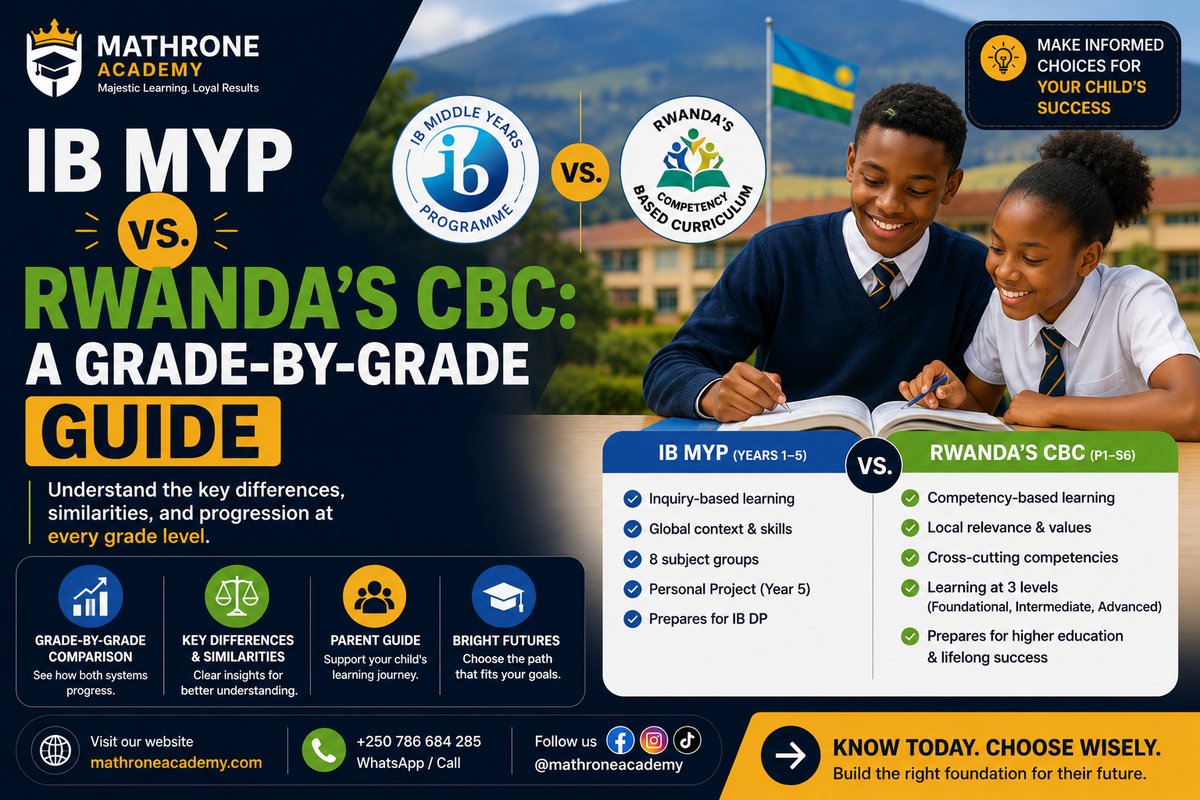
Parents comparing international schooling options in Rwanda, or families relocating and trying to work out where their child fits after a move, often run into two systems that sound completely different but actually cover a lot of the same age range: the IB Middle Years Programme (MYP) and Rwanda's own Competence Based Curriculum (CBC). This guide lines them up grade by grade, age by age, and explains exactly how each one is assessed, so you can see clearly where your child would sit in either system.
What the IB Middle Years Programme Actually Is
The IB Middle Years Programme is the second of four programmes offered by the International Baccalaureate, sitting between the IB Primary Years Programme and the IB Diploma Programme. It's designed for students aged 11 to 16, and it typically spans five years, referred to as MYP Year 1 through MYP Year 5, though some schools offer shorter two, three, or four-year versions depending on when they introduce the programme. It's currently used in more than 5,000 authorized IB World Schools across over 140 countries.
The MYP curriculum is built around eight required subject groups: Language Acquisition, Language and Literature, Individuals and Societies, Sciences, Mathematics, Arts, Physical and Health Education, and Design. Every subject group requires a minimum of 50 hours of instruction each year, though in the final two years (Years 4 and 5), schools can narrow this to six of the eight groups to give students more flexibility. A defining feature of the programme is interdisciplinary learning: each year, students complete at least one unit that deliberately combines two or more subject groups around a shared real-world theme, alongside a required community-based project in Years 3-4 and a substantial independent research project, the Personal Project, completed in the final year.
What Rwanda's CBC Actually Is
Rwanda's Competence Based Curriculum, introduced by the Rwanda Education Board (REB) starting in the 2016/2017 school year, replaced an older, more knowledge-focused national curriculum. Its explicit aim, in REB's own framing, is to shift learning away from memorizing content toward developing competences: the ability to actually apply what's been learned in real situations, alongside critical thinking, problem-solving, and communication skills that support Rwanda's broader ambitions around building a knowledge-based economy.
CBC follows Rwanda's overall education structure, sometimes described as a 6-3-3 system: six years of Primary school (P1 to P6), three years of Ordinary Level secondary school (S1 to S3), and three years of Advanced Level secondary school (S4 to S6). The official entry age for Primary school is 7, meaning P1 to P6 covers roughly ages 7 to 12, Ordinary Level covers roughly ages 13 to 15, and Advanced Level covers roughly ages 16 to 18. Kinyarwanda is the language of instruction for P1 to P3, with English becoming the primary medium of instruction from P4 onward through university. National examinations, set and marked externally by the National Examination and School Inspection Authority (NESA), are sat at three specific checkpoints: the end of P6, the end of S3, and the end of S6.
Grade-by-Grade Comparison: MYP Age Range vs. CBC Years
Because MYP is defined by age (11-16) rather than a fixed grade-naming convention, and CBC is defined by grade level (P1-S6), it helps to line the two up directly against real ages, since this is where most parent confusion actually happens.
| Age | IB MYP Stage | Rwanda CBC Equivalent |
|---|---|---|
| 7-10 | Not yet in MYP (Primary Years Programme age range) | P1-P4 |
| 11 | MYP Year 1 | P5 |
| 12 | MYP Year 2 | P6 (national exam year) |
| 13 | MYP Year 3 | S1 |
| 14 | MYP Year 4 | S2 |
| 15 | MYP Year 5 (Personal Project, optional eAssessment) | S3 (national exam year) |
| 16 | Transition into IB Diploma Programme | S4 (start of Advanced Level) |
The most important thing this table reveals is that MYP's five-year span doesn't cleanly map onto either the whole of CBC's Primary cycle or the whole of O-Level; it actually straddles both. MYP Year 1 and Year 2 fall within Rwanda's upper Primary years, while MYP Year 3 through Year 5 line up with the entire O-Level cycle. This matters enormously for a family transferring a child between the two systems, since a straightforward "same grade number" comparison doesn't work here.
How Assessment Actually Differs
This is where the two systems diverge most sharply, and it's the detail that trips up parents most often when comparing report cards or transcripts across systems.
MYP assessment is criterion-referenced rather than percentage-based. Each subject group is evaluated against four specific, defined criteria (labelled A through D), and a student's performance against each criterion is combined into an overall subject grade on a 1-to-7 scale, rather than being compared against other students or reduced to a single percentage mark. There are no traditional written final exams in most years of MYP. In the final year (Year 5), schools can choose to enter students for optional MYP eAssessment: two-hour, on-screen, externally IB-marked papers, plus ePortfolios for subjects like Arts and Design. Students who complete eAssessment receive an IB MYP Certificate with grades independently validated by the IB itself; schools that skip eAssessment still issue valid MYP course results, but these remain internal to the school rather than externally certified. The Personal Project, completed over roughly six months in the final year, is graded separately against its own four criteria and requires a minimum score of 3 out of 7 to count toward the MYP Certificate.
CBC assessment works differently in structure, though it shares the same underlying philosophy of assessing applied competence rather than pure memorization. Rwandan schools conduct continuous, formative assessment throughout each term and year, aligned with Bloom's Taxonomy levels, alongside REB's own annual year-end testing for grades that don't sit a national exam. At the three national checkpoints, P6, S3, and S6, students sit formal, externally set and marked examinations administered by NESA. These are scored numerically (commonly out of 100 per subject) and combined into an aggregate used to determine overall performance divisions, which in turn affects progression: passing the P6 exam is required to advance into S1, and passing the S3 exam is required to advance into S4 and Advanced Level, with the specific stream (Sciences, Humanities, or Languages) also typically decided at this transition point.
The practical difference for a parent to hold onto: MYP largely defers high-stakes, externally graded exams until the very end of the programme (and even then, only if the school opts in), while CBC builds in externally marked, progression-determining national exams at three fixed points throughout the entire school journey. Neither approach is more rigorous than the other; they simply distribute pressure differently across the years.
What This Means If You're Comparing Schools or Considering a Switch
For a family currently in an MYP school and considering a move into Rwanda's national CBC system, the most important adjustment isn't really about content, since both systems are broadly aligned with competence-based, applied learning as a philosophy. The bigger adjustment is exam culture: a student moving from a school using only internal MYP grading, without Assessment, into CBC's S3 national exam year will be encountering formal, high-stakes, externally marked written examinations for the first time in a genuinely structured way, and that transition benefits enormously from advance preparation on exam technique specifically, not just subject content.
The reverse move, from CBC into an MYP school partway through O-Level, tends to be smoother in terms of exam pressure, since MYP's criterion-based, project-heavy approach is generally less exam-intensive year to year. The adjustment there is more about unfamiliar assessment language: CBC students moving into MYP need to quickly understand what "Criterion A, B, C, D" actually means for each subject, since grades are no longer simply a percentage out of 100.
If you're weighing curriculum options for your child more broadly, not just MYP versus CBC specifically, our guide on the Cambridge curriculum explained for parents covers a third major option many Rwandan and internationally mobile families also consider, and it includes a direct comparison of how Cambridge's assessment philosophy differs from more modular systems like Edexcel, which is useful context alongside this MYP-CBC comparison. And if IGCSE specifically, rather than MYP, is on your radar as the next step after CBC's O-Level, our explainer on what Cambridge IGCSE actually is is the natural next read.
Why Universities and Employers Treat Both Systems Seriously
It's worth reassuring families directly on this point, since it comes up often: neither MYP nor CBC is a "lesser" system compared to the other in terms of how seriously downstream institutions take them. MYP is explicitly designed as preparation for the IB Diploma Programme, which is recognized by universities worldwide, and CBC's National Examination and School Inspection Authority credentials are the standard pathway into Rwandan higher education and are recognized regionally across the East African Community, which deliberately aligned its member states' curriculum frameworks, including Rwanda's, under a shared 2013 harmonization agreement specifically so that competence-based approaches would translate more smoothly across borders.
What actually matters more than the system itself is how well a student is supported through the specific transition points where each system places its pressure: the Personal Project and any eAssessment year in MYP, and the P6, S3, and S6 national exam years in CBC.
Supporting Your Child Through Either System
Whether your child is navigating an MYP Personal Project, preparing for CBC's S3 national exam, or moving between the two, consistent, subject-specific support around these specific pressure points makes the biggest measurable difference to outcomes. If you're trying to work out whether your child needs that kind of support right now, our article on signs your child needs a private tutor is a useful starting point, and our worked S3 national exam past papers are a practical resource specifically for CBC students approaching their O-Level exam.
Mathrone Academy provides one-on-one tutoring for both Rwanda's national CBC curriculum and international pathways including Cambridge, for students anywhere in the world, matched to whichever system, or transition between systems, your child is currently navigating.
Get matched with a tutor:
WhatsApp: +250 786 684 285
Email: [email protected]