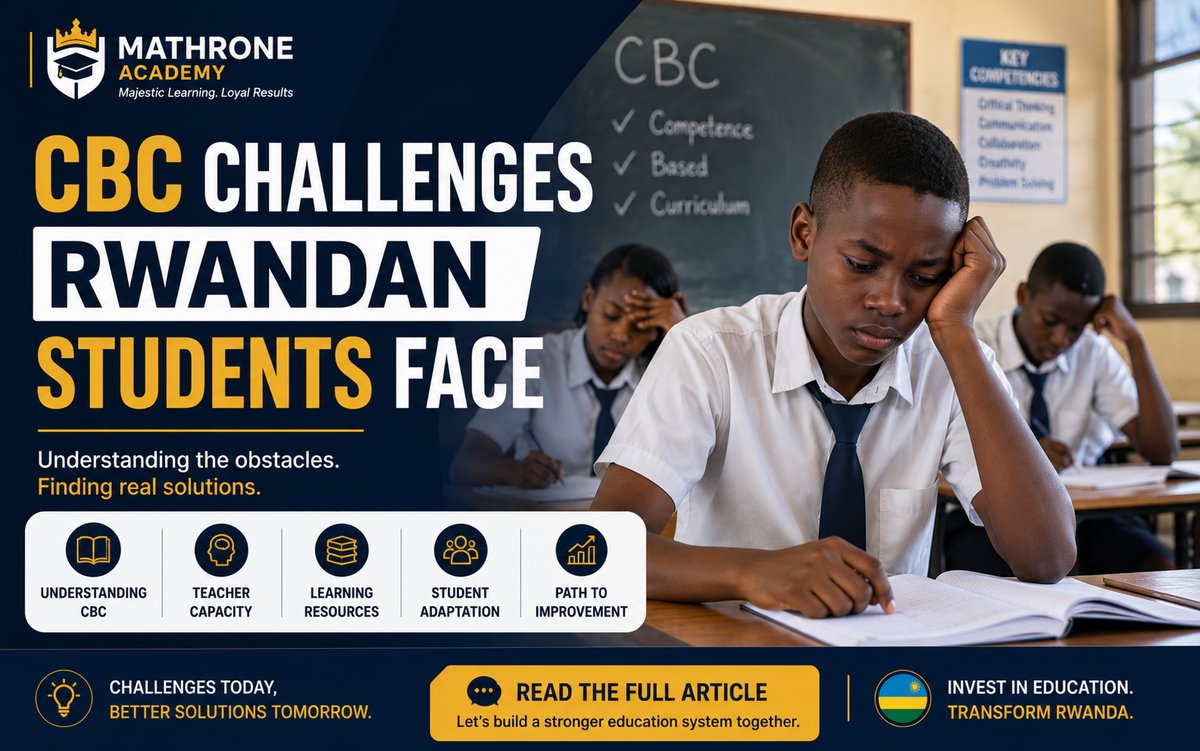
Rwanda's Competence-Based Curriculum was never meant to be another way of testing what students can recite. It was built to test what they can do. That single shift, from remembering facts to applying skills, has quietly become the hardest part of school for thousands of Rwandan learners, and the most confusing part for the parents trying to help them.
I have taught Physics and Geography inside this curriculum since it reached secondary schools, and I have watched the same pattern repeat itself in classroom after classroom: strong students who can explain a concept perfectly on a whiteboard freeze when a national exam asks them to apply it to a scenario they have never seen. The problem is rarely intelligence. It is almost always a mismatch between how CBC is taught and how CBC is assessed.
This article breaks down the real, documented challenges of CBC in Rwanda, not the theory in the policy documents, but what actually happens in classrooms, at home, and in exam halls, along with practical solutions that Rwandan parents, students, and teachers can start using immediately.
What CBC Actually Changed
Before 2016, Rwanda's curriculum rewarded recall. A student who memorised definitions, formulas, and dates well could pass comfortably. CBC replaced that model with competences: literacy, numeracy, critical thinking, cooperation, ICT skills, and lifelong learning, embedded into every subject. Instead of asking "define photosynthesis," a CBC-aligned question asks a student to design an experiment, interpret a graph, or solve a problem set in an unfamiliar real-world context.
This is a good idea. It is also a much harder skill to teach, and an even harder one to assess fairly at national scale. That gap between the ambition of CBC and the reality of delivering it in an average Rwandan classroom is where most of the challenges below come from.
1. Overcrowded Classrooms Make Competency-Based Teaching Nearly Impossible
CBC depends on individual attention. A teacher is supposed to observe how each learner applies a skill, give targeted feedback, and adjust. In a classroom of 60 to 80 students, which is common in many Rwandan public and government-aided schools, that kind of individualised teaching is structurally difficult, no matter how skilled the teacher is.
Practical solution: Where class size cannot change immediately, small-group rotation works better than whole-class lecturing. Split the class into groups of 8 to 10 for the application segment of a lesson, even if the explanation segment stays whole-class. Peer-tutoring pairs (a stronger student paired with one who is struggling) also multiplies the teacher's reach without adding headcount. Outside school, one-on-one tutoring closes exactly this gap, which is why finding the right private tutor in Kigali has become one of the fastest ways families compensate for classroom size.
2. Teachers Were Trained Faster Than the Curriculum Could Be Absorbed
CBC asked teachers who were themselves trained under the old knowledge-based system to suddenly teach differently, assess differently, and plan differently. In-service training helped, but a short workshop cannot fully rewire a decade of teaching habit. The result, seen across multiple independent studies on CBC implementation in Rwanda, is that many lessons are still delivered in a lecture format even when the lesson plan on paper is competency-based.
Practical solution: Teachers benefit most from continuous, subject-specific peer mentoring rather than one-off training days. Sector-based and school-based INSET sessions where teachers of the same subject solve real CBC exam questions together, then compare teaching approaches, tend to move practice further than generic seminars. If you are a teacher building this habit alone, start with past national exam papers in your subject and reverse-engineer the competence each question is testing before you plan the lesson that leads to it.
3. Learning and Laboratory Materials Are Still Catching Up
Competence-based Science and ICT subjects assume access to practical materials: lab equipment, reagents, computers, internet connectivity. Many rural and even some urban schools do not have consistent access to these. A Chemistry competence like "conduct a titration experiment" is difficult to assess authentically without a functioning lab.
Practical solution: Simulation tools and virtual labs are a genuine bridge here, not a replacement for hands-on science, but a way to build the reasoning skill even without physical equipment. This is part of why we built Majestic Lab, a real-time virtual STEM whiteboard, so students and tutors can work through diagrams, graphs, and problem-solving together even when physical lab access is limited.
4. Assessment Still Doesn't Fully Match the Teaching Philosophy
This is the challenge I see most often as a teacher. CBC lessons are designed around competences, but students still sit national exams under time pressure, answering questions that require them to transfer a skill to a new scenario instantly. A student who understood a concept perfectly in class can underperform simply because the exam phrased it in an unfamiliar way. This is a known tension in CBC systems: strong lesson-level implementation does not automatically translate into strong exam-level performance, because the assessment format itself is still catching up to the teaching philosophy.
Practical solution: The single best preparation is repeated exposure to real past national exam papers, not generic revision notes. Working through worked solutions from past NESA papers teaches students how competence-based questions are actually phrased, which is different from how most textbooks phrase practice questions. We publish full worked solutions for exactly this reason. If your child is preparing for the 2026 national exams, start with past papers at least eight weeks before the exam date, not the week before.
5. Parents Often Cannot Help With Homework the Way They Used To
This challenge is rarely discussed but affects almost every household. Parents who went through the old knowledge-based curriculum find CBC homework genuinely unfamiliar. A geography assignment that asks a student to analyse a case study and propose a solution looks nothing like the geography homework parents remember. This leaves many capable parents feeling unable to help, even when they want to.
Practical solution: Parents do not need to know the subject content to help effectively. Asking a child to explain their reasoning out loud, "why did you choose that answer," and simply listening, builds the same critical-thinking competence CBC is trying to develop, without requiring subject expertise. For families who want more structured support, recognising when a child needs a tutor early, rather than after a difficult exam result, makes a measurable difference. If a bad result has already happened, how you talk to your child about it matters as much as the tutoring itself.
6. Math and Science Anxiety Is Amplified, Not Reduced, by CBC
Because CBC in Mathematics, Physics, and Chemistry demands application rather than recall, students who already feel anxious about these subjects often experience that anxiety more acutely. A student who could previously pass by memorising a formula now has to reason through why the formula works, which is a much more exposing task if their foundation has gaps.
Practical solution: Address the foundation gap directly rather than pushing forward. We have written specifically about why Rwandan students develop math and science anxiety and what actually fixes it, and the short version is: anxiety almost always traces back to one or two unaddressed gaps from an earlier year, not a lack of ability in the present one.
7. The Stream Choice at S4 Adds Pressure Before Students Are Ready
Under CBC, students choose their S4 stream (Mathematics and Sciences, or Arts, Humanities and Languages) at a point where many are still discovering their strengths. Because Computer Science is compulsory across both streams and CBC assessment rewards applied competence over memorised content, a student who chooses the wrong stream can spend two years struggling against a curriculum that doesn't fit how they think.
Practical solution: Stream choice should be based on a student's demonstrated performance in application-based tasks, not just their exam scores in isolation. Our full breakdown of Rwanda's S4 stream system walks through what each stream actually demands day to day, which is worth reading before the choice is made, not after.
Where This Leaves Rwandan Families
None of these challenges mean CBC is the wrong direction for Rwanda's education system. Every country that has shifted from knowledge-based to competence-based education has faced a version of this transition gap, and the research is consistent that CBC, done well, produces graduates who can actually apply what they know. The challenges above are implementation gaps, not design flaws, and every one of them has a practical, achievable fix at the classroom, home, or individual student level.
What matters most for a Rwandan parent or student right now is not waiting for the system-level gaps to close on their own. Targeted tutoring, consistent past-paper practice, and honest conversations about where the real difficulty lies (foundation, not intelligence) close the gap faster than any policy change will.
IF YOU NEED A TUTOR TEXT US ON +250786684285
Frequently Asked Questions
What is the biggest challenge of CBC in Rwanda?
The most commonly cited challenge across studies and classroom experience is the mismatch between competency-based teaching and exam-based assessment: students learn to apply skills in class but are tested under exam conditions that can feel unfamiliar and high-pressure.
Why do Rwandan students struggle with CBC Mathematics and Science?
Because CBC removes the option to pass by memorisation alone. Students with small unaddressed gaps from earlier years find those gaps become much more visible when they are asked to apply a concept rather than recite it.
How can parents help with CBC homework if they don't understand the subject?
By asking their child to explain their reasoning out loud rather than checking the answer directly. This builds the same critical-thinking competence CBC assesses, regardless of the parent's own subject knowledge.
Does private tutoring help with CBC-style learning?
Yes, particularly one-on-one or small-group tutoring, because it restores the individualised feedback loop that large CBC classrooms often cannot provide.