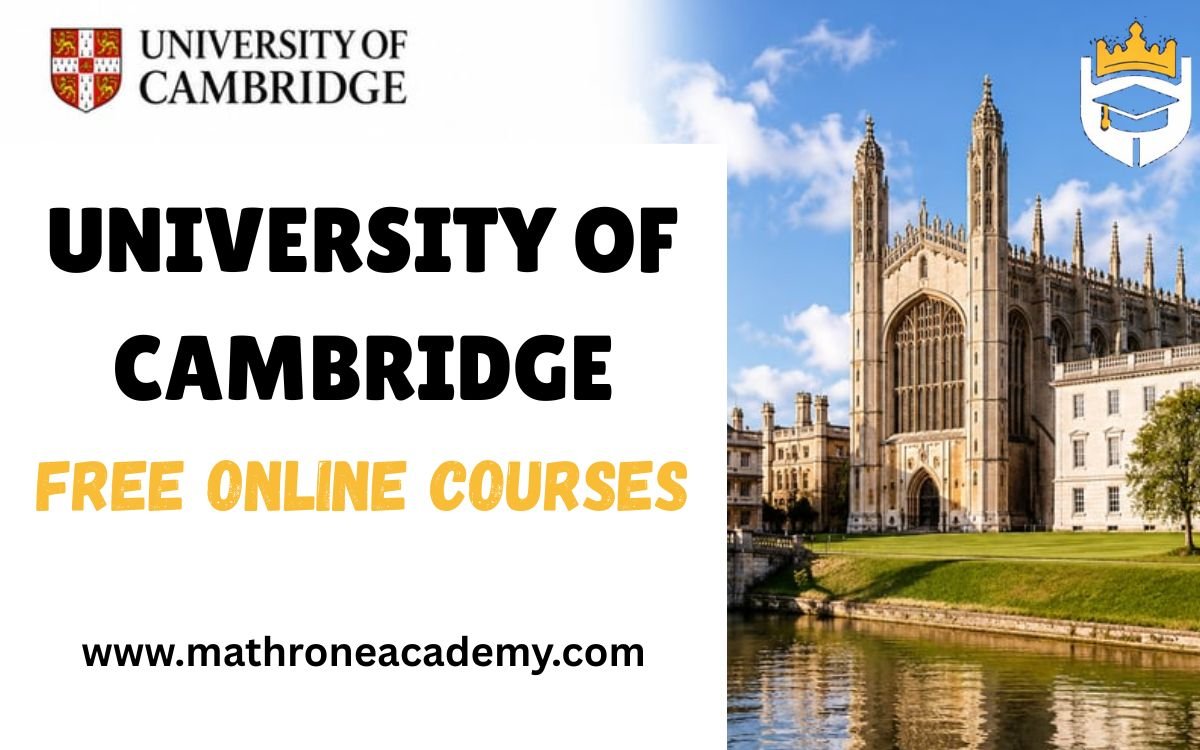
The University of Cambridge which was founded in 1209 and consistently ranked among the top three universities in the world offers a growing library of free online courses accessible to any learner, anywhere, with nothing more than an internet connection and a device with No application, No tuition,No age restriction and No country restriction.
Whether you are a secondary school student exploring a subject you are curious about, a working professional looking to upskill, or a researcher seeking structured exposure to a new field, Cambridge's free online learning ecosystem is one of the most accessible and genuinely valuable opportunities available in global education today.
This guide covers everything you need to know: the three platforms offering Cambridge content, what subjects are available, how the free audit track works, its honest limitations, how to get a certificate, and financial assistance options for learners who cannot afford to pay.
The Three Platforms
Most articles about Cambridge free online courses mention only edX but the full picture is more useful. Cambridge delivers free and low-cost online learning through three distinct platforms, each with a different focus and course style:
Platform 1: edX (CambridgeX)
edX is the most well-known platform for Cambridge online courses and offers the broadest subject range. The University of Cambridge is listed directly as a course provider under the name CambridgeX and the Cambridge Institute for Sustainability Leadership (CISL) also has its own dedicated space on edX with courses in sustainable business and climate leadership.
On edX, you can audit most Cambridge courses for free. Auditing gives you access to all video lectures, reading materials, and course exercises at no cost.
Platform 2: FutureLearn
Cambridge also offers courses on FutureLearn, a UK-based online learning platform with a strong social learning model that encourages discussion and peer interaction. Cambridge FutureLearn courses span science, law, humanities, and professional development.
FutureLearn's model is slightly different from edX , some courses are free for a limited time with the option to upgrade for unlimited access, while others require a small enrollment fee. However, many Cambridge courses on FutureLearn can be audited for free during their active run period.
Browse Cambridge courses on FutureLearn: futurelearn.com/partners/cambridge
Platform 3: Cambridge PACE (Programme for Continuing Education)
Cambridge PACE is the University of Cambridge's own continuing education division offering short online courses taught directly by Cambridge academics for professionals, postgraduate learners, and advanced self-learners. PACE goes beyond MOOCs into more formal, structured learning.
PACE offers:
- Short online courses of typically 7 weeks
- Award-bearing undergraduate certificates, diplomas, and advanced diplomas in over 30 subjects
- Courses accredited through the UK Credit Accumulation and Transfer Scheme (CATS) at FHEQ levels 4, 5, and 6
- Graduates are recognised as alumni of the University of Cambridge
Some PACE courses have a small enrollment fee, though reduced or free access may be available through bursaries or promotions. This is the most academic and structured of the three platforms and the one that genuinely positions you as a Cambridge alumnus upon completion of accredited programmes.
Browse Cambridge PACE courses: ice.cam.ac.uk/online-learning
What Subjects Are Available
Cambridge's online catalogue spans a remarkably wide range of disciplines. Here is a subject overview of what is available across all three platforms:
Science and Technology
- Forensic Science and DNA Analysis
- Data Science and Machine Learning
- Artificial Intelligence and its applications
- Computer Science fundamentals
- Environmental Science and Sustainability
- Physics and Mathematics foundations
Business and Economics
- Sustainable Business through the Cambridge Institute for Sustainability Leadership (CISL)
- Business Ethics
- Finance and Investment
- Entrepreneurship and Innovation
- Leadership and Management
Humanities and Social Sciences
- History of Ideas
- Philosophy and Ethics
- Literature and Creative Writing
- Education and Learning
- Psychology and Behavioural Science
Law
- Introduction to Criminal Law
- International Law foundations
- Law and Technology
Health and Medicine
- Global Health
- Mental Health and Wellbeing
- Public Health Policy
- Clinical Medicine foundations
Languages and Communication
- Academic English
- Communication and Presentation skills
The full current catalogue changes as new courses are added and old cohorts end. Browse the live catalogue on edX, FutureLearn, and PACE for the most current list.
How the Free Audit Track Works
This is where most articles are vague or misleading and here is exactly what free access gives you and what it does not.
What you get with the free audit track:
- Full access to video lectures from Cambridge academics
- Reading materials, articles, and supplementary resources
- Course exercises and practice activities
- Self-paced learning at your own schedule
What the free audit track does NOT give you:
- A certificate: this always requires payment
- Graded assignments: typically reserved for the paid verified track
- Access to discussion forums: restricted in most courses to paid learners
- Unlimited long-term access: audit track access is temporary, typically lasting 4 to 12 weeks while the course is active. Once the course session ends, audit learners lose access to all materials. Only learners on the paid certificate track retain unlimited access after the course closes.
This last point is important. If you want to keep course materials for reference after completing the course, you need to download or save what you need during the active period or upgrade to the verified track.
How to Get a Certificate. And How to Get Financial Assistance
To receive a certificate, you need to upgrade from the audit track to the verified (paid) track on edX or the equivalent paid option on FutureLearn or PACE. Certificate prices on edX typically range from approximately $50 to $300 depending on the course length and level.
Financial assistance is available, edX offers a financial assistance programme for learners who genuinely cannot afford to pay for a verified certificate. To apply:
- Go to the course page on edX
- Scroll down and find the ‘Financial Assistance Available’ link
- Complete the application you will be asked to explain why you need assistance and how this course aligns with your goals
- edX reviews applications on a rolling basis decisions are typically communicated within 15 business days
Financial assistance is not guaranteed, but it is a real programme that has helped thousands of learners worldwide access verified certificates from top universities including Cambridge at no cost. If cost is the barrier between you and a Cambridge certificate, apply for financial assistance before giving up.
How to Enroll: Step by Step
Getting started with Cambridge free online courses takes approximately five minutes.
For edX Cambridge courses:
Step 1: Go to edx.org/school/cambridgex
Step 2: Browse the available courses and click on any course that interests you
Step 3: Click "Enroll" on the course page
Step 4: Create a free edX account with your name, email, and password — or sign in if you already have one
Step 5: On the enrollment page, select "Audit this course" to access for free
Step 6: Begin learning immediately — no waiting, no application review, no approval needed
For FutureLearn Cambridge courses:
Step 1: Go to futurelearn.com/partners/cambridge
Step 2: Browse and select your course
Step 3: Create a free FutureLearn account
Step 4: Enroll for free when the course is in session — join the waitlist if the course has not yet started
For Cambridge PACE courses:
Step 1: Go to ice.cam.ac.uk/online-learning
Step 2: Browse short courses by subject
Step 3: Click on your chosen course to view dates, fees, and enrollment options
Step 4: Create a PACE learner account and complete enrollment
Who These Courses Are For
Cambridge free online courses are genuinely useful for a wide range of learners not just students:
Students at secondary school level
Exploring a subject at university level before choosing a degree, or building knowledge beyond what the school curriculum offers. A secondary school student who completes a Cambridge course in Data Science or Forensic Science before university stands out significantly in applications.
University students
Supplementing their degree with exposure to academic content from one of the world's top institutions. A student studying economics at a local university who also completes a Cambridge business or finance course builds a stronger professional profile.
Working professionals
By upskilling in areas relevant to career development. The Cambridge Institute for Sustainability Leadership courses are particularly valuable for professionals in business, government, and NGOs working on sustainability, ESG, or climate policy.
Researchers and academics
Accessing structured exposure to adjacent fields without committing to a formal programme. A researcher in public health who takes a Cambridge law course gains interdisciplinary perspective at zero cost.
Lifelong learners
People who are simply curious and want access to rigorous, high-quality academic content. Cambridge's MOOC catalogue makes this possible for anyone with internet access anywhere in the world.
The Honest Limitations
No guide would be complete without acknowledging what free Cambridge online courses cannot do:
They are not a Cambridge degree.
Completing a free edX or FutureLearn course does not make you a Cambridge student or alumnus but it demonstrates self-directed learning and engagement with world-class content which is genuinely valuable but it should not be misrepresented on a CV as equivalent to Cambridge enrolment.
The audit track is temporary.
As explained above, free access lasts only while the course session is active — typically 4 to 12 weeks. This is different from permanent access, which requires payment.
Certificates require payment.
The audit track never includes a certificate. If you need a credential for career or application purposes, you will need to pay or apply for financial assistance.
Not all content is from Cambridge academics.
Some edX courses listed under the Cambridge partnership are co-produced with other organisations — for example, ARM Education for computing courses. Read the course description carefully to understand who is delivering the content.
Engagement quality varies.
Some courses are highly interactive with rich discussion communities. Others are more static. Review the course overview, estimated effort per week, and learner reviews before committing significant time.
Why This Still Matters for Your Learning
With all those limitations stated honestly, the core opportunity remains significant: free access to structured academic content from one of the world's most respected universities, available immediately, to anyone with internet access.
For a student in Kigali, Nairobi, Lagos, or Jakarta who wants to engage with Cambridge-level academic thinking before pursuing a scholarship application this is the most direct and accessible route available. For a professional anywhere who wants to add rigour to their understanding of sustainability, law, data science, or business Cambridge's free catalogue provides a credible, self-directed path.
The value is real. Just enter it with accurate expectations.
Frequently Asked Questions
Q: Are University of Cambridge online courses really free?
Yes, through the audit track on edX and FutureLearn, you can access Cambridge course content including video lectures, reading materials, and exercises at no cost. However, free access is temporary (typically 4–12 weeks while the course runs), does not include a certificate, and does not provide access to graded assignments or discussion forums. Cambridge PACE courses may have small enrollment fees but offer more formal, award-bearing qualifications.
Q: Do Cambridge free online courses give you a certificate?
No. The free audit track does not include a certificate. To receive a verified certificate, you need to upgrade to the paid track — typically costing $50–$300 on edX. Financial assistance is available for learners who cannot afford to pay apply through the financial assistance link on any edX course page.
Q: Is there a deadline to enroll in Cambridge free online courses?
Deadlines vary by course. Some courses run on fixed schedules with specific start and end dates; others are self-paced and available year-round. Check the individual course page on edX, FutureLearn, or Cambridge PACE for current enrollment windows. Enroll as soon as you decide some courses fill their cohorts and waitlist remaining applicants.
Q: Can I access Cambridge free online courses from any country?
Yes. Cambridge online courses through edX and FutureLearn are available globally with no country restrictions. All you need is an internet connection and a device. No visa, no travel, and no minimum academic qualification is required to start most courses.
Q: What is the difference between edX, FutureLearn, and Cambridge PACE for Cambridge courses?
edX (CambridgeX) offers the broadest course catalogue with free audit access best for self-directed learners exploring a subject. FutureLearn offers Cambridge courses with a social learning model emphasising peer discussion good for interactive learners. Cambridge PACE offers the most formal and structured programmes, including award-bearing qualifications that make you a Cambridge alumnus best for learners seeking formal academic credentials from Cambridge directly.
Q: Does completing a Cambridge online course help with university applications?
Yes , particularly if you complete the course seriously and can discuss what you learned. Admissions committees value evidence of intellectual curiosity and self-directed learning. A completed Cambridge course in a subject related to your intended degree demonstrates genuine engagement with the field beyond your school curriculum. This is especially relevant for scholarship applications that ask about academic initiative and self-development.
Read: How to Study Effectively — Proven Techniques Every Student Should Know →
Read: Best Learning Materials for Students →
Read: Germany PhD Fully Funded Scholarships 2027 →
Browse all scholarships and opportunities →
Published by Mathrone Academy — connecting students and professionals worldwide with quality education resources and scholarship opportunities. Visit us at mathroneacademy.com