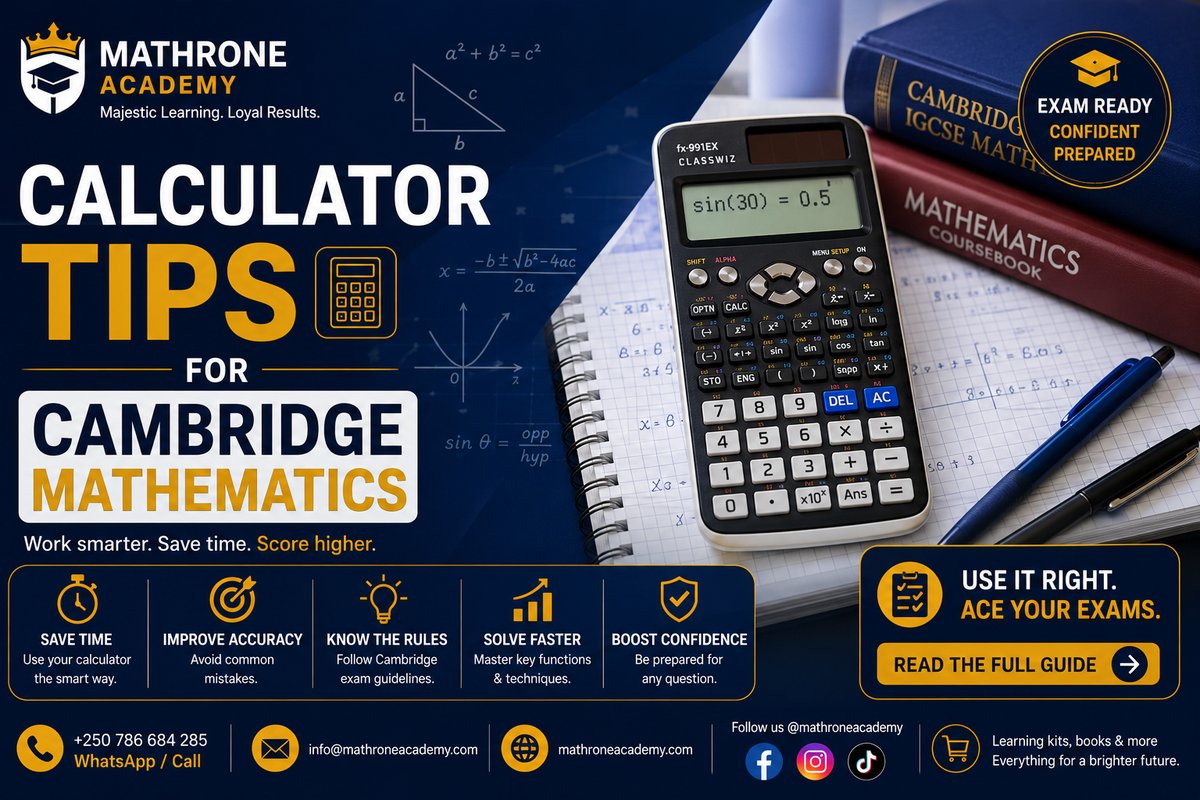
Calculator rules are one of those details that seem minor until a student loses marks over them, either by bringing the wrong type of calculator into the exam hall, or by relying on a calculator so heavily on a non-calculator paper that arithmetic fluency quietly falls apart. Cambridge's calculator policy also changed meaningfully in 2025, which means plenty of older guidance floating around online is now out of date. This article covers exactly which Cambridge Mathematics papers allow a calculator, what's banned outright, and the practical technique that actually protects marks on exam day.
The 2025 Syllabus Change That Caught Many Families Off Guard
Before 2025, every paper in Cambridge IGCSE Mathematics (0580) allowed a calculator. From the June 2025 series onward, that changed: Cambridge introduced a dedicated non-calculator paper at both the Core and Extended tiers, splitting each tier into one non-calculator paper and one calculator paper. This is genuinely important for any family whose understanding of the exam still reflects the older, fully-calculator-permitted structure, since the skills a student now needs to practise deliberately, quick mental and written arithmetic without a calculator to fall back on, are different from what worked under the old system. If your family is still weighing which tier is the right fit for your child in the first place, our complete guide to what Cambridge IGCSE actually involves covers the Core versus Extended decision in full, and this calculator split now applies identically to both tiers.
Cambridge IGCSE Mathematics (0580): Exactly Which Papers Allow a Calculator
Cambridge IGCSE Mathematics 0580 is tiered, and each tier now has one non-calculator paper and one calculator paper, each worth 50 percent of the final grade:
| Tier | Non-Calculator Paper | Calculator Paper |
|---|---|---|
| Core (grades C-G) | Paper 1 | Paper 3 |
| Extended (grades A*-E) | Paper 2 | Paper 4 |
On the non-calculator papers, examiners consistently report a strong emphasis on algebraic manipulation, basic geometry, and pure arithmetic fluency, and clear method and working are rewarded specifically, since final-answer-only responses without shown working frequently lose marks even when the answer itself is correct. The calculator papers still test genuine mathematical understanding, not just calculator operation, with recurring question types including inequalities and set notation, geometric constructions, indices, functions, bearings and scale, volume, and probability with tree diagrams.
Cambridge Additional Mathematics (0606) and International Mathematics (0607)
It's worth being precise here, since Cambridge offers three distinct Mathematics IGCSE qualifications and the rules aren't identical across all of them. Cambridge IGCSE Additional Mathematics (0606) is assessed through two papers, one non-calculator and one calculator paper, each contributing 50 percent to the final grade, broadly mirroring the 0580 structure but covering more advanced content including functions, calculus, and trigonometry. Cambridge IGCSE International Mathematics (0607), meanwhile, follows slightly different rules from the standard 0580 qualification and has historically allowed graphical calculators in certain circumstances where 0580 does not; students and parents should always check the specific 0607 syllabus document directly rather than assuming the 0580 rules apply, since conflating the two is a genuinely common and costly mistake.
What Kind of Calculator Is Actually Allowed
Cambridge doesn't publish a list of specific approved calculator models, since there are simply too many available worldwide to maintain an exhaustive list. Instead, the rule is functional: on the papers where calculators are permitted, the calculator must be purely numerical and must not be able to manipulate algebra symbolically. In practice, this means:
- A standard scientific calculator is expected and appropriate for the calculator papers, ideally one with trigonometric functions built in
- CAS (Computer Algebra System) calculators are explicitly banned. A CAS calculator can perform symbolic algebra manipulation, solving an equation algebraically rather than numerically, which Cambridge treats as equivalent to the calculator doing part of the mathematical thinking the exam is actually meant to test
- Graphical calculators are generally not permitted for Cambridge IGCSE Mathematics 0580 specifically, since part of what the assessment tests is a student's own ability to plot a graph accurately, judge a line of best fit, and calculate a gradient by hand, skills a graphical calculator would otherwise bypass entirely
- Wireless connectivity and internet-capable devices are banned outright, even if the feature would never actually be used during the exam itself
- Using a banned calculator is treated as malpractice by Cambridge, a serious classification that can affect a student's result well beyond simply losing a few marks, so this is genuinely worth double-checking well before exam day rather than assuming
Because CAS and non-CAS versions of the same calculator model sometimes look nearly identical on the outside, it's worth checking the exact model number and packaging carefully, or confirming directly with your school's exams officer, rather than assuming a calculator is compliant just because a similar-looking model is commonly used by classmates.
Cambridge A-Level Mathematics: What's Different
At A-Level, the specific rules shift again. Cambridge expects candidates sitting AS and A-Level Mathematics to bring a calculator with standard scientific functions, but computers and any calculator capable of algebraic manipulation or graphing are explicitly not permitted, following the regulations set out in the Cambridge Handbook. This is a meaningfully stricter standard than some other exam boards or curricula that do permit graphical calculators at this level, so it's worth confirming this specifically if a student or family has prior experience with a different system, or if a sibling studied under an older syllabus version with different rules. If your family is still deciding on the right subject combination heading into A-Level, our guide to the best A-Level subject combinations by career path is worth reading alongside this, since Mathematics sits at the center of nearly every STEM-focused combination it covers.
Calculator Technique That Actually Protects Marks
Owning the right calculator is only the starting point; how a student actually uses it in the exam room makes a real difference to the final mark. A handful of habits consistently separate students who use their calculator effectively from those who quietly lose marks despite understanding the mathematics.
Always show full working, even when the calculator gives the answer directly. Cambridge mark schemes are explicit that no marks are given for unsupported answers produced purely from a calculator, even on the calculator papers, and past paper instructions state this directly. A student who enters a full calculation into their calculator and writes down only the final number, without the intermediate working that shows their method, can lose the majority of the marks available for that question even with a completely correct final answer.
Learn your specific calculator's functions well before exam day, not during it. Every extra second spent hunting through unfamiliar calculator menus during a timed paper is time lost from actually solving the problem. Students should practise with the exact calculator model they'll bring into the exam room throughout their revision, not switch to a different or unfamiliar model in the final weeks.
Don't let calculator dependence erode non-calculator fluency. Since the 2025 syllabus change split each tier into a non-calculator and calculator paper, students genuinely need dedicated practice at working through arithmetic, fractions, and algebraic manipulation entirely by hand. A student who's grown reliant on a calculator throughout the two-year IGCSE course can be caught out badly on Paper 1 or Paper 2 if this specific skill hasn't been deliberately maintained through regular non-calculator practice sessions.
Check answers for reasonableness, not just calculator accuracy. A calculator will faithfully compute whatever is entered into it, including a genuine input error, an extra digit, a misplaced decimal point, a wrong operation. Developing the habit of pausing to ask "does this answer make sense given the context of the question" catches these errors far more reliably than simply trusting whatever number appears on the display.
Practise past papers under genuine timed conditions, calculator and non-calculator alike. This remains one of the single most effective ways to build the specific technique each paper type demands, and it exposes any gaps in either non-calculator fluency or calculator familiarity while there's still time to address them properly, rather than discovering the gap for the first time in the real exam.
Where Calculator Confusion Most Commonly Costs Marks
A few specific, recurring mistakes show up consistently across IGCSE Mathematics cohorts, and being aware of them in advance genuinely helps a student avoid them. Rounding too early in a multi-step calculation, rather than carrying full calculator precision through to the final step and only rounding the final answer, is one of the most common sources of lost marks, since Cambridge mark schemes are often unforgiving of accumulated rounding error. Misreading calculator display notation, particularly standard form or fraction display, is another frequent, avoidable error. And forgetting that certain functions, like inverse trigonometric ratios, can return answers in a different mode (degrees versus radians) than the question requires is a classic, easily preventable mistake that a few minutes of dedicated calculator-mode practice eliminates entirely.
How This Fits Into a Broader Mathematics Revision Plan
Calculator technique is one piece of a much larger picture, and it's worth treating it as a specific, practicable skill within regular Mathematics revision rather than an afterthought addressed only in the final week before exams. If your child is working through a structured revision plan and past paper practice more broadly, our guide on how consistent, well-structured tutoring genuinely improves Cambridge grades covers why regular, timed past paper work, calculator technique included, is one of the most evidence-backed forms of exam preparation available. And if Mathematics specifically is where your child needs the most support right now, our broader guide to choosing an online IGCSE tutor covers exactly what to look for in a tutor who can address exam technique like this alongside core content.
Getting Structured Support Ahead of the Exam
Small, easily fixed issues like calculator technique and non-calculator fluency are exactly the kind of gap that a good tutor identifies and corrects quickly, often within just a few focused sessions, rather than something a student needs to discover the hard way in a real exam. If you're weighing whether your child would benefit from that kind of structured, syllabus-specific support, our article on spotting the early signs a child needs extra academic support is a useful starting point.
Mathrone Academy provides one-on-one Cambridge Mathematics tutoring, covering IGCSE 0580, Additional Mathematics, and A-Level, for students anywhere in the world, with tutors who work through exactly this kind of exam technique, calculator use, non-calculator fluency, and past paper practice, alongside core syllabus content. For Rwanda-based families, our tutors also support the REB national curriculum alongside Cambridge.
Get matched with a tutor:
WhatsApp: +250 786 684 285
Email: [email protected]