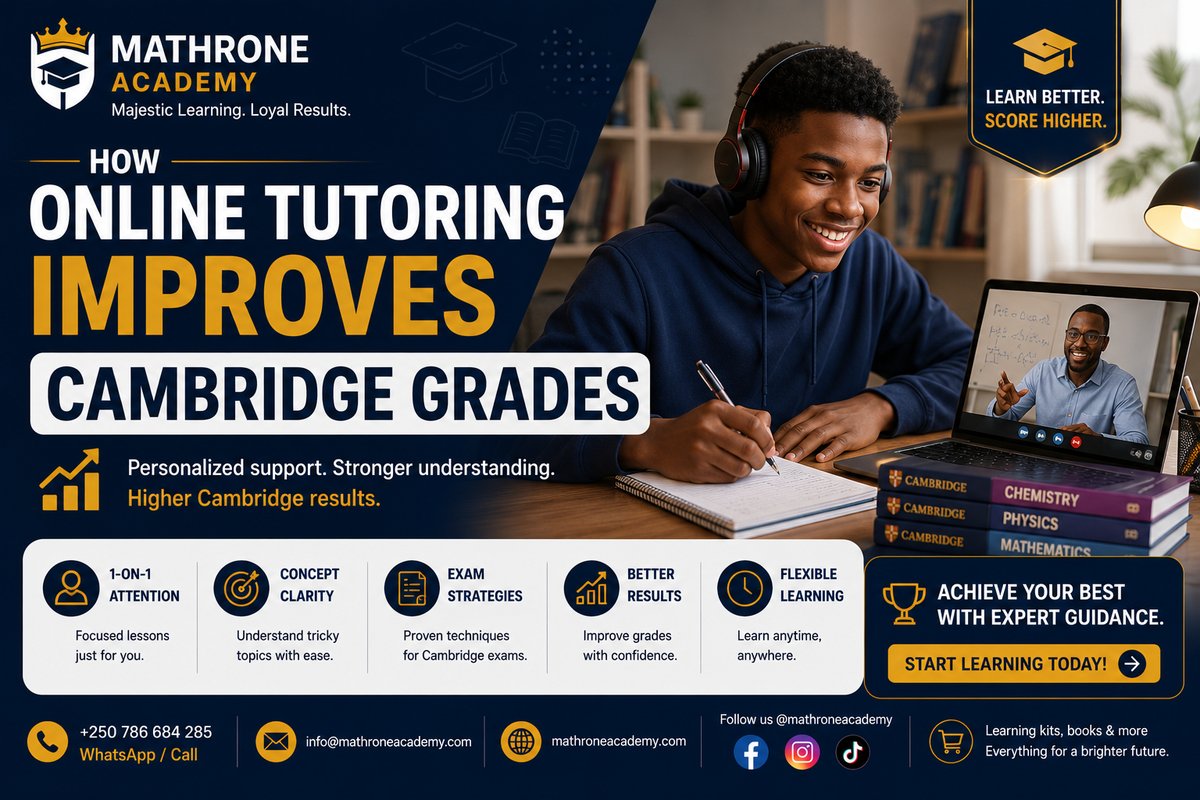
Every parent researching tutoring eventually asks the same honest question: does it actually work, or is it an expensive way to feel like something is being done? For Cambridge families specifically, weighing tutoring against school fees that are already substantial, this question deserves a real answer grounded in evidence, not just reassurance. This article walks through what the research genuinely shows about tutoring effectiveness, why online tutoring in particular has closed the gap with in-person teaching, and, more usefully, exactly what separates tutoring that moves a Cambridge grade from tutoring that doesn't.
What the Research Actually Shows
The foundational research behind one-on-one tutoring goes back further than most people realize. Educational psychologist Benjamin Bloom's landmark 1984 study found that students receiving individual tutoring, combined with mastery learning techniques, performed roughly two standard deviations better than students in a conventional classroom, a gap so large it would move an average student into the top few percent of their class. That finding, often called Bloom's "two sigma problem," has shaped tutoring research for four decades since, and while few real-world tutoring arrangements fully replicate the ideal conditions of Bloom's original study, the underlying principle, that individualized instruction outperforms group teaching, has held up consistently across dozens of subsequent studies.
More recent, large-scale evidence backs this up with real numbers. A comprehensive meta-analysis covering more than 100 randomized controlled trials found tutoring programs produce a pooled effect size of roughly 0.37 standard deviations, an improvement large enough to move a student from the 50th percentile to somewhere around the 66th percentile relative to peers who received no tutoring. High-dosage tutoring, delivered three or more times per week, showed meaningfully larger effects than less frequent arrangements, reinforcing something that matters enormously for how a family should actually structure Cambridge tutoring: consistency and frequency genuinely drive results, not occasional help before a test.
Specific to online delivery, a randomized controlled trial published in a leading economics journal found that online tutoring meaningfully improved exam performance and overall grades relative to a control group, with particularly strong effects among students who hadn't previously received other tutoring support. This matters for Cambridge families weighing online against in-person options specifically: the research base increasingly shows format isn't the deciding factor in outcomes, tutor quality and session consistency are.
Why Online Tutoring Has Closed the Gap With In-Person Teaching
Online tutoring in 2026 looks genuinely different from the early pandemic-era video calls many parents still picture when they hear the term. Modern platforms typically include interactive whiteboards for real-time collaborative problem-solving, session recordings a student can revisit before an exam, and integrated past paper banks with performance tracking, tools that in several ways exceed what a typical in-person session offers. None of this replaces a skilled tutor, but it genuinely amplifies what a good one can do, particularly for Cambridge subjects like Mathematics and the Sciences, where working through a calculation together on a shared digital whiteboard is just as effective as doing so on paper in the same room.
Research specifically comparing formats has generally found that online tutoring produces equivalent or better outcomes than in-person tutoring once tutor quality is properly controlled for, which lines up with what most experienced educators would predict: a brilliant tutor is effective whether the session happens over video or across a kitchen table, and a mediocre one is equally ineffective in either setting. This is precisely why the practical guidance in our broader guide to choosing an online IGCSE tutor focuses so heavily on vetting the tutor's specific subject and syllabus depth rather than treating "online" itself as a quality signal one way or the other.
What Actually Drives Grade Improvement, Beyond Just "Having a Tutor"
Simply booking a tutor doesn't automatically produce a better Cambridge grade; the research and real classroom experience both point to a handful of specific factors that separate tutoring that genuinely moves the needle from tutoring that quietly wastes a family's time and money.
Diagnosing the specific gap, not re-teaching the whole syllabus. The most effective tutoring starts by identifying exactly where a student's understanding breaks down, a particular topic, a specific type of question, a recurring exam technique error, rather than generically working through the textbook from the beginning. This is exactly the same principle behind Cambridge's own Lower Secondary Checkpoint diagnostic reports, which deliberately break results down by strand so a family knows precisely where to focus, rather than only seeing one overall number. A tutor who spends the first session or two properly diagnosing gaps, rather than immediately launching into content delivery, is following the same evidence-based logic.
Genuine exam board and syllabus fluency. Cambridge-specific tutoring outperforms generic subject tutoring precisely because IGCSE and A-Level examiners reward very specific things: correct command word interpretation, exact working shown in the right format, and syllabus-specific content rather than adjacent material that never actually appears on a Cambridge paper. Our subject-specific guides on choosing an online Physics tutor and an online Chemistry tutor for Cambridge students go into this in more depth, since the gap between a generalist and a genuine Cambridge specialist shows up clearly in exactly this kind of syllabus-level precision.
Consistency and frequency, not occasional crisis-mode help. The research is unusually consistent on this point: tutoring delivered regularly, at minimum weekly, produces meaningfully larger effects than sporadic sessions booked only when a test is imminent. A single emergency session before a mock exam rarely closes a genuine understanding gap; it can help with immediate exam technique, but the deeper learning gains tutoring research actually documents come from sustained, structured work over weeks and months, not isolated interventions.
Structured past paper practice under timed, exam-realistic conditions. Across every Cambridge subject, from the mole concept calculations we cover in our Chemistry tutor guide to the mechanics and fields topics covered in our Physics tutor guide, past paper practice under genuine time pressure is one of the single most effective revision tools available, precisely because it trains the specific skill Cambridge actually examines: applying knowledge under time constraint, not simply recognizing it in a textbook.
How This Applies Specifically to IGCSE and A-Level Timelines
Cambridge's own pathway is structured in a way that makes early, consistent tutoring support particularly valuable rather than something to reach for only once a student is visibly struggling. Our complete guide to how the Cambridge curriculum fits together explains how each stage builds directly on the one before it, which means a gap that opens quietly at Lower Secondary tends to resurface, harder, at IGCSE, and an IGCSE gap resurfaces again, harder still, at A-Level. This cumulative structure is precisely why the research finding that tutoring works best when started early and sustained, rather than crammed into the final months before an exam, matters so much for Cambridge students specifically.
At A-Level, where subject specialization narrows to just three or four subjects studied in genuine depth, the stakes of an unaddressed gap rise sharply, since university offers frequently hinge on very specific grade thresholds in very specific subjects. Our guide to the best A-Level subject combinations by career path covers exactly how demanding those university-set thresholds can be, particularly for Medicine, Engineering, and other competitive pathways, which makes consistent, well-timed tutoring support during the A-Level years a genuinely higher-stakes decision than it might have felt earlier in a child's schooling.
What Tutoring Genuinely Cannot Replace
It's worth being honest about tutoring's real limits, since overselling it would undercut the credibility of everything above. No amount of tutoring substitutes for a student's own consistent independent study between sessions; research and practical classroom experience both agree that tutoring works best as a structured supplement to a student's own effort, not a replacement for it. Tutoring also can't compensate for chronic absenteeism from school or a fundamentally unsuitable curriculum fit; if a student is enrolled in a school or curriculum genuinely mismatched to their needs, our comparisons of IB against Cambridge and Cambridge against Rwanda's CBC are worth reading before assuming tutoring alone can close what is really a structural mismatch rather than a knowledge gap.
Signs Your Child Would Genuinely Benefit From Tutoring Right Now
Not every dip in a Cambridge student's performance calls for tutoring, and not every family needs to wait for a crisis before starting either. Our dedicated article on spotting the early signs a child needs extra academic support walks through the specific, practical indicators worth watching for, consistently rushed homework, avoidance of a specific subject, or grades that don't match the effort a student is visibly putting in, since catching these signals early is exactly when tutoring research shows the intervention works best, well before a gap has had time to compound across an entire Cambridge stage.
Getting Tutoring That's Actually Built to Move the Needle
The evidence is genuinely clear on the core question: consistent, well-matched, subject-specific tutoring measurably improves academic outcomes, and online delivery, done properly, produces results on par with in-person teaching. What separates tutoring that works from tutoring that doesn't isn't the platform or the price tag alone, it's whether the tutor genuinely diagnoses the specific gap, knows the exact Cambridge syllabus and exam board in question, and delivers consistent, structured sessions rather than occasional, reactive help.
Mathrone Academy provides one-on-one tutoring across the full Cambridge Pathway, IGCSE and A-Level, in Mathematics, the Sciences, English, and other core subjects, for students anywhere in the world, built around exactly this evidence-based approach: proper diagnosis, syllabus-specific teaching, and consistent, regular sessions rather than last-minute cramming. For Rwanda-based families, our tutors also support the REB national curriculum alongside Cambridge, so you can get guidance across both systems from a single team.
Get matched with a tutor:
WhatsApp: +250 786 684 285
Email: [email protected]