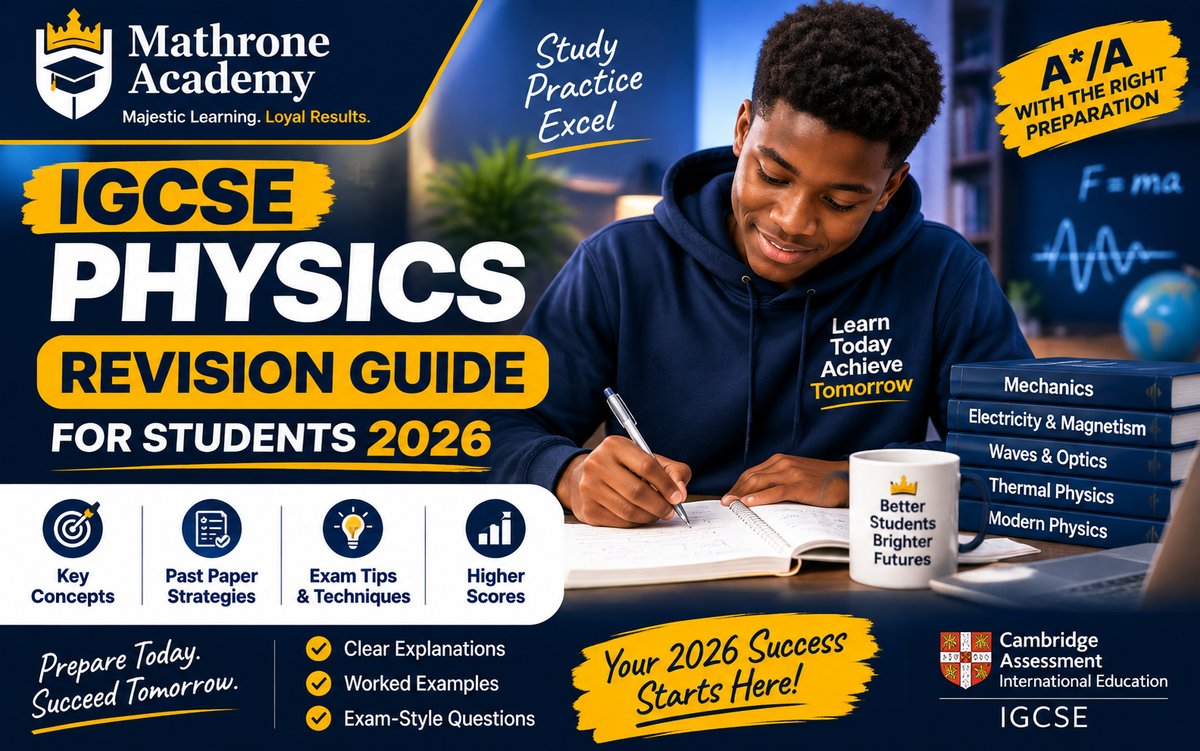
Cambridge IGCSE Physics has a reputation for being one of the more calculation-heavy IGCSE sciences, and that reputation is fair. Between motion graphs, circuit equations, and wave calculations, a huge share of the marks in Paper 2 and Paper 4 come from applying formulas correctly rather than simply recalling facts. The good news is that the syllabus is predictable. Once you understand which equations appear every series and how the papers are structured, IGCSE Physics revision becomes a much more manageable process than it first appears.
This guide walks through the Cambridge IGCSE Physics (0625) exam structure, the equations you are expected to know for the 2026 series, and a practical 25-chapter study plan you can follow whether you are three months or three weeks from your exam. If you are still deciding between curricula for your child, our Cambridge IGCSE parent guide explains how the qualification fits into secondary education more broadly.
Understanding the Cambridge IGCSE Physics 0625 Exam Structure
Before you can build an effective IGCSE Physics study plan, you need to know exactly what you are preparing for. Cambridge IGCSE Physics offers two tiers, and the tier you are entered for determines which papers you sit.
Core candidates, typically those expected to achieve a grade D or below on the old grading scale, sit Paper 1 (multiple choice) and Paper 3 (theory), plus a practical component. Extended candidates, who make up the majority of students aiming for the top grades, sit Paper 2 (multiple choice) and Paper 4 (theory), plus either Paper 5 or Paper 6 for the practical element. If your target is a grade A or above, you almost certainly need to be entered for the Extended tier and Papers 2 and 4.
Paper 2 is a 45-minute multiple choice paper testing definitions, units, and quick application of concepts. Paper 4 is the main theory paper, roughly 1 hour 15 minutes, combining short-answer questions, calculations, and longer structured questions that ask you to explain a physical process in full sentences. Paper 6, the Alternative to Practical, tests the same experimental skills as a lab-based Paper 5 exam, but through written questions about experimental design, tables, graphs, and evaluating sources of error, without requiring access to physical apparatus. This matters a great deal for students studying through online IGCSE tutoring, since Paper 6 lets you demonstrate practical understanding without a school laboratory.
A detail many students miss: calculation marks on Paper 4 are almost always awarded in three parts — one mark for selecting the correct equation, one for correct substitution of values, and one for the final answer with the correct unit. This means that even if your final numerical answer is wrong, writing down the correct formula and showing your substitution can still earn you two out of three marks. Never skip straight to a final number without showing your working.
The Core IGCSE Physics Equations List You Must Know
Cambridge does not give you a blank equation sheet in the exam room the way some other boards do for every formula — a number of key equations are expected to be memorized. Below are the equations that appear across nearly every exam series, organized by topic, which is the same structure we use across our Majestic Lab STEM simulations when students want to visualize how a formula behaves before memorizing it.
Motion and Forces
Speed and velocity calculations rest on this foundational relationship:
$$v = \frac{d}{t}$$where \(v\) is speed in meters per second, \(d\) is distance in meters, and \(t\) is time in seconds. Acceleration follows a similar structure:
$$a = \frac{\Delta v}{t} = \frac{v - u}{t}$$Here \(u\) is initial velocity and \(v\) is final velocity. For questions involving distance-time and velocity-time graphs, remember that the gradient of a velocity-time graph gives acceleration, and the area under a velocity-time graph gives distance traveled, this single idea accounts for a large share of graph-based marks on Paper 4.
Newton's second law connects force, mass, and acceleration:
$$F = ma$$and weight, which is frequently confused with mass in exam answers, is calculated as:
$$W = mg$$where \(g\) is the gravitational field strength, usually given as 9.8 or 10 N/kg depending on the question. Density questions, which appear in nearly every series, use:
$$\rho = \frac{m}{V}$$Energy, Work, and Power
Work done and energy transferred use the same core formula:
$$W = Fd$$Kinetic energy and gravitational potential energy are two of the most heavily tested equations on the entire syllabus:
$$E_k = \frac{1}{2}mv^2$$$$E_p = mgh$$Power, the rate of doing work, is calculated as:
$$P = \frac{W}{t}$$and efficiency, which appears in longer structured questions about energy resources, is expressed as:
$$\text{efficiency} = \frac{\text{useful energy output}}{\text{total energy input}} \times 100\%$$Electricity Equations
The electricity section carries significant weight on Paper 4, and three equations form the backbone of nearly every circuit question:
$$V = IR$$$$P = IV$$$$E = Pt$$where \(V\) is potential difference in volts, \(I\) is current in amperes, \(R\) is resistance in ohms, \(P\) is power in watts, and \(E\) is energy in joules. For series and parallel circuit questions, remember that current is the same at every point in a series circuit but splits across branches in a parallel circuit, while potential difference behaves the opposite way. This distinction alone accounts for several marks in most exam series.
Waves and Sound
The wave equation connects frequency, wavelength, and speed:
$$v = f\lambda$$where \(f\) is frequency in hertz and \(\lambda\) is wavelength in meters. This single equation is tested across sound, light, and the electromagnetic spectrum, so it is worth memorizing thoroughly rather than treating it as a one-topic formula.
Pressure
Pressure calculations, particularly for liquids and gases, rely on:
$$p = \frac{F}{A}$$and for pressure in a liquid column:
$$p = h \rho g$$where \(h\) is the height of the liquid column, \(\rho\) is the density of the liquid, and \(g\) is gravitational field strength. For students preparing to move on to A-Level, our A-Level Physics support builds directly on these IGCSE pressure and forces concepts.
A 25-Chapter IGCSE Physics Study Plan
Trying to revise the entire syllabus in one pass rarely works. A structured, chapter-by-chapter approach lets you track genuine progress and identify weak areas early. This is the same 25-chapter structure we used when building Mathrone Academy's IGCSE Physics quiz bank, which now covers 82 practice questions mapped directly to the syllabus.
- Measurement and units , significant figures, using a micrometer and vernier calipers
- Motion: distance-time and velocity-time graphs, calculating acceleration
- Mass, weight, and density: experimental methods for finding density
- Forces and resultant force: free body diagrams, Newton's laws
- Moments and equilibrium: principle of moments, center of mass
- Energy, work, and power: conservation of energy, efficiency calculations
- Pressure: pressure in solids, liquids, and gases, manometers
- Kinetic particle model of matter: states of matter, Brownian motion
- Thermal properties and temperature: thermal expansion, specific heat capacity
- Thermal processes: conduction, convection, radiation
- General wave properties: transverse and longitudinal waves, the wave equation
- Light: reflection, refraction, total internal reflection, lenses
- Electromagnetic spectrum: properties and applications of each region
- Sound: speed of sound, echoes, ultrasound applications
- Magnetism: magnetic fields, electromagnets
- Electrical quantities: current, potential difference, resistance, \(V = IR\)
- Electric circuits , series and parallel circuits, circuit diagrams
- Electrical safety and power : fuses, \(P = IV\), household wiring
- Electromagnetic effects: the motor effect, electromagnetic induction
- Nuclear physics: radioactive decay, half-life calculations
- The particle model applied to gases: pressure, volume, and temperature relationships
- Space physics: the solar system, orbits, the life cycle of stars
- Practical skills for Paper 6: planning experiments, identifying variables
- Data handling and graphs: plotting, interpreting gradients and intercepts
- Full past paper practice: timed conditions, examiner-style mark schemes
A realistic pace is one to two chapters per week if you are starting three months out, moving to full past-paper practice in the final month. If your child needs closer support working through this plan, our Physics tutor in Kigali service pairs students with tutors experienced in both REB and Cambridge Physics, and we also offer online Physics tutoring for Cambridge students anywhere.
Common Mistakes That Cost Marks on Paper 4
Examiner reports for Cambridge IGCSE Physics consistently flag the same handful of errors year after year. Being aware of them before you sit the exam is often worth more than an extra week of content revision.
Forgetting units in the final answer. Even when the correct equation and substitution are shown, a missing or wrong unit on the final line can cost the accuracy mark. Always write the unit as part of your final answer, not as an afterthought.
Confusing mass and weight. Mass is measured in kilograms and does not change with location; weight is a force, measured in newtons, calculated using \(W = mg\). Structured questions frequently test whether students understand this distinction rather than simply asking for a calculation.
Not showing substitution. As mentioned earlier, the three-mark structure of most calculations means skipping the substitution step, even when your final answer is correct, can occasionally cost a mark if the answer contains an arithmetic slip that examiners cannot trace back to a specific step.
Vague descriptions in practical questions. Paper 6 questions asking you to "describe how you would investigate" a variable require specific, controlled, repeatable steps, naming the equipment, stating what is measured, and identifying which variables are controlled. General answers like "measure it carefully" earn no credit.
Misreading graph scales. A significant number of lost marks on motion and wave questions come from misreading the gradient of a graph because a student assumed each grid square represented one unit rather than reading the actual axis labels. Always check the scale before calculating a gradient or area.
How to Use Past Papers Effectively
Past papers are the single most effective revision tool for IGCSE Physics, but only when used correctly. Working through a past paper without timing yourself, or checking the mark scheme only after finishing the entire paper, teaches you far less than doing it under exam conditions. A better approach is to complete one paper per sitting, in the actual time allowed, then mark it immediately against the official mark scheme and log every lost mark by topic. Over two or three papers, a clear pattern of weak chapters usually emerges, which then tells you exactly where to focus your remaining revision time rather than re-reading the whole syllabus evenly.
It also helps to revisit our study techniques guide for spaced repetition and active recall methods, both of which apply especially well to equation-heavy subjects like Physics where forgetting a formula two weeks after learning it is common without deliberate review.
Frequently Asked Questions
Do I need to memorize every equation for IGCSE Physics?
Most core equations, including those for motion, energy, electricity, and waves, are expected to be memorized rather than provided. A small number of more complex relationships are given in the question itself when needed, but the equations covered in this guide should be committed to memory.
What calculator can I use for IGCSE Physics exams?
A basic scientific calculator is permitted and sufficient for all Cambridge IGCSE Physics calculations. See our calculator tips guide for advice that applies equally well to Physics calculations.
Is Paper 6 easier than Paper 5?
Neither paper is inherently easier; they test the same practical skills through different formats. Paper 6 tends to suit students who are strong at written analysis and reasoning about experimental design, since it does not require physical apparatus.
How many past papers should I complete before the exam?
Most successful Extended-tier students complete between eight and twelve full past papers across Paper 2 and Paper 4 combined, spread over the final two to three months of preparation, alongside continued content revision.
Get Personalized IGCSE Physics Support
Revising alone works for some students, but many benefit from structured, one-on-one guidance through the equations and past-paper technique covered in this guide. Mathrone Academy provides IGCSE Physics tutoring, an AI Study Tutor for instant practice, and Majestic Lab simulations that let students visualize concepts like circuits and wave behavior interactively.
To book a Physics tutor or ask about our IGCSE resources, reach out on WhatsApp at +250 786 684 285 or email us at [email protected]. We tutor Cambridge IGCSE, A-Level, and IB Physics both online and in person in Kigali.