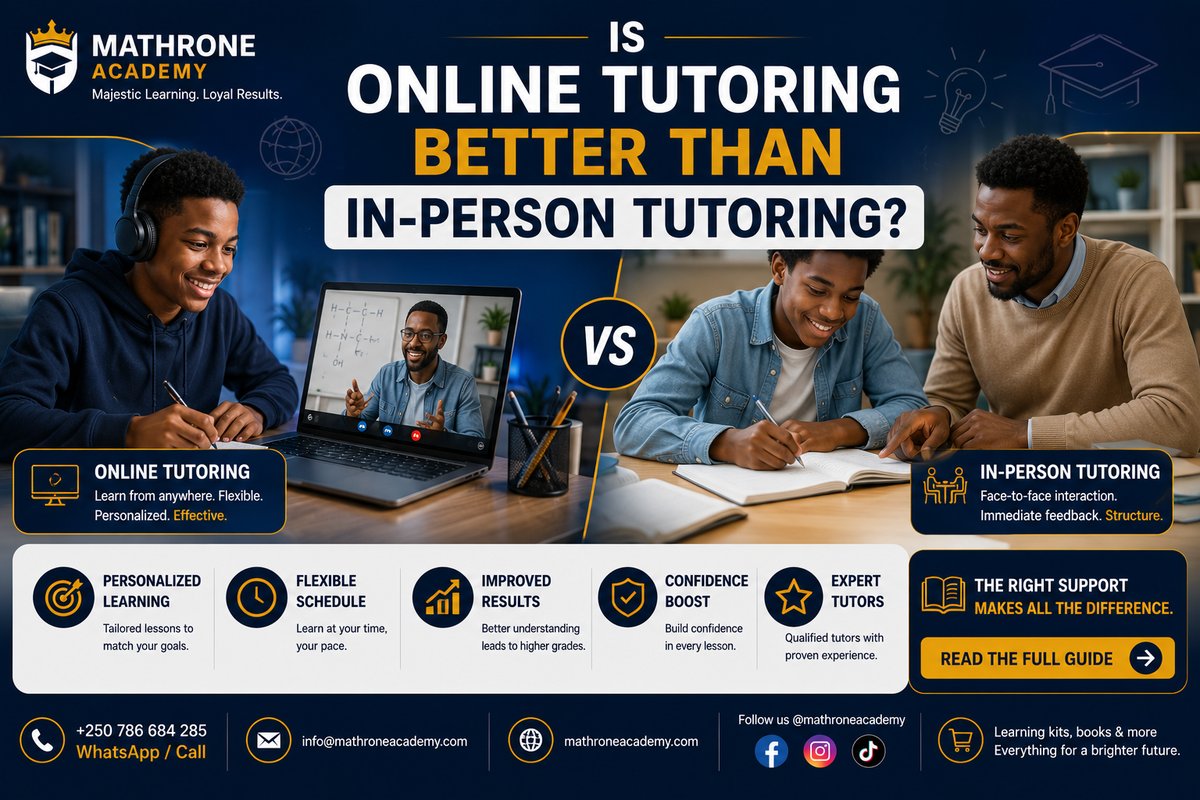
This is one of the most practical questions a parent faces once they've decided their child needs tutoring at all: should it happen over a screen or across a kitchen table? For years, in-person tutoring was assumed to be the safer, more effective default, with online treated as a lesser substitute born of necessity during the pandemic. That assumption no longer holds up against the evidence. This article compares both formats directly, cost, effectiveness, and the specific factors, age, subject, and access, that should actually drive the decision for your family.
The Core Finding: Format Matters Less Than Tutor Quality
Across the research on this question, one conclusion comes up with unusual consistency: once tutor quality and session structure are properly controlled for, online and in-person tutoring produce statistically similar outcomes. A brilliant, well-prepared tutor is effective whether the session happens over video or in the same room; a mediocre, poorly structured tutor fails in either setting. This finding matters enormously for how a family should actually approach the decision, since it reframes the real question away from "which format is better" and toward "which tutor is genuinely good, and which format fits my child's specific needs." This is precisely the framing we take in our broader look at how online tutoring improves Cambridge grades, where the underlying research shows tutor quality and session consistency, not format, are what actually move results.
Cost: A Genuinely Large, Consistent Gap
This is where the two formats diverge most clearly, and the gap is large enough to matter for most families' budgeting decisions. Multiple independent sources converge on a similar range: online tutoring typically costs somewhere between 20 and 60 dollars per hour, while in-person tutoring commonly runs 60 to over 100 dollars per hour, particularly in major cities where a tutor's travel time and local cost of living get built into the rate. Some analyses put online tutoring as much as 20 to 40 percent cheaper overall than an equivalent in-person arrangement, once you account for the fact that in-person tutoring often carries additional costs beyond the hourly rate itself: transportation, sometimes physical learning materials, and occasionally venue or sign-up fees for a tutoring center.
For families weighing this specifically for Cambridge subjects, our guide to choosing an online IGCSE tutor breaks down the realistic hourly ranges by tutor specialization and experience level, which is worth reading alongside this cost comparison, since the price gap between online and in-person tends to hold at every tier, from open marketplace tutors through to genuine subject specialists and examiners.
Access to Genuine Subject Specialists
This is arguably online tutoring's single biggest structural advantage, and it matters especially for a globally distributed qualification like Cambridge IGCSE and A-Level. In-person tutoring limits a family to whoever happens to be geographically available nearby, which can be a genuine constraint for a subject like Physics or Chemistry, where, as we cover in our dedicated guides to finding an online Physics tutor and an online Chemistry tutor for Cambridge students, the pool of tutors genuinely fluent in both the specific exam board and the subject's mathematical and practical demands is naturally smaller than the pool of generalist tutors. Online tutoring removes the geographic constraint entirely, letting a family in Kigali, Kampala, or Dar es Salaam access a tutor with genuine, specific Cambridge Physics or Chemistry depth, regardless of where that tutor happens to be physically based.
Age Matters More Than Almost Any Other Factor
If there's one place the research consistently favors in-person tutoring, it's for young children, generally those under 8, or students in the earliest primary years. Younger learners often benefit from hands-on, tactile learning, physical manipulatives for early Mathematics, direct physical cues to maintain attention, and the simple structure of a dedicated in-person learning environment that's harder to replicate through a screen. This lines up closely with what we cover in our guide to Cambridge Primary schools, where the earliest stages of the Cambridge Pathway lean heavily on structured play and guided, hands-on exploration rather than screen-based instruction.
The picture shifts considerably by the time students reach Cambridge Lower Secondary and beyond, roughly ages 11 and up. Older primary and secondary-age students generally have the focus, digital literacy, and independence to engage effectively through online sessions, and for IGCSE and A-Level students specifically, online tutoring is widely regarded as a genuinely strong fit, since these students' primary need is high-level subject expertise rather than close physical supervision. This is exactly the age range our own detailed breakdown of Cambridge Lower Secondary Checkpoint covers, and it's the point at which most families start seriously weighing tutoring format for the first time as academic stakes rise.
Subject Type: Hands-On vs. Conceptual
Subject matter genuinely affects which format works better, though the difference is more nuanced than it might first appear. Highly hands-on subjects, certain practical science components, some art and design work, can favor in-person instruction, where a tutor can physically demonstrate a technique or directly observe fine motor execution. But for the bulk of Cambridge's core academic subjects, Mathematics, the Sciences at a conceptual and calculation level, English, and the Humanities, online tutoring with a shared digital whiteboard performs just as well as an in-person session, since the actual teaching, working through a calculation, discussing an essay structure, explaining a concept, translates naturally to video with the right tools. Even Cambridge Chemistry's practical papers, which we cover in detail in our Chemistry tutor guide, can be taught effectively online through careful use of video demonstration and structured discussion of experimental method, provided the tutor has genuine hands-on teaching experience with those specific practicals to draw from.
Attention, Engagement, and the Screen Fatigue Question
Parental concern about screen fatigue and attention is legitimate and worth taking seriously, but the research suggests it's a manageable factor rather than a fundamental barrier. Good online tutors structure sessions with variety, breaks, and interactive elements specifically to maintain engagement, matching session length to a student's age and attention span rather than defaulting to a rigid hour-long format regardless of who's on the other end of the call. For students with genuinely severe attention difficulties, in-person tutoring's more controlled physical environment can offer real advantages, and this is a case where consulting directly with a tutor about your specific child's needs, rather than assuming either format automatically, is worth the extra conversation before committing.
Scheduling Flexibility and Real-World Logistics
Beyond cost and effectiveness, online tutoring offers a practical advantage that's easy to underestimate: it eliminates travel time entirely, for both the student and, in many cases, the tutor, which opens up evening and weekend scheduling that would otherwise be constrained by commute time. For busy Cambridge families juggling school, extracurriculars, and, in many cases, multiple children with different schedules, this flexibility is often what makes consistent, weekly tutoring, the frequency research consistently shows drives the strongest results, genuinely sustainable over a full term rather than something that quietly falls away after a few sporadic sessions.
What This Means for Cambridge Families Specifically
Pulling this together for the specific context of Cambridge IGCSE and A-Level students: for the vast majority of families reading this, students aged roughly 11 and up working through Lower Secondary, IGCSE, or A-Level content, online tutoring is a genuinely strong, evidence-backed choice, not a compromise. It's typically more affordable, gives access to genuine subject specialists regardless of geography, a critical advantage for Cambridge's specific syllabus and exam-board requirements, and research shows it produces outcomes on par with in-person tutoring once tutor quality is accounted for. The clearest cases for choosing in-person instead are younger children still in Cambridge Primary, students with significant attention or focus challenges who need close physical structure, and specific hands-on components where physical demonstration is genuinely central to the learning.
If you're earlier in this decision process and still working out whether your child needs tutoring support at all, our article on spotting the early signs a child needs extra academic support is a useful starting point before the format question even becomes relevant.
Making the Decision With Confidence
Rather than treating this as a binary choice between two competing philosophies, the most useful approach is to focus on what the evidence actually points to: consistency, tutor quality, and genuine syllabus fit matter far more than the medium itself. A trial session is one of the most practical ways to test this directly, letting you see firsthand whether a specific tutor engages your child effectively online before committing to a term of sessions.
Mathrone Academy provides one-on-one online tutoring across the full Cambridge Pathway, IGCSE and A-Level, for students anywhere in the world, matched specifically to your child's subject, exam board, and current academic gaps, alongside support for Rwanda's REB national curriculum for families based locally. If cost, access to genuine specialists, and scheduling flexibility matter to your family, online tutoring built around the right tutor, not just the right platform, is exactly what the evidence points toward.
Get matched with a tutor:
WhatsApp: +250 786 684 285
Email: [email protected]