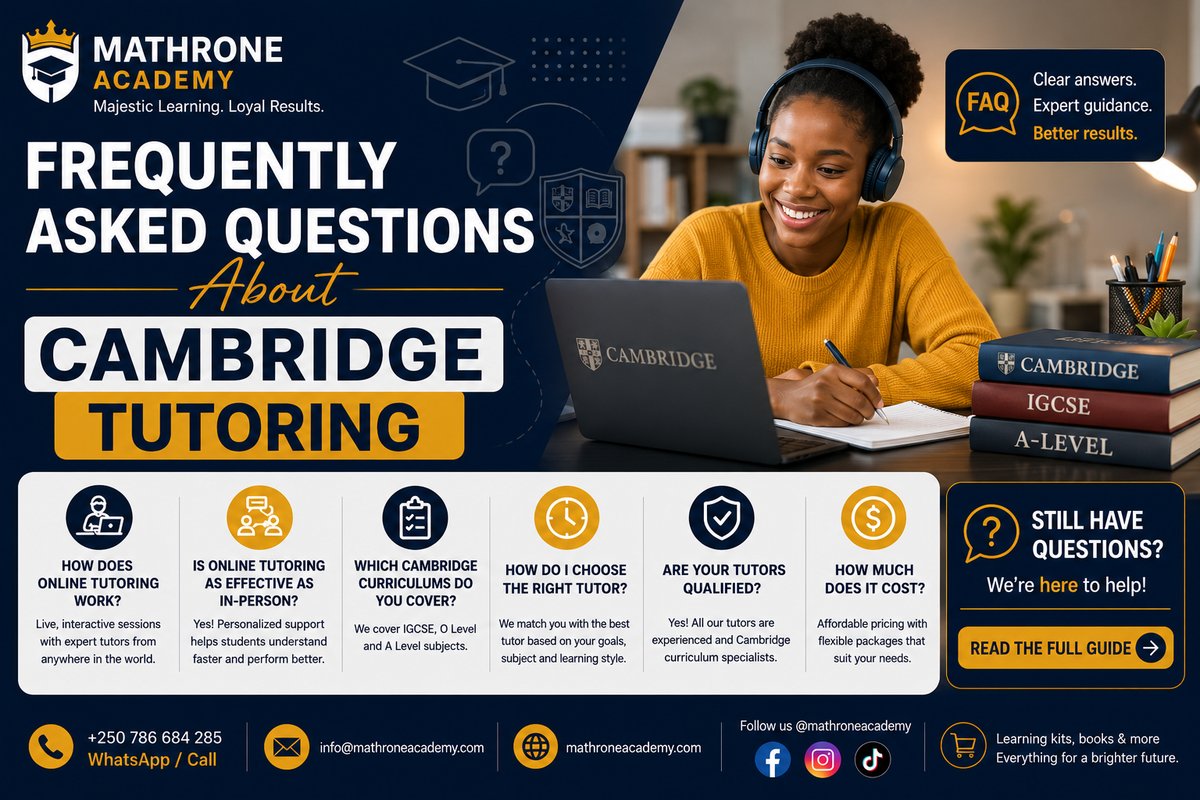
Parents researching Cambridge tutoring for the first time tend to run into the same practical, unglamorous questions again and again: how often, how long, how much, and when to actually start. Subject-specific guides answer part of this picture, but the logistics of tutoring itself, the questions that come up regardless of whether a child needs help in Mathematics, Chemistry, or English, deserve a clear, honest answer of their own. This article works through the questions parents ask most often about Cambridge tutoring, grounded in what the evidence and Cambridge's own guidance actually say, rather than generic reassurance.
When Should My Child Start Cambridge Tutoring?
Earlier than most families assume. The strongest, most consistent guidance across tutoring research and practice is that starting at the beginning of a stage, rather than waiting until a student is visibly struggling or exams are imminent, produces meaningfully better outcomes. For IGCSE specifically, that means the start of Year 10, when the two-year Cambridge IGCSE programme actually begins, giving a tutor time to build genuinely strong foundations and catch small gaps before they compound into bigger ones by Year 11. This lines up closely with how the Cambridge Pathway itself is structured; our complete guide to how the Cambridge curriculum fits together explains why each stage builds cumulatively on the one before it, which is exactly why a gap left unaddressed at Lower Secondary tends to resurface, harder, once IGCSE content gets underway.
That said, starting later isn't a lost cause. A student already partway through Year 11 or deep into A-Level content genuinely still benefits from tutoring, the support simply needs to be more tightly focused on specific, immediate gaps and exam technique rather than broad foundation-building, since there's less runway before the exam itself.
How Many Sessions Per Week Does My Child Actually Need?
This depends heavily on the individual student, but there's a genuinely consistent range worth using as a starting point. Most students benefit from one to two sessions per week per subject during the main body of the academic year, with many families and tutors increasing this frequency as mock exams and final Cambridge exams approach. A student who's generally doing well but hits occasional difficulty with specific topics often does fine with a lighter, roughly weekly or even fortnightly check-in, while a student working to close a genuine, established gap, or juggling several subjects simultaneously, tends to benefit from the higher end of that range.
It's worth resisting the instinct to assume more sessions automatically means faster progress. Research and practical tutoring experience both point to consistency mattering more than sheer volume: regular, well-structured weekly sessions with real practice happening between them tend to outperform sporadic, crammed sessions squeezed in right before a test. Our broader look at how tutoring actually improves Cambridge grades goes into this in more depth, covering the specific research behind why frequency and consistency, not just total hours booked, drive real results.
How Long Should Each Session Be?
Session length should scale with a student's age and the complexity of what's being covered, rather than defaulting to a fixed hour regardless of context. Younger students, particularly those in Cambridge Primary or early Lower Secondary, generally focus better in shorter sessions, often 45 minutes rather than a full hour, since attention naturally wanes faster at that age. Older secondary and A-Level students, especially closer to exams, often benefit from longer sessions of 90 minutes to two hours, since this gives enough time to work through a full past paper section or a genuinely complex topic without constantly running out of time mid-explanation.
A useful reference point here comes directly from Cambridge itself: the organization designs its IGCSE syllabuses on the assumption of roughly 130 guided learning hours per subject across the full two-year course, a figure that includes direct teaching and any other supervised study time. That number is a helpful sense-check for how much structured support a subject genuinely requires over two years, though it's intended as classroom guidance rather than a tutoring-specific benchmark, and actual tutoring needs vary considerably depending on a student's starting point and how much support their school is already providing.
What Does Cambridge Tutoring Actually Cost?
Pricing varies by subject, tutor experience, and whether a family chooses an open marketplace tutor or a genuine Cambridge specialist, but the broad ranges are fairly consistent across the subjects we've covered in detail elsewhere. Our dedicated guides to finding an online IGCSE tutor, an online Physics tutor, and an online Chemistry tutor for Cambridge students each break down realistic hourly rates in more depth, but as a general pattern: open marketplace tutors with minimal vetting tend to sit at the lower end, genuine subject specialists with specific Cambridge experience sit in the middle, and premium tutors, often current or former examiners, sit at the top of the range. Across most Cambridge subjects, families working with a genuine specialist rather than a generalist tend to see faster progress per session, which is worth weighing against the higher hourly rate rather than assuming the cheapest available option is automatically the best value.
Is Online Tutoring as Effective as In-Person Tutoring?
For the vast majority of Cambridge IGCSE and A-Level students, yes, provided the tutor is genuinely skilled and sessions are structured consistently. This is one of the more thoroughly researched questions in the whole tutoring space, and the consistent finding is that tutor quality, not format, is what actually drives outcomes. Our direct comparison of online versus in-person tutoring covers this in full depth, including the specific age ranges and subject types where in-person instruction still holds a genuine edge, mainly for very young children and certain hands-on practical work, but for secondary-age Cambridge students specifically, online tutoring performs on par with in-person while typically costing noticeably less and giving access to a far wider pool of genuine subject specialists.
How Do I Know My Child's Tutor Actually Knows Cambridge Specifically?
This is worth checking directly rather than assuming, since general subject competence and genuine Cambridge-specific expertise aren't the same thing. A tutor should be able to name the exact exam board (Cambridge International, sometimes written as CAIE, versus Edexcel or Oxford AQA), confirm which specific syllabus code and tier your child is working toward, and speak specifically about command word interpretation and mark scheme conventions rather than general subject knowledge alone. If you're weighing this in more depth for a specific subject, our guides on choosing a Physics tutor and choosing a Chemistry tutor for Cambridge students walk through exactly the kind of syllabus-specific questions worth asking before committing to anyone.
What's a Reasonable First Step Before Committing to Regular Sessions?
A trial lesson is genuinely one of the most useful, low-risk ways to test fit before committing to a term of ongoing sessions. It lets a family see directly how a specific tutor explains a concept, how well they connect with the student, and whether their claimed Cambridge and subject-specific expertise actually shows up in practice, rather than relying purely on a profile description or a general reputation. Any tutor or platform unwilling to offer some form of trial or introductory session before a longer-term commitment is worth treating with a degree of caution.
How Do I Know If My Child Actually Needs Tutoring Right Now?
Not every dip in performance calls for tutoring immediately, and not every family needs to wait for a crisis before starting either. Our dedicated article on spotting the early signs a child needs extra academic support walks through specific, practical indicators worth watching for, avoidance of a particular subject, homework that takes far longer than it should, or grades that don't match the visible effort a student is putting in, since catching these signals early is exactly when tutoring tends to work best, well before a gap has had time to compound across a full Cambridge stage.
Does Tutoring Make Sense Alongside a Strong School, or Only for Struggling Students?
Tutoring is genuinely useful for students at every level, not only those visibly behind. For a student already performing well, targeted, subject-specific tutoring can push a solid grade toward a top one, which matters enormously for competitive university offers that hinge on very specific grade thresholds. Our guide to the best A-Level subject combinations by career path covers exactly how demanding some of these university-set thresholds can be, particularly for Medicine, Engineering, and other competitive routes, which is precisely the context where even strong students benefit from an extra layer of specialist support rather than assuming school teaching alone is sufficient.
What If My Child Is Switching Curricula, Schools, or Countries?
This is a genuinely common scenario for internationally mobile families, and tutoring can play a particularly important bridging role during a transition like this. Whether a student is moving between Cambridge and Rwanda's national CBC system, weighing Cambridge against the IB, or relocating between countries entirely, a knowledgeable tutor can help identify exactly where the two systems' content and pacing diverge, rather than a student quietly falling behind simply because the new system assumes different prior knowledge. Our comparisons of Cambridge against Rwanda's CBC and IB against Cambridge A-Level are useful starting points for understanding exactly what changes during a transition like this, before tutoring support even enters the picture.
Getting Started With Cambridge Tutoring
Most of the practical questions above come down to the same underlying principle: start early rather than waiting for a crisis, prioritize consistency over sporadic intensity, and confirm genuine Cambridge-specific expertise directly rather than assuming general subject knowledge is enough. Mathrone Academy provides one-on-one tutoring across the full Cambridge Pathway, IGCSE and A-Level, in Mathematics, the Sciences, English, and other core subjects, for students anywhere in the world, with sessions structured around exactly this evidence-based approach. For Rwanda-based families, our tutors also support the REB national curriculum alongside Cambridge, so you can get guidance across both systems from a single team.
Get matched with a tutor:
WhatsApp: +250 786 684 285
Email: [email protected]